
Technische Daten
| Formel | C20H22F3N5O |
||||||
| Molekulargewicht | 405.42 | CAS-Nr. | 1025065-69-3 | ||||
| Löslichkeit (25°C)* | In vitro | DMSO | 81 mg/mL (199.79 mM) | ||||
| Ethanol | 81 mg/mL (199.79 mM) | ||||||
| Water | Insoluble | ||||||
| In vivo (Lösungsmittel einzeln und der Reihe nach zum Produkt hinzufügen.) |
|
||||||
|
* <1 mg/ml bedeutet schwer löslich oder unlöslich. * Bitte beachten Sie, dass Selleck die Löslichkeit aller Verbindungen intern testet und die tatsächliche Löslichkeit geringfügig von veröffentlichten Werten abweichen kann. Dies ist normal und ist auf geringfügige Batch-zu-Batch-Variationen zurückzuführen. * Versand bei Raumtemperatur (Stabilitätstests zeigen, dass dieses Produkt ohne Kühlmaßnahmen versendet werden kann.) |
|||||||
Vorbereitung von Stammlösungen
Biologische Aktivität
| Beschreibung | SGI-1776 free base ist ein neuartiger ATP-kompetitiver Inhibitor von Pim1 mit einer IC50 von 7 nM in einem zellfreien Assay, 50- und 10-fach selektiver gegenüber Pim2 und Pim3, auch wirksam gegen Flt3 und Haspin. SGI-1776 induziert Apoptose und Autophagy. | ||||||||
|---|---|---|---|---|---|---|---|---|---|
| Ziele |
|
||||||||
| In vitro | Zusätzlich zu Pim zielt SGI-1776 auch potent auf FLT3 ab (IC50 = 44nM). Die Behandlung von AML-Zellen mit SGI-1776 führt zu einer konzentrationsabhängigen Induktion von Apoptosis. Wichtig ist, dass SGI-1776 auch in primären AML-Zellen zytotoxisch ist, unabhängig vom FLT3-Mutationsstatus, und zu einem Rückgang des Mcl-1-Proteins führt. Die Behandlung von CLL-Zellen mit SGI-1776 führt zu einer konzentrationsabhängigen Induktion von Apoptosis. SGI-1776 induziert Apoptosis in CLL, und der Mechanismus beinhaltet eine Reduktion von Mcl-1. Eine Induktion von Apoptosis, gekoppelt mit der Hemmung der RNA-Synthese, wird in CLL-Zellen beobachtet, die mit SGI-1776 behandelt wurden. SGI-1776 zeigt in vitro zytotoxische Aktivität mit einem medianen relativen IC50 von 3,1 mM. SGI-1776 induziert eine Tumorwachstumshemmung, die die Kriterien für eine intermediäre EFS T/C-Aktivität in 1 von 39 auswertbaren Modellen erfüllt. Im Gegensatz dazu induziert SGI-1776 vollständige Remissionen bei subkutanen MV4;11. |
||||||||
| In vivo | In Übereinstimmung mit den Zellliniendaten zeigen Xenograft-Modellstudien an Mäusen mit MV-4-11-Tumoren eine Wirksamkeit von SGI-1776. SGI-1776 hat präklinische Aktivität gegen Leukämie- und solide Tumorzelllinienmodelle mit IC50-Werten von 0,005–11,68 mM gezeigt. SGI-1776 induziert signifikante Unterschiede in der EFS-Verteilung in vivo in 9 von 31 soliden Tumor-Xenografts und in 1 von 8 der auswertbaren ALL-Xenografts. |
Protokoll (aus Referenz)
| Kinase-Assay: |
|
|---|---|
| Zell-Assay: |
|
| Tierstudie: |
|
Referenzen
|
Kundenproduktvalidierung
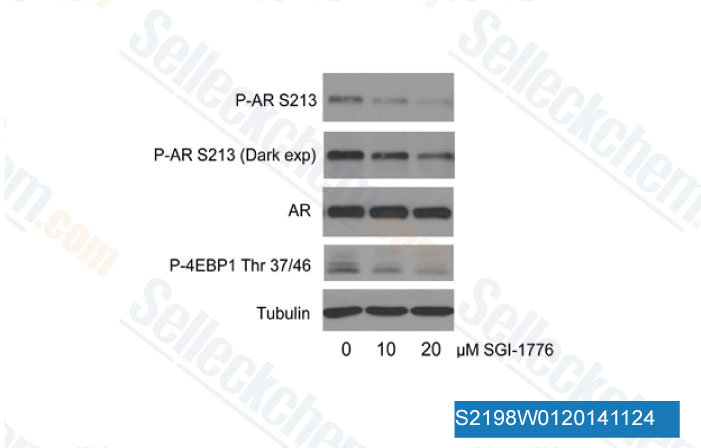
-
Daten von [ Oncogene , 2013 , 32(34), 3992-4000 ]
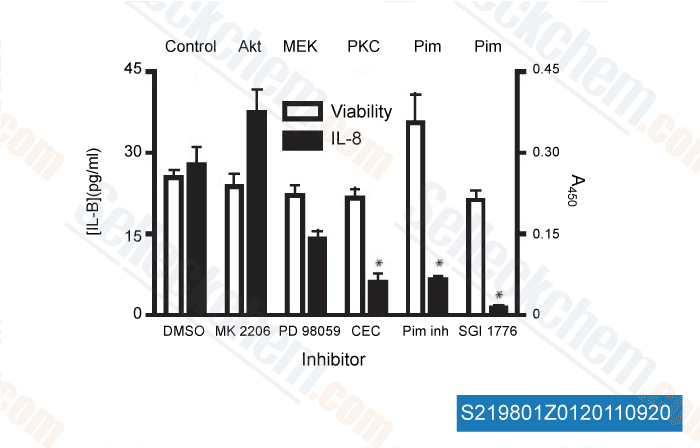
-
Daten von [ Sci Signal , 2011 , 4, rs9 ]
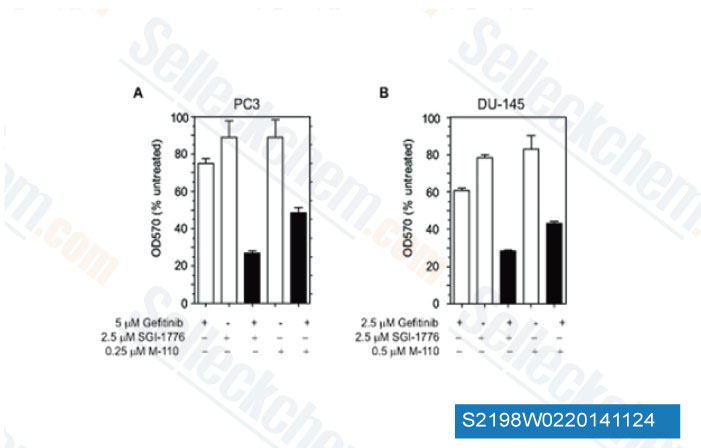
-
Daten von [ Oncotarget , 2011 , 2(12), 1134-44 ]
Sellecks SGI-1776 free base Wurde zitiert von 43 Publikationen
| PIM1 kinase promotes EMT-associated osimertinib resistance via regulating GSK3β signaling pathway in EGFR-mutant non-small cell lung cancer [ Cell Death Dis, 2024, 15(9):644] | PubMed: 39227379 |
| New Fusarochromanone Derivatives from the Marine Fungus Fusarium equiseti UBOCC-A-117302 [ Mar Drugs, 2024, 22(10)444] | PubMed: 39452852 |
| CDK9 inhibition induces epigenetic reprogramming revealing strategies to circumvent resistance in lymphoma [ Mol Cancer, 2023, 22(1):64] | PubMed: 36998071 |
| Neoprzewaquinone A Inhibits Breast Cancer Cell Migration and Promotes Smooth Muscle Relaxation by Targeting PIM1 to Block ROCK2/STAT3 Pathway [ Int J Mol Sci, 2023, 24(6)5464] | PubMed: 36982538 |
| Structure Activity Relationship Studies around DB18, a Potent and Selective Inhibitor of CLK Kinases [ Molecules, 2022, 27(19)6149] | PubMed: 36234686 |
| Targeting Echinococcus multilocularis PIM kinase for improving anti-parasitic chemotherapy [ PLoS Negl Trop Dis, 2022, 16(10):e0010483] | PubMed: 36190997 |
| Preclinical Immunopharmacologic Assessment of KPL-404, a Novel, Humanized, Non-Depleting Antagonistic Anti-CD40 Monoclonal Antibody [ Int J Gynecol Pathol, 2022, 10.1097/PGP.0000000000000882] | PubMed: 35443252 |
| Inhibition of PIM Kinases in DLBCL Targets MYC Transcriptional Program and Augments the Efficacy of Anti-CD20 Antibodies [ Cancer Res, 2021, 81(23):6029-6043] | PubMed: 34625423 |
| Inhibition of PIM Kinases in DLBCL Targets MYC Transcriptional Program and Augments the Efficacy of Anti-CD20 Antibodies [ Cancer Res, 2021, canres.1023.2021] | PubMed: 34625423 |
| PIM1 phosphorylation of the androgen receptor and 14-3-3 ζ regulates gene transcription in prostate cancer [ Commun Biol, 2021, 4(1):1221] | PubMed: 34697370 |
RÜCKGABERICHTLINIE
Die bedingungslose Rückgaberichtlinie von Selleck Chemical gewährleistet unseren Kunden ein reibungsloses Online-Einkaufserlebnis. Wenn Sie in irgendeiner Weise mit Ihrem Kauf unzufrieden sind, können Sie jeden Artikel innerhalb von 7 Tagen nach Erhalt zurückgeben. Im Falle von Produktqualitätsproblemen, sei es protokollbezogene oder produktbezogene Probleme, können Sie jeden Artikel innerhalb von 365 Tagen ab dem ursprünglichen Kaufdatum zurückgeben. Bitte befolgen Sie die nachstehenden Anweisungen, wenn Sie Produkte zurücksenden.
VERSAND UND LAGERUNG
Selleck-Produkte werden bei Raumtemperatur transportiert. Wenn Sie das Produkt bei Raumtemperatur erhalten, seien Sie versichert, dass die Qualitätskontrollabteilung von Selleck Experimente durchgeführt hat, um zu überprüfen, dass die normale Temperaturplatzierung von einem Monat die biologische Aktivität von Pulverprodukten nicht beeinträchtigt. Nach dem Sammeln lagern Sie das Produkt bitte gemäß den in der Datenblatt beschriebenen Anforderungen. Die meisten Selleck-Produkte sind unter den empfohlenen Bedingungen stabil.
NICHT FÜR DIE ANWENDUNG AM MENSCHEN, FÜR VETERINÄRMEDIZINISCHE DIAGNOSTIK ODER THERAPEUTISCHE ZWECKE.