
Technische Daten
| Formel | C21H24N4O2 |
||||||
| Molekulargewicht | 364.44 | CAS-Nr. | 663619-89-4 | ||||
| Löslichkeit (25°C)* | In vitro | DMSO | 12 mg/mL (32.92 mM) | ||||
| Water | Insoluble | ||||||
| Ethanol | Insoluble | ||||||
| In vivo (Lösungsmittel einzeln und der Reihe nach zum Produkt hinzufügen.) |
|
||||||
|
* <1 mg/ml bedeutet schwer löslich oder unlöslich. * Bitte beachten Sie, dass Selleck die Löslichkeit aller Verbindungen intern testet und die tatsächliche Löslichkeit geringfügig von veröffentlichten Werten abweichen kann. Dies ist normal und ist auf geringfügige Batch-zu-Batch-Variationen zurückzuführen. * Versand bei Raumtemperatur (Stabilitätstests zeigen, dass dieses Produkt ohne Kühlmaßnahmen versendet werden kann.) |
|||||||
Vorbereitung von Stammlösungen
Biologische Aktivität
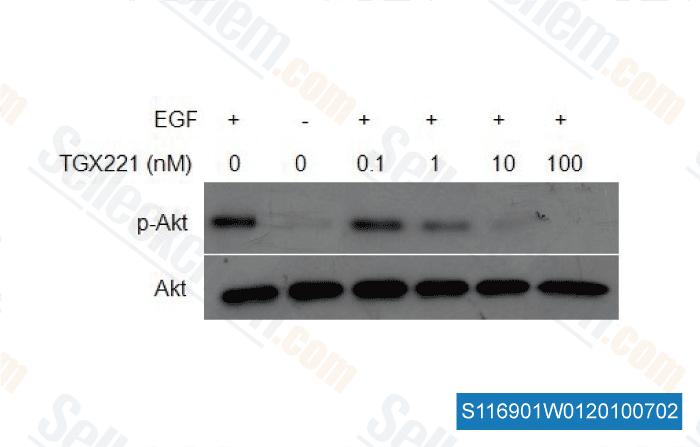
| Beschreibung | TGX-221 ist ein p110β-spezifischer Inhibitor mit einer IC50 von 5 nM in einem zellfreien Assay, 1000-fach selektiver für p110β als p110α. | ||||
|---|---|---|---|---|---|
| Ziele |
|
||||
| In vitro | Die Aktivität von TGX-221 gegen verschiedene Isoformen wird in einem In-vitro-PI3K-Assay unter Verwendung mehrerer Präparationen von rekombinantem p85/p110 gemessen. Diese Verbindung zeigt eine langsame Wirksamkeit gegenüber p110δ mit einer IC50 von 211 nM. Weiterhin dämpft sie teilweise die Insulin-induzierte Phosphorylierung von Ser473 von PKB in J774.2 Makrophagenzellen. Diese Chemikalie hemmt die Plättchen-ECC-Interaktion, die Plättchenaggregation und die Plättchen-Granulozyten-Bindung in einem extrakorporalen Zirkulationsmodell (ECC). Eine aktuelle Studie zeigt, dass nach Behandlung mit dieser Verbindung (0,2, 2 und 20 μM) PC3-Zellen eine Hemmung der Proliferation mit einer signifikanten Reduktion der Aktivität der p110β PI3K-Isoform aufweisen. | ||||
| In vivo | Als antithrombotisches Mittel verbessert TGX-221 in Dosen von 1 + 1 (49 %) und 3 + 3 (88 %) den integrierten Blutfluss über 30 Minuten in einem Mausmodell. Zusätzlich erhöht sich die Schwanzblutungszeit (BT) (Sek.) mit dieser Verbindung in Dosen von 3 + 3 (Median 1560) und 1 + 1 (1305), und die mittlere renale BT (Sek.) erhöht sich ebenfalls in allen TGX-221-Gruppen. |
Protokoll (aus Referenz)
| Kinase-Assay:[1] |
|
|---|---|
| Zell-Assay:[3] |
|
| Tierstudie:[3] |
|
Referenzen
|
Kundenproduktvalidierung
![<p>(H) 30-min pretreatment of LCLs with 0.5 μmol/L TGX-221 significantly reduces protein synthesis in FXS patient cells [n = 40, 4 independent experiments, 2-way ANOVA: * P (genotype) < 0.001, * P (treatment) = 0.005, * P (interaction) < 0.001, Bon-ferroni post hocanalyses, * P = 0.001, #P = 0.002, ≠P = 0.02]. Example images are shown on the left: upper panel: signal for newly synthesized proteins (red), lower panel: overlay with tubulin staining (green). Scale bar is 20 μm. (I) Increasing concentrations of TGX-221 (5 μmol/L and 10 μmol/L) further reduce protein synthesis rates in FXS LCLs to healthy control levels.</p>](https://file.selleckchem.com/downloads/review/700px/TGX-221-S116901Y0120120509.gif)
-
Daten von [ Mol Med , 2012 , 18, 336-45 ]
![<p>(E) TGX-221 treatment (0.5 μmol/L, 30 min) of control and FXS LCLs reduces PI3K activity as shown by a radioactive PI3K assay of p110β-specific immunoprecipitates from LCL lysates, and decreases PI3K/mTOR down-stream signaling as shown by strongly reduced phosphorylation of S6 independently of the genotype. (F, G) Quantification demonstrates a significant, dose-dependent effect of TGX-221 treatment on PI3K activity [F, competitive ELISA, n = 4, 2-way ANOVA, *P (genotype) = 0.0079, *P (treatment) = 0.0258, P (interaction) = 0.9418], and on S6 phosphorylation[G, ELISA, n = 4, 2-way ANOVA, *P (genotype) = 0.013), *P (treatment) < 0.0001, P (interaction) = 0.195].</p>](https://file.selleckchem.com/downloads/review/700px/TGX-221-S116901Z0220120509.gif)
-
Daten von [ Mol Med , 2012 , 18, 336-45 ]
![<p>A p110β-selective antagonist rescues increased protein synthesis in synaptic fractions from Fmr1 KO mice and in LCLs from a patient with FXS. (A–C) Treatment of synaptoneurosomes with TGX-221 (1 μmol/L, 30 min) reduces p110β-specific PI3K activity and phosphorylation of the downstream target AKT in both WT and Fmr1 KO SNS, shown by a radioactive PI3K assay and phosphoAkt- specific western blot-ting (A). (B) Quantification of PI3K activity using a competitive ELISA showed a significant reduction in PI3K activity in both genotypes after treatment [ n = 4, 2-way ANOVA, *P (genotype) = 0.0086, * P (treatment) = 0.0087, P (interaction) = 0.7154]. (C) Densitometric quantification of phosphoAkt-specific western blots showed a significant effect of treatment (C, n = 4, 2-way ANOVA, *P (treatment) = 0.0005, P (genotype) =0.372, P (interaction) = 0.4894).</p>](https://file.selleckchem.com/downloads/review/700px/TGX-221-S116901Z0120120509.gif)
-
Daten von [ Mol Med , 2012 , 18, 336-45 ]
-
, , Dr. Zhang of Tianjin Medical University
Sellecks TGX-221 Wurde zitiert von 102 Publikationen
| hnRNPL phase separation activates PIK3CB transcription and promotes glycolysis in ovarian cancer [ Nat Commun, 2025, 16(1):4828] | PubMed: 40413189 |
| PI3K-dependent GAB1/Erk phosphorylation renders head and neck squamous cell carcinoma sensitive to PI3Kα inhibitors [ Cell Death Dis, 2025, 16(1):457] | PubMed: 40533463 |
| Role and Therapeutic Potential of miR-301b-3p in Regulating the PI3K-AKT Pathway via PIK3CB in Eosinophilic Chronic Rhinosinusitis [ J Inflamm Res, 2025, 18:10235-10251] | PubMed: 40756418 |
| Development of Acquired Resistance in Alpelisib-treated Gastric Cancer Cells With PIK3CA Mutations and Overcoming Strategies [ Anticancer Res, 2025, 45(5):1877-1896] | PubMed: 40295072 |
| Integration of 3D bioprinting and multi-algorithm machine learning identified glioma susceptibilities and microenvironment characteristics [ Cell Discov, 2024, 10(1):39] | PubMed: 38594259 |
| Microglia degrade Alzheimer's amyloid-beta deposits extracellularly via digestive exophagy [ Cell Rep, 2024, 43(12):115052] | PubMed: 39644493 |
| WWP1 inhibition suppresses the proliferation of pancreatic cancer cells by regulating the PI3K-AKT pathway [ J Gastroenterol, 2024, 10.1007/s00535-024-02192-x] | PubMed: 39656237 |
| Machine learning-based identification of lower grade glioma stemness subtypes discriminates patient prognosis and drug response [ Comput Struct Biotechnol J, 2023, 21:3827-3840] | PubMed: 37560125 |
| Pan-PI3K inhibition with copanlisib overcomes Treg- and M2-TAM-mediated immune suppression and promotes anti-tumor immune responses [ Clin Exp Med, 2023, 10.1007/s10238-023-01227-6] | PubMed: 37935952 |
| Overcoming resistance to immune checkpoint therapy in PTEN-null prostate cancer by intermittent anti-PI3Kα/β/δ treatment [ Nat Commun, 2022, 13(1):182] | PubMed: 35013322 |
RÜCKGABERICHTLINIE
Die bedingungslose Rückgaberichtlinie von Selleck Chemical gewährleistet unseren Kunden ein reibungsloses Online-Einkaufserlebnis. Wenn Sie in irgendeiner Weise mit Ihrem Kauf unzufrieden sind, können Sie jeden Artikel innerhalb von 7 Tagen nach Erhalt zurückgeben. Im Falle von Produktqualitätsproblemen, sei es protokollbezogene oder produktbezogene Probleme, können Sie jeden Artikel innerhalb von 365 Tagen ab dem ursprünglichen Kaufdatum zurückgeben. Bitte befolgen Sie die nachstehenden Anweisungen, wenn Sie Produkte zurücksenden.
VERSAND UND LAGERUNG
Selleck-Produkte werden bei Raumtemperatur transportiert. Wenn Sie das Produkt bei Raumtemperatur erhalten, seien Sie versichert, dass die Qualitätskontrollabteilung von Selleck Experimente durchgeführt hat, um zu überprüfen, dass die normale Temperaturplatzierung von einem Monat die biologische Aktivität von Pulverprodukten nicht beeinträchtigt. Nach dem Sammeln lagern Sie das Produkt bitte gemäß den in der Datenblatt beschriebenen Anforderungen. Die meisten Selleck-Produkte sind unter den empfohlenen Bedingungen stabil.
NICHT FÜR DIE ANWENDUNG AM MENSCHEN, FÜR VETERINÄRMEDIZINISCHE DIAGNOSTIK ODER THERAPEUTISCHE ZWECKE.