
Technische Daten
| Formel | C33H35NO6S |
||||||||||
| Molekulargewicht | 573.7 | CAS-Nr. | 877877-35-5 | ||||||||
| Löslichkeit (25°C)* | In vitro | DMSO | 100 mg/mL (174.3 mM) | ||||||||
| Water | Insoluble | ||||||||||
| Ethanol | Insoluble | ||||||||||
| In vivo (Lösungsmittel einzeln und der Reihe nach zum Produkt hinzufügen.) |
|
||||||||||
|
* <1 mg/ml bedeutet schwer löslich oder unlöslich. * Bitte beachten Sie, dass Selleck die Löslichkeit aller Verbindungen intern testet und die tatsächliche Löslichkeit geringfügig von veröffentlichten Werten abweichen kann. Dies ist normal und ist auf geringfügige Batch-zu-Batch-Variationen zurückzuführen. * Versand bei Raumtemperatur (Stabilitätstests zeigen, dass dieses Produkt ohne Kühlmaßnahmen versendet werden kann.) |
|||||||||||
Vorbereitung von Stammlösungen
Biologische Aktivität
| Beschreibung | TW-37 ist ein neuartiger Nicht-Peptid-Inhibitor für rekombinantes Bcl-2, Bcl-xL und Mcl-1 mit Ki-Werten von 0,29 μM, 1,11 μM bzw. 0,26 μM in zellfreien Assays. | ||||||
|---|---|---|---|---|---|---|---|
| Ziele |
|
||||||
| In vitro | TW-37 zielt auf die BH3-Bindungsfurche in Bcl-2 ab, an die proapoptotische Bcl-2-Proteine binden, und zeigt eine höhere Affinität und Selektivität für Bcl-2 und Mcl-1 gegenüber Bcl-xL mit Ki-Werten von 0,29 μM, 0,26 μM bzw. 1,11 μM. In vitro zeigt diese Verbindung eine signifikante antiproliferative und pro-apoptotische Wirkung in einer de novo chemoresistenten WSU-DLCL2 Lymphomzelllinie und primären Zellen, die von einem Lymphompatienten stammen, ohne Auswirkungen auf normale periphere Blutlymphozyten. Es zeigt die hemmende Wirkung sowohl auf das Zellwachstum als auch auf den Zelltod in Endothelzellen mit einem IC50 von ca. 1,8 μM ohne Wirkung auf Fibroblasten, die dem gleichen Konzentrationsbereich wie die Endothelzellen ausgesetzt waren. Darüber hinaus zeigt diese Chemikalie auch antiproliferative Effekte in MCF-7, LNCaP und SLK Tumorzelllinien mit dem gleichen oder einem niedrigeren Konzentrationsbereich als die, die zur Hemmung des Endothelzellwachstums erforderlich sind. |
||||||
| In vivo | TW-37 zeigt eine maximal tolerierte Dosis (MTD) von 40 mg/kg für drei i.v. Injektionen bei SCID-Mäusen (Severe Combined Immunodeficient), wenn es allein verabreicht wird, und verstärkt die tumorhemmende Wirkung des CHOP-Regimes. Diese Verbindung, i.v. verabreicht, erzeugt den antiangiogenen Effekt, indem sie die Dichte funktioneller menschlicher Mikrogefäße im SCID-Mausmodell der menschlichen Angiogenese verringert. Die Kombination dieser Chemikalie und MEK-Inhibitoren blockiert synergistisch das Melanomzellwachstum bei Mäusen durch eine signifikante Reduktion des Tumorvolumens und der Tumormasse. |
Protokoll (aus Referenz)
| Kinase-Assay: |
|
|---|---|
| Zell-Assay: |
|
| Tierstudie: |
|
Referenzen
|
Kundenproduktvalidierung
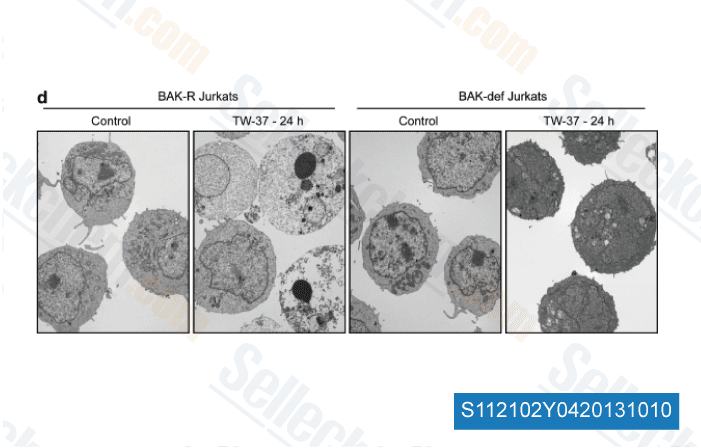
-
Daten von [ Cell Death Differ , 2013 , 20, 1475-84 ]
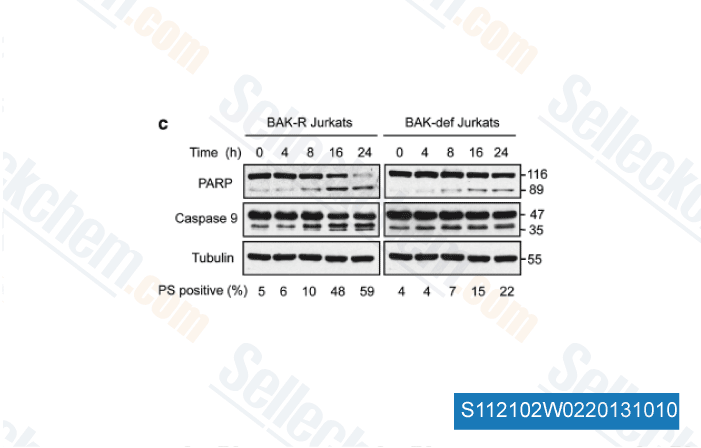
-
Daten von [ Cell Death Differ , 2013 , 20, 1475-84 ]
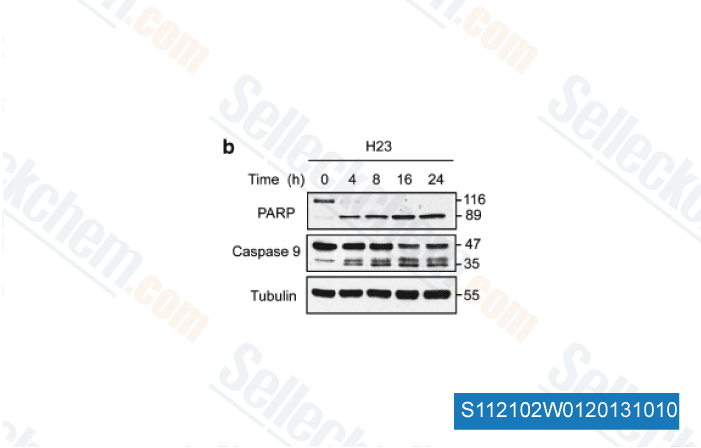
-
Daten von [ Cell Death Differ , 2013 , 20, 1475-84 ]
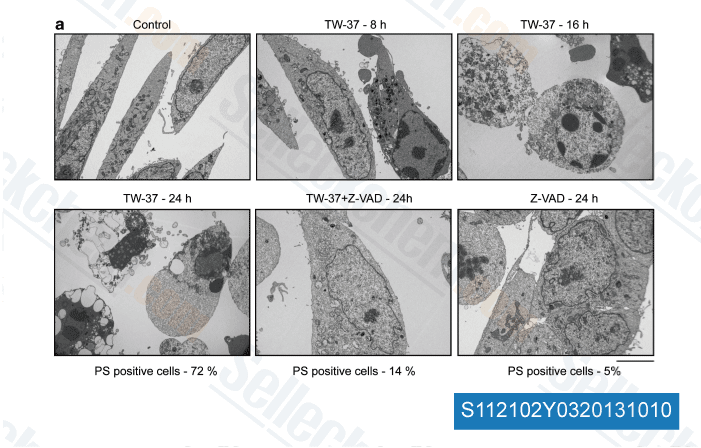
-
Daten von [ Cell Death Differ , 2013 , 20, 1475-84 ]
Sellecks TW-37 Wurde zitiert von 49 Publikationen
| Anti-BCL2 therapy eliminates giant congenital melanocytic nevus by senolytic and immune induction [ Signal Transduct Target Ther, 2025, 10(1):161] | PubMed: 40374605 |
| Gravitational and mechanical forces drive mitochondrial translation [ bioRxiv, 2024, 10.1101/2023.01.18.524628] | PubMed: none |
| Obatoclax Rescues FUS-ALS Phenotypes in iPSC-Derived Neurons by Inducing Autophagy [ Cells, 2023, 12(18)2247] | PubMed: 37759469 |
| Obatoclax Rescues FUS-ALS Phenotypes in iPSC-Derived Neurons by Inducing Autophagy [ Cells, 2023, 10.3390/cells12182247] | PubMed: 37759469 |
| Mcl-1 inhibition overcomes BET inhibitor resistance induced by low FBW7 expression in breast cancer [ J Cell Mol Med, 2022, 10.1111/jcmm.17210] | PubMed: 35132755 |
| Prediction and identification of synergistic compound combinations against pancreatic cancer cells [ iScience, 2021, 24(9):103080] | PubMed: 34585118 |
| Development and implementation of the SUM breast cancer cell line functional genomics knowledge base [ NPJ Breast Cancer, 2020, 6:30] | PubMed: 32715085 |
| Comparison of putative BH3 mimetics AT-101, HA14-1, sabutoclax and TW-37 with ABT-737 in platelets. [ Platelets, 2020, 10.1080/09537104.2020.1724276] | PubMed: 32079453 |
| KIM-1/TIM-1 is a Receptor for SARS-CoV-2 in Lung and Kidney [ medRxiv, 2020, 2020.09.16.20190694] | PubMed: 32995803 |
| The small molecule Bcl-2/Mcl-1 inhibitor TW-37 shows single-agent cytotoxicity in neuroblastoma cell lines. [ BMC Cancer, 2019, 19(1):243] | PubMed: 30885150 |
RÜCKGABERICHTLINIE
Die bedingungslose Rückgaberichtlinie von Selleck Chemical gewährleistet unseren Kunden ein reibungsloses Online-Einkaufserlebnis. Wenn Sie in irgendeiner Weise mit Ihrem Kauf unzufrieden sind, können Sie jeden Artikel innerhalb von 7 Tagen nach Erhalt zurückgeben. Im Falle von Produktqualitätsproblemen, sei es protokollbezogene oder produktbezogene Probleme, können Sie jeden Artikel innerhalb von 365 Tagen ab dem ursprünglichen Kaufdatum zurückgeben. Bitte befolgen Sie die nachstehenden Anweisungen, wenn Sie Produkte zurücksenden.
VERSAND UND LAGERUNG
Selleck-Produkte werden bei Raumtemperatur transportiert. Wenn Sie das Produkt bei Raumtemperatur erhalten, seien Sie versichert, dass die Qualitätskontrollabteilung von Selleck Experimente durchgeführt hat, um zu überprüfen, dass die normale Temperaturplatzierung von einem Monat die biologische Aktivität von Pulverprodukten nicht beeinträchtigt. Nach dem Sammeln lagern Sie das Produkt bitte gemäß den in der Datenblatt beschriebenen Anforderungen. Die meisten Selleck-Produkte sind unter den empfohlenen Bedingungen stabil.
NICHT FÜR DIE ANWENDUNG AM MENSCHEN, FÜR VETERINÄRMEDIZINISCHE DIAGNOSTIK ODER THERAPEUTISCHE ZWECKE.