
Technische Daten
| Formel | C24H18F2N2O5 |
||||||
| Molekulargewicht | 452.41 | CAS-Nr. | 936727-05-8 | ||||
| Löslichkeit (25°C)* | In vitro | DMSO | 90 mg/mL (198.93 mM) | ||||
| Ethanol | 13 mg/mL (28.73 mM) | ||||||
| Water | Insoluble | ||||||
| In vivo (Lösungsmittel einzeln und der Reihe nach zum Produkt hinzufügen.) |
|
||||||
|
* <1 mg/ml bedeutet schwer löslich oder unlöslich. * Bitte beachten Sie, dass Selleck die Löslichkeit aller Verbindungen intern testet und die tatsächliche Löslichkeit geringfügig von veröffentlichten Werten abweichen kann. Dies ist normal und ist auf geringfügige Batch-zu-Batch-Variationen zurückzuführen. * Versand bei Raumtemperatur (Stabilitätstests zeigen, dass dieses Produkt ohne Kühlmaßnahmen versendet werden kann.) |
|||||||
Vorbereitung von Stammlösungen
Biologische Aktivität
| Beschreibung | Lumacaftor (VX-809, VRT 826809) korrigiert CFTR-Mutationen, die bei Mukoviszidose häufig vorkommen, indem es die Reifung des mutierten CFTR (F508del-CFTR) erhöht, EC50 von 0,1 μM in Fisher-Ratten-Schilddrüsenzellen. Phase 3. | ||
|---|---|---|---|
| Ziele |
|
||
| In vitro | Lumacaftor (VX-809) wirkt auf der Ebene des ER, um einem Teil des F508del-CFTR eine korrekt gefaltete Form anzunehmen, das ER zu verlassen und zur Zelloberfläche zu mobilisieren, um normal zu funktionieren. In Fischer-Ratten-Schilddrüsenzellen (FRT), die F508del-CFTR exprimieren, verbessert diese Verbindung die F508del-CFTR-Reifung signifikant um das 7,1-fache mit einer EC50 von 0,1 μM und verstärkt den F508del-CFTR-vermittelten Chloridtransport um etwa das 5-fache mit einer EC50 von 0,5 μM, während VRT-768 höhere EC50-Werte von 7,9 μM bzw. 16 μM aufweist. In HEK-293-Zellen, die F508del-CFTR exprimieren, erhöht es (3 μM) den Austritt von F508del-CFTR aus dem ER um das 6-fache und erreicht Niveaus, die 34 % des CFTR entsprechen. In primären menschlichen bronchialen Epithelzellen (HBE) mit F508del-CFTR-Mutation erhöht der Wirkstoff die CFTR-Reifung und verstärkt die Chloridsekretion mit einer EC50 von 350 nM bzw. 81 nM, was wirksamer ist als Corr-4a und VRT-325. F508del-CFTR, korrigiert durch den Wirkstoff, weist eine Einzelkanal-Öffnungswahrscheinlichkeit von 0,39 auf, ähnlich dem normalen CFTR von 0,40. Im Gegensatz zu VX-770 ist es kein CFTR-Potentiator, da eine akute Zugabe keine Auswirkung auf die F508del-CFTR-Funktion hat. Im Gegensatz zu VRT-325 und Corr-4a verbessert es die Verarbeitung der normalen oder mutierten Formen von hERG oder P-gp sowie anderer krankheitsverursachender fehlplatzierter Proteine, einschließlich α1-Antitrypsin-Z-Mutante (E342K-α1-AT) oder N370S-β-Glucosidase, nicht, was darauf hindeutet, dass es spezifisch für CFTR ist. Es hat in Kombination mit VRT-325 oder Corr-4a eine additive Wirkung auf den CFTR-vermittelten Chloridtransport in kultivierten F508del-HBE. |
||
| In vivo | Lumacaftor (VX-809; VRT 826809) ist ein CFTR-Modulator, der die Faltung und den Transport des CFTR-Proteins korrigiert. |
||
| Merkmale | Höhere Spezifität und Wirksamkeit im Vergleich zu anderen CFTR-Defektmedikamenten. |
Protokoll (aus Referenz)
| Kinase-Assay: |
|
|---|---|
| Zell-Assay: |
|
| Tierstudie: |
|
Referenzen
|
Kundenproduktvalidierung
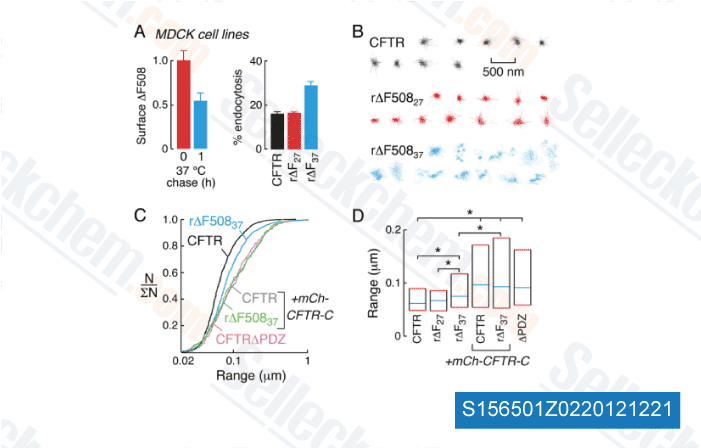
-
Daten von [ J Biol Chem , 2012 , 287, 43630-8 ]
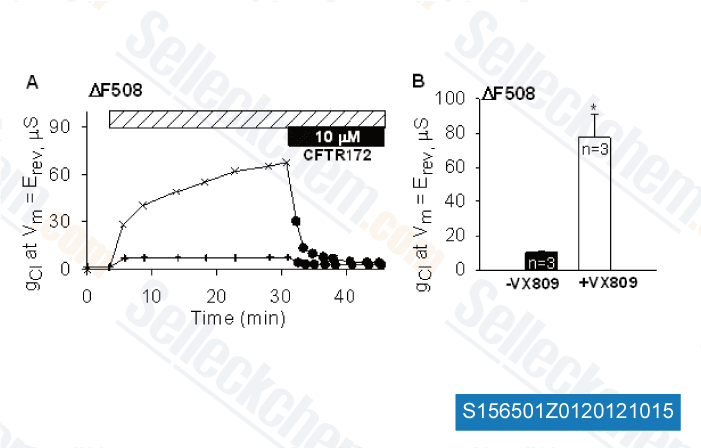
-
, , Xuehong Liu of Oregon Health & Science University
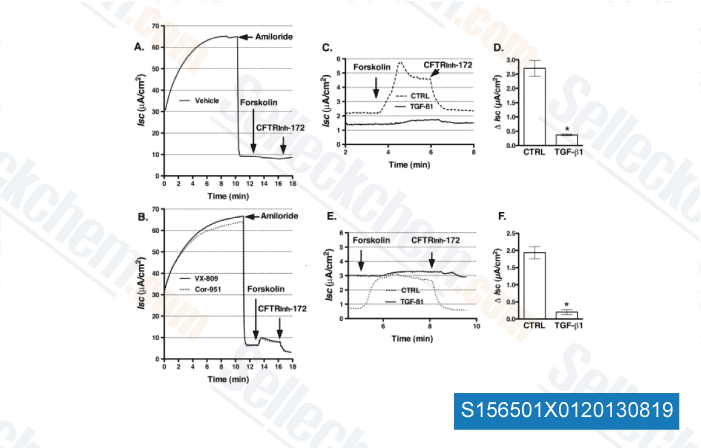
-
,

-
Daten von [ , , Mol Pharm, 2018, 15(3):759-767 ]
Sellecks VX-809 (Lumacaftor) Wurde zitiert von 240 Publikationen
| ACE-tRNAs are a platform technology for suppressing nonsense mutations that cause cystic fibrosis [ Nucleic Acids Res, 2025, 53(13)gkaf675] | PubMed: 40650978 |
| In silico, in vitro and ex vivo characterization of cystic fibrosis transmembrane conductance regulator pathogenic variants localized in the fourth intracellular loop and their rescue by modulators [ Br J Pharmacol, 2025, 10.1111/bph.70176] | PubMed: 40831301 |
| Global functional genomics reveals GRK5 as a cystic fibrosis therapeutic target synergistic with current modulators [ iScience, 2025, 28(3):111942] | PubMed: 40040803 |
| Human Induced Lung Organoids: A Promising Tool for Cystic Fibrosis Drug Screening [ Int J Mol Sci, 2025, 26(2)437] | PubMed: 39859153 |
| Nasal cells as a bronchial cell surrogate for pre-clinical assessment of drug response in cystic fibrosis [ Front Pharmacol, 2025, 16:1651122] | PubMed: 40978488 |
| Inhibitors of the ubiquitin‑proteasome system rescue cellular levels and ion transport function of pathogenic pendrin (SLC26A4) protein variants [ Int J Mol Med, 2025, 55(5)69] | PubMed: 40052591 |
| The Inhibition of the Membrane-Bound Transcription Factor Site-1 Protease (MBTP1) Alleviates the p.Phe508del-Cystic Fibrosis Transmembrane Conductance Regulator (CFTR) Defects in Cystic Fibrosis Cells [ Cells, 2024, 13(2)185] | PubMed: 38247876 |
| Comprehensive Assessment of CFTR Modulators' Therapeutic Efficiency for N1303K Variant [ Int J Mol Sci, 2024, 25(5)2770] | PubMed: 38474016 |
| Estimation of Chloride Channel Residual Function and Assessment of Targeted Drugs Efficiency in the Presence of a Complex Allele [L467F;F508del] in the CFTR Gene [ Int J Mol Sci, 2024, 25(19)10424] | PubMed: 39408749 |
| The F508del-CFTR trafficking correctors elexacaftor and tezacaftor are CFTR-independent Ca2+-mobilizing agonists normalizing abnormal Ca2+ levels in human airway epithelial cells [ Respir Res, 2024, 25(1):436] | PubMed: 39702307 |
RÜCKGABERICHTLINIE
Die bedingungslose Rückgaberichtlinie von Selleck Chemical gewährleistet unseren Kunden ein reibungsloses Online-Einkaufserlebnis. Wenn Sie in irgendeiner Weise mit Ihrem Kauf unzufrieden sind, können Sie jeden Artikel innerhalb von 7 Tagen nach Erhalt zurückgeben. Im Falle von Produktqualitätsproblemen, sei es protokollbezogene oder produktbezogene Probleme, können Sie jeden Artikel innerhalb von 365 Tagen ab dem ursprünglichen Kaufdatum zurückgeben. Bitte befolgen Sie die nachstehenden Anweisungen, wenn Sie Produkte zurücksenden.
VERSAND UND LAGERUNG
Selleck-Produkte werden bei Raumtemperatur transportiert. Wenn Sie das Produkt bei Raumtemperatur erhalten, seien Sie versichert, dass die Qualitätskontrollabteilung von Selleck Experimente durchgeführt hat, um zu überprüfen, dass die normale Temperaturplatzierung von einem Monat die biologische Aktivität von Pulverprodukten nicht beeinträchtigt. Nach dem Sammeln lagern Sie das Produkt bitte gemäß den in der Datenblatt beschriebenen Anforderungen. Die meisten Selleck-Produkte sind unter den empfohlenen Bedingungen stabil.
NICHT FÜR DIE ANWENDUNG AM MENSCHEN, FÜR VETERINÄRMEDIZINISCHE DIAGNOSTIK ODER THERAPEUTISCHE ZWECKE.