
Technische Daten
| Formel | C20H15ClN4.2HCl |
||||||
| Molekulargewicht | 419.73 | CAS-Nr. | 212141-51-0 | ||||
| Löslichkeit (25°C)* | In vitro | DMSO | 21.25 mg/mL (50.62 mM) | ||||
| Water | 10 mg/mL (23.82 mM) | ||||||
| Ethanol | 6 mg/mL (14.29 mM) | ||||||
| In vivo (Lösungsmittel einzeln und der Reihe nach zum Produkt hinzufügen.) |
|
||||||
|
* <1 mg/ml bedeutet schwer löslich oder unlöslich. * Bitte beachten Sie, dass Selleck die Löslichkeit aller Verbindungen intern testet und die tatsächliche Löslichkeit geringfügig von veröffentlichten Werten abweichen kann. Dies ist normal und ist auf geringfügige Batch-zu-Batch-Variationen zurückzuführen. * Versand bei Raumtemperatur (Stabilitätstests zeigen, dass dieses Produkt ohne Kühlmaßnahmen versendet werden kann.) |
|||||||
Vorbereitung von Stammlösungen
Biologische Aktivität
| Beschreibung | Vatalanib 2HCl (PTK787, ZK 222584, cpg-79787) ist ein Inhibitor von VEGFR2/KDR mit einer IC50 von 37 nM in einem zellfreien Assay, weniger potent gegen VEGFR1/Flt-1 und 18-fach weniger potent gegen VEGFR3/Flt-4. Phase 3. | |||||||||||
|---|---|---|---|---|---|---|---|---|---|---|---|---|
| Ziele |
|
|||||||||||
| In vitro | Vatalanib hemmt auch Flk, c-Kit und PDGFRβ mit IC50-Werten von 270 nM, 730 nM bzw. 580 nM. Darüber hinaus zeigt Vatalanib eine antiproliferative Wirkung durch Hemmung der VEGF-induzierten Thymidininkorporation in HUVECs mit einer IC50 von 7,1 nM und unterdrückt dosisabhängig das VEGF-induzierte Überleben und die Migration von Endothelzellen im gleichen Dosisbereich ohne zytotoxische oder antiproliferative Wirkung auf Zellen, die keine VEGF-Rezeptoren exprimieren. Eine aktuelle Studie zeigt, dass Vatalanib das Wachstum von Hepatozellulären Karzinomzellen signifikant hemmt und die IFN/5-FU-induzierte Apoptose durch Erhöhung der Proteinspiegel von Bax und Reduzierung von Bcl-xL und Bcl-2 verstärkt. | |||||||||||
| In vivo | Vatalanib induziert eine dosisabhängige Hemmung der angiogenen Reaktion auf VEGF und PDGF sowohl in einem Wachstumsfaktor-Implantationsmodell als auch in einem Tumorzell-gesteuerten Angiogenese-Modell nach einmal täglicher oraler Gabe (25-100 mg/kg). Im gleichen Dosisbereich hemmt Vatalanib auch das Wachstum und die Metastasen mehrerer menschlicher Karzinome in Nacktmäusen ohne signifikante Auswirkungen auf zirkulierende Blutzellen oder Knochenmarkleukozyten. |
Protokoll (aus Referenz)
| Kinase-Assay:[1] |
|
|---|---|
| Zell-Assay:[1] |
|
| Tierstudie:[1] |
|
Referenzen
|
Kundenproduktvalidierung
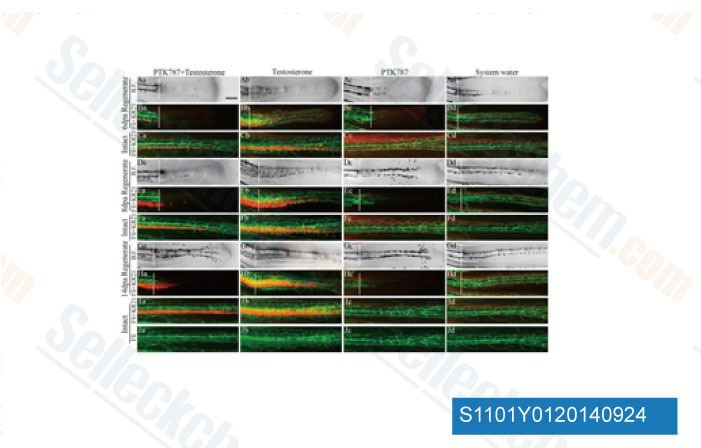
-
Daten von [ Development , 2013 , 140, 4323-34 ]
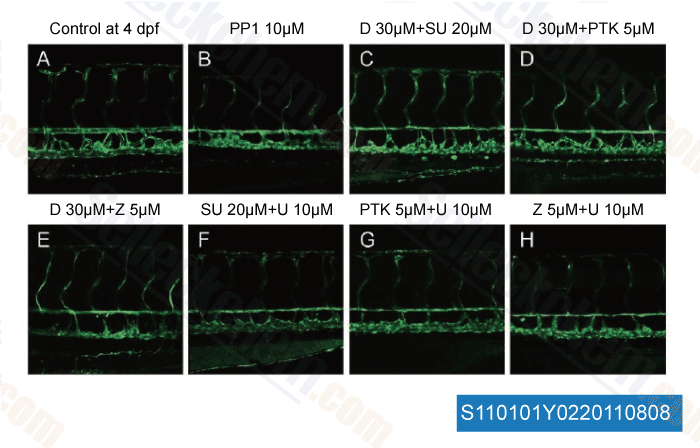
-
Daten von [ Cell Res , 2011 , 21, 1080-1087 ]
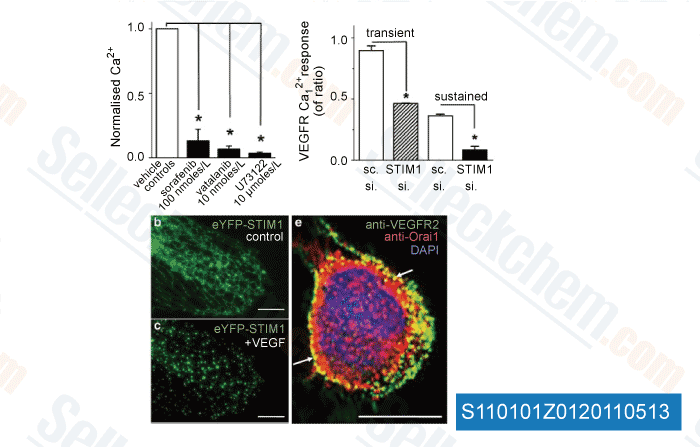
-
Daten von [ Circ Res , 2011 , 108, 1190-1198 ]
Sellecks Vatalanib (PTK787) 2HCl Wurde zitiert von 55 Publikationen
| Galectin-3-integrin α5β1 phase separation disrupted by advanced glycation end-products impairs diabetic wound healing in rodents [ Nat Commun, 2025, 16(1):7287] | PubMed: 40775187 |
| Development of an Automated Morphometric Approach to Assess Vascular Outcomes following Exposure to Environmental Chemicals in Zebrafish [ Environ Health Perspect, 2024, 132(5):57001] | PubMed: 38701112 |
| Nudifloside, a Secoiridoid Glucoside Derived from Callicarpa nudiflora, Inhibits Endothelial-to-Mesenchymal Transition and Angiogenesis in Endothelial Cells by Suppressing Ezrin Phosphorylation [ J Cancer, 2024, 15(9):2448-2459] | PubMed: 38577590 |
| Platform combining statistical modeling and patient-derived organoids to facilitate personalized treatment of colorectal carcinoma [ J Exp Clin Cancer Res, 2023, 42(1):79] | PubMed: 37013646 |
| Inhibition of VEGFR2 and EGFR signaling cooperatively suppresses the proliferation of oral squamous cell carcinoma [ Cancer Med, 2023, 12(15):16416-16430] | PubMed: 37341071 |
| Temporal mapping and pharmacological manipulation of signaling architecture of Tyrosine kinases in Traumatic Brain Injury (TBI) [ oparu, 2023, 10.18725/OPARU-47820] | PubMed: None |
| Investigation of the pharmacological effect and mechanism of mountain-cultivated ginseng and garden ginseng in cardiovascular diseases based on network pharmacology and zebrafish experiments [ Front Pharmacol, 2022, 13:920979] | PubMed: 36120313 |
| In Vitro Angiogenesis Inhibition and Endothelial Cell Growth and Morphology [ Int J Mol Sci, 2022, 23(8)4277] | PubMed: 35457095 |
| Establishment and Characterization of NCC-PMP1-C1: A Novel Patient-Derived Cell Line of Metastatic Pseudomyxoma Peritonei [ J Pers Med, 2022, 12(2)258] | PubMed: 35207746 |
| Establishment and characterization of NCC-UPS4-C1: a novel cell line of undifferentiated pleomorphic sarcoma from a patient with Li-Fraumeni syndrome [ Hum Cell, 2022, 10.1007/s13577-022-00671-y] | PubMed: 35118583 |
RÜCKGABERICHTLINIE
Die bedingungslose Rückgaberichtlinie von Selleck Chemical gewährleistet unseren Kunden ein reibungsloses Online-Einkaufserlebnis. Wenn Sie in irgendeiner Weise mit Ihrem Kauf unzufrieden sind, können Sie jeden Artikel innerhalb von 7 Tagen nach Erhalt zurückgeben. Im Falle von Produktqualitätsproblemen, sei es protokollbezogene oder produktbezogene Probleme, können Sie jeden Artikel innerhalb von 365 Tagen ab dem ursprünglichen Kaufdatum zurückgeben. Bitte befolgen Sie die nachstehenden Anweisungen, wenn Sie Produkte zurücksenden.
VERSAND UND LAGERUNG
Selleck-Produkte werden bei Raumtemperatur transportiert. Wenn Sie das Produkt bei Raumtemperatur erhalten, seien Sie versichert, dass die Qualitätskontrollabteilung von Selleck Experimente durchgeführt hat, um zu überprüfen, dass die normale Temperaturplatzierung von einem Monat die biologische Aktivität von Pulverprodukten nicht beeinträchtigt. Nach dem Sammeln lagern Sie das Produkt bitte gemäß den in der Datenblatt beschriebenen Anforderungen. Die meisten Selleck-Produkte sind unter den empfohlenen Bedingungen stabil.
NICHT FÜR DIE ANWENDUNG AM MENSCHEN, FÜR VETERINÄRMEDIZINISCHE DIAGNOSTIK ODER THERAPEUTISCHE ZWECKE.