
Technische Daten
| Formel | C20H12N2O3S |
||||||
| Molekulargewicht | 360.39 | CAS-Nr. | 844499-71-4 | ||||
| Löslichkeit (25°C)* | In vitro | DMSO | 72 mg/mL (199.78 mM) | ||||
| Water | Insoluble | ||||||
| Ethanol | Insoluble | ||||||
| In vivo (Lösungsmittel einzeln und der Reihe nach zum Produkt hinzufügen.) |
|
||||||
|
* <1 mg/ml bedeutet schwer löslich oder unlöslich. * Bitte beachten Sie, dass Selleck die Löslichkeit aller Verbindungen intern testet und die tatsächliche Löslichkeit geringfügig von veröffentlichten Werten abweichen kann. Dies ist normal und ist auf geringfügige Batch-zu-Batch-Variationen zurückzuführen. * Versand bei Raumtemperatur (Stabilitätstests zeigen, dass dieses Produkt ohne Kühlmaßnahmen versendet werden kann.) |
|||||||
Vorbereitung von Stammlösungen
Biologische Aktivität
| Beschreibung | A-769662 ist ein potenter, reversibler AMPK-Aktivator mit einem EC50 von 0,8 μM in zellfreien Assays, mit geringem Einfluss auf die GPPase/FBPase-Aktivität. | ||||
|---|---|---|---|---|---|
| Ziele |
|
||||
| In vitro | A-769662 stimuliert teilweise gereinigte AMPK aus Rattenleber mit einem EC50-Wert von 0,8 µM. Diese Verbindung aktiviert AMPK, die aus mehreren Geweben und Spezies gereinigt wurde, in einer dosisabhängigen Weise mit geringfügigen Variationen der beobachteten EC50-Werte. Die für diese Chemikalie unter Verwendung von teilweise gereinigten AMPK-Extrakten aus Rattenherz, Rattenmuskel oder menschlichen embryonalen Nierenzellen (HEKs) bestimmten EC50-Werte betragen 2,2 mM, 1,9 mM bzw. 1,1 mM. Eine 4-stündige Behandlung von primären Rattenhepatozyten mit dieser Verbindung erhöht die ACC-Phosphorylierung dosisabhängig, was mit einer Hemmung der Fatty Acid Synthase mit einem IC50 von 3,2 µM korrelierte. Es hemmt auch die Fatty Acid Synthase in Maushepatozyten mit einem IC50 von 3,6 µM Diese Verbindung aktiviert AMPK sowohl allosterisch als auch durch Hemmung der Dephosphorylierung von AMPK an Thr-172, ähnlich den Effekten von AMP. Es hemmt die proteasomale Funktion durch einen AMPK-unabhängigen Mechanismus. Diese Chemikalie beeinflusst die In-vitro-Aktivität von gereinigten 26S-Proteasomen, aber nicht die In-vitro-Aktivität von gereinigten 20S-Proteasomen. Sie hat toxische Wirkungen auf MEF-Zellen. Eine aktuelle Untersuchung zeigt, dass diese Verbindung die Zellproliferation und DNA-Synthese hemmt. |
||||
| In vivo | Kurzfristige Behandlung von normalen Sprague Dawley Ratten mit A-769662 verringert die Malonyl-CoA-Spiegel in der Leber und das respiratorische Austauschverhältnis, VCO2/VO2, was auf eine erhöhte Rate der Fettsäureoxidation im gesamten Körper hinweist. Die Behandlung von ob/ob-Mäusen mit 30 mg/kg b.i.d. dieser Verbindung verringert die hepatische Expression von PEPCK, G6Pase und FAS, senkt den Plasmaglukosespiegel um 40 %, reduziert die Gewichtszunahme und senkt signifikant sowohl die Plasma- als auch die Leber-Triglyceridspiegel. |
Protokoll (aus Referenz)
| Kinase-Assay: |
|
|---|---|
| Zell-Assay: |
|
| Tierstudie: |
|
Referenzen
|
Kundenproduktvalidierung
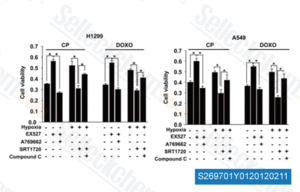
-
Daten von [ Cancer Res , 2014 , 74(1), 298-308 ]
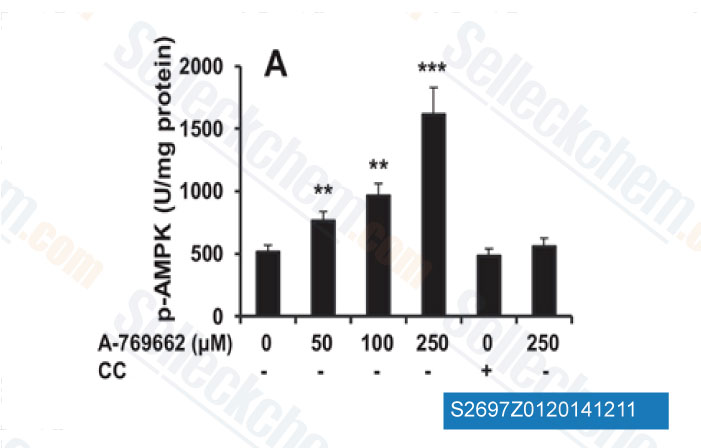
-
Daten von [ Pharmacol Res , 2014 , 81, 34-43 ]
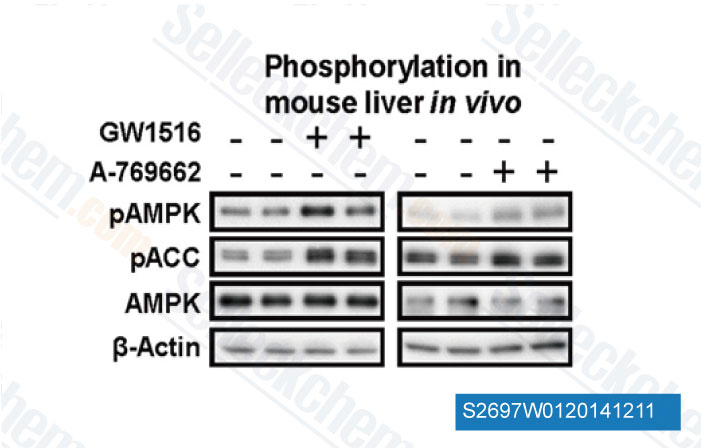
-
Daten von [ J Lipid Res , 2014 , 55(7), 1254-1266 ]
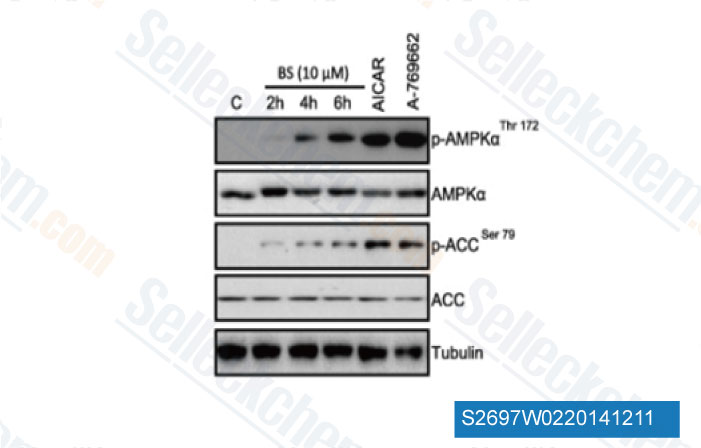
-
Daten von [ Biochem Biophys Res Commun , 2013 , 437(1), 1-6 ]
Sellecks A-769662 Wurde zitiert von 76 Publikationen
| Propionibacterium acnes evades microbicidal phagocytosis by inhibiting the mitochondrial biogenesis of nucleus pulposus cells [ FEBS J, 2025, 10.1111/febs.70247] | PubMed: 40891515 |
| AMPK-YAP signaling pathway-mediated mitochondrial dynamics and mitophagy participate in the protective effect of silibinin on HaCaT cells under high glucose conditions [ Arch Biochem Biophys, 2025, 769:110433] | PubMed: 40268264 |
| Nuclear PD-L1 compartmentalization suppresses tumorigenesis and overcomes immunocheckpoint therapy resistance in mice via histone macroH2A1 [ J Clin Invest, 2024, 134(22)e181314] | PubMed: 39545415 |
| Maternal adiponectin restores cholinergic vasodilation in resistance vessels from adult offspring exposed to maternal obesity in utero [ bioRxiv, 2024, 2024.09.21.612123] | PubMed: 39345365 |
| Hypoxanthine phosphoribosyl transferase 1 metabolizes temozolomide to activate AMPK for driving chemoresistance of glioblastomas [ Nat Commun, 2023, 14(1):5913] | PubMed: 37737247 |
| Pathogenesis-related protein 1 suppresses oomycete pathogen by targeting against AMPK kinase complex [ J Adv Res, 2023, 43:13-26] | PubMed: 36585103 |
| A subset of VEGFR-TKIs activates AMPK in LKB1-mutant lung cancer [ Cancer Sci, 2023, 114(4):1651-1662] | PubMed: 36459496 |
| Loss of Lactate/Proton Monocarboxylate Transporter 4 Induces Ferroptosis via the AMPK/ACC Pathway and Inhibition of Autophagy on Human Bladder Cancer 5637 Cell Line [ J Oncol, 2023, 2023:2830306] | PubMed: 36718218 |
| Discovery of a natural small-molecule AMP-activated kinase activator that alleviates nonalcoholic steatohepatitis [ Mar Life Sci Technol, 2023, 5(2):196-210] | PubMed: 37275542 |
| Identification of purine biosynthesis as an NADH-sensing pathway to mediate energy stress [ Nat Commun, 2022, 13(1):7031] | PubMed: 36396642 |
RÜCKGABERICHTLINIE
Die bedingungslose Rückgaberichtlinie von Selleck Chemical gewährleistet unseren Kunden ein reibungsloses Online-Einkaufserlebnis. Wenn Sie in irgendeiner Weise mit Ihrem Kauf unzufrieden sind, können Sie jeden Artikel innerhalb von 7 Tagen nach Erhalt zurückgeben. Im Falle von Produktqualitätsproblemen, sei es protokollbezogene oder produktbezogene Probleme, können Sie jeden Artikel innerhalb von 365 Tagen ab dem ursprünglichen Kaufdatum zurückgeben. Bitte befolgen Sie die nachstehenden Anweisungen, wenn Sie Produkte zurücksenden.
VERSAND UND LAGERUNG
Selleck-Produkte werden bei Raumtemperatur transportiert. Wenn Sie das Produkt bei Raumtemperatur erhalten, seien Sie versichert, dass die Qualitätskontrollabteilung von Selleck Experimente durchgeführt hat, um zu überprüfen, dass die normale Temperaturplatzierung von einem Monat die biologische Aktivität von Pulverprodukten nicht beeinträchtigt. Nach dem Sammeln lagern Sie das Produkt bitte gemäß den in der Datenblatt beschriebenen Anforderungen. Die meisten Selleck-Produkte sind unter den empfohlenen Bedingungen stabil.
NICHT FÜR DIE ANWENDUNG AM MENSCHEN, FÜR VETERINÄRMEDIZINISCHE DIAGNOSTIK ODER THERAPEUTISCHE ZWECKE.