
|
Wie zu zitieren 1. Für Zitate im Text (Materialien & Methoden): 2. Für die Tabelle der Schlüsselressourcen: |
||
|
Gebührenfrei: (877) 796-6397 -- Nur USA und Kanada -- |
Fax: +1-832-582-8590 Bestellungen: +1-832-582-8158 |
Technischer Support: +1-832-582-8158 Ext:3 Bitte geben Sie Ihre Bestellnummer in der E-Mail an. Wir bemühen uns, alle E-Mail-Anfragen innerhalb eines Werktages zu beantworten. |
Biologische Beschreibung
| Spezifität | ABCA1 Antibody [D20K13] detektiert endogene Spiegel des gesamten ABCA1-Proteins. |
|---|---|
| Hintergrund | Der ATP-bindende Kassettentransporter A1 (ABCA1) ist ein großer Membrantransporter der ABC-Familie, der ATP-Hydrolyse nutzt, um zelluläres Cholesterin und Phospholipide zu lipidarmen Apolipoproteinen, insbesondere ApoA I, zu exportieren, wodurch die Bildung von nascentem HDL eingeleitet und der erste, geschwindigkeitsbestimmende Schritt des reversen Cholesterintransports von peripheren Geweben zur Leber angetrieben wird. ABCA1 ist ein Protein, das zwei Transmembrandomänen mit sechs Helices umfasst, die einen Lipidtranslokationspfad bilden, zwei zytosolische Nukleotidbindungsdomänen mit Walker A/B- und LSGGQ-Signaturmotiven für ATP-Bindung und -Hydrolyse sowie zwei große, glykosylierte extrazelluläre Domänen, die einzigartig für die ABCA-Unterfamilie sind und eine hydrophobe Oberfläche oder einen Tunnel für das Andocken von ApoA I und die Lipidbeladung bilden, mit zusätzlichen regulatorischen Merkmalen wie einer PEST-Sequenz, die den proteolytischen Umsatz steuert, und palmitoylierten Cysteinresten, die für die Plasmamembran-Targetierung wichtig sind. Cholesterinbeladung aktiviert LXR/RXR, was ABCA1 hochreguliert; an der Plasmamembran und in Endosomen durchläuft ABCA1 ATP-getriebene konformationelle Zyklen, um Phospholipide und freies Cholesterin aus dem inneren Blatt und intrazellulären Pools an die Zelloberfläche zu mobilisieren, wo die Bindung von ApoA I ABCA1 sowohl stabilisiert als auch diese Lipide einfängt, um diskoidales nascentes HDL zu bilden, während gleichzeitig cholesterinreiche Lipid-Rafts gestört und JAK2/STAT3 und andere Signalwege ausgelöst werden, die Entzündungen dämpfen und einen weiteren Efflux in Makrophagen fördern. Durch diese Transport- und Signalfunktionen ist ABCA1 essentiell für die Verhinderung von Schaumzellbildung und Atherosklerose und trägt auch zur β-Zellfunktion, Insulinsekretion und ApoE-Lipidierung und Amyloid-β-Verarbeitung im Gehirn bei; Funktionsverlustmutationen in ABCA1 verursachen die Tangier-Krankheit und familiären HDL-Mangel mit fast fehlendem HDL und Cholesterinesterakkumulation, während subtilere Defekte in der ABCA1-Expression oder -Aktivität das kardiovaskuläre und metabolische Risiko erhöhen und die Anfälligkeit für spät einsetzende Alzheimer-Krankheit modulieren können. |
Nutzungsinformationen
| Anwendung | WB, IHC, FCM | Verdünnung |
|
||||||
|---|---|---|---|---|---|---|---|---|---|
| Reaktivität | Mouse, Human | ||||||||
| Quelle | Mouse Monoclonal Antibody | MW | 254 kDa | ||||||
| Lagerpuffer | PBS, pH 7.2+50% Glycerol+0.05% BSA+0.01% NaN3 | Lagerung (Ab dem Datum des Erhalts) |
-20°C (avoid freeze-thaw cycles), 2 years | ||||||
| WB |
Experimental Protocol:
Sample preparation
1. Tissue: Lyse the tissue sample by adding an appropriate volume of ice-cold RIPA/NP-40 Lysis Buffer (containing Protease Inhibitor Cocktail),and homogenize the tissue at a low temperature. 2. Adherent cell: Aspirate the culture medium and wash the cells with ice-cold PBS twice. Lyse the cells by adding an appropriate volume of RIPA/NP-40 Lysis Buffer (containing Protease Inhibitor Cocktail) and put the sample on ice for 5 min. 3. Suspension cell: Transfer the culture medium to a pre-cooled centrifuge tube. Centrifuge and aspirate the supernatant. Wash the cells with ice-cold PBS twice. Lyse the cells by adding an appropriate volume of RIPA/NP-40 Lysis Buffer (containing Protease Inhibitor Cocktail) and put the sample on ice for 5 min. 4. Place the lysate into a pre-cooled microcentrifuge tube. Centrifuge at 4°C for 15 min. Collect the supernatant;
5. Remove a small volume of lysate to determine the protein concentration;
6. Combine the lysate with protein loading buffer. Boil 20 µL sample under 95-100°C for 5 min. Centrifuge for 5 min after cool down on ice.
Electrophoretic separation
1. According to the concentration of extracted protein, load appropriate amount of protein sample and marker onto SDS-PAGE gels for electrophoresis. Recommended separating gel (lower gel) concentration: 5%. Reference Table for Selecting SDS-PAGE Separation Gel Concentrations 2. Power up 80V for 30 minutes. Then the power supply is adjusted (110 V~150 V), the Marker is observed, and the electrophoresis can be stopped when the indicator band of the predyed protein Marker where the protein is located is properly separated. (Note that the current should not be too large when electrophoresis, too large current (more than 150 mA) will cause the temperature to rise, affecting the result of running glue. If high currents cannot be avoided, an ice bath can be used to cool the bath.)
Transfer membrane
1. Take out the converter, soak the clip and consumables in the pre-cooled converter;
2. Activate PVDF membrane with methanol for 1 min and rinse with transfer buffer;
3. Install it in the order of "black edge of clip - sponge - filter paper - filter paper - glue -PVDF membrane - filter paper - filter paper - sponge - white edge of clip"; 4. The protein was electrotransferred to PVDF membrane. ( 0.45 µm PVDF membrane is recommended ) Reference Table for Selecting PVDF Membrane Pore Size Specifications Recommended conditions for wet transfer: 250 mA, 180 min. ( Note that the transfer conditions can be adjusted according to the protein size. For high-molecular-weight proteins, a higher current and longer transfer time are recommended. However, ensure that the transfer tank remains at a low temperature to prevent gel melting.)
Block
1. After electrotransfer, wash the film with TBST at room temperature for 5 minutes;
2. Incubate the film in the blocking solution for 1 hour at room temperature;
3. Wash the film with TBST for 3 times, 5 minutes each time.
Antibody incubation
1. Use 5% skim milk powder to prepare the primary antibody working liquid (recommended dilution ratio for primary antibody 1:200), gently shake and incubate with the film at 4°C overnight; 2. Wash the film with TBST 3 times, 5 minutes each time;
3. Add the secondary antibody to the blocking solution and incubate with the film gently at room temperature for 1 hour;
4. After incubation, wash the film with TBST 3 times for 5 minutes each time.
Antibody staining
1. Add the prepared ECL luminescent substrate (or select other color developing substrate according to the second antibody) and mix evenly;
2. Incubate with the film for 1 minute, remove excess substrate (keep the film moist), wrap with plastic film, and expose in the imaging system.
|
| IHC |
Experimental Protocol:
Deparaffinization/Rehydration
1. Deparaffinize/hydrate sections:
2. Incubate sections in three washes of xylene for 5 min each.
3. Incubate sections in two washes of 100% ethanol for 10 min each.
4. Incubate sections in two washes of 95% ethanol for 10 min each.
5. Wash sections two times in dH2O for 5 min each.
6.Antigen retrieval: For Citrate: Heat slides in a microwave submersed in 1X citrate unmasking solution until boiling is initiated; continue with 10 min at a sub-boiling temperature (95°-98°C). Cool slides on bench top for 30 min.
Staining
1. Wash sections in dH2O three times for 5 min each.
2. Incubate sections in 3% hydrogen peroxide for 10 min.
3. Wash sections in dH2O two times for 5 min each.
4. Wash sections in wash buffer for 5 min.
5. Block each section with 100–400 µl of blocking solution for 1 hr at room temperature.
6. Remove blocking solution and add 100–400 µl primary antibody diluent in to each section. Incubate overnight at 4°C.
7. Remove antibody solution and wash sections with wash buffer three times for 5 min each.
8. Cover section with 1–3 drops HRPas needed. Incubate in a humidified chamber for 30 min at room temperature.
9. Wash sections three times with wash buffer for 5 min each.
10. Add DAB Chromogen Concentrate to DAB Diluent and mix well before use.
11. Apply 100–400 µl DAB to each section and monitor closely. 1–10 min generally provides an acceptable staining intensity.
12. Immerse slides in dH2O.
13. If desired, counterstain sections with hematoxylin.
14. Wash sections in dH2O two times for 5 min each.
15. Dehydrate sections: Incubate sections in 95% ethanol two times for 10 sec each; Repeat in 100% ethanol, incubating sections two times for 10 sec each; Repeat in xylene, incubating sections two times for 10 sec each.
16. Mount sections with coverslips and mounting medium.
|
Referenzen
|
Anwendungsdaten
WB
Validiert von Selleck
-
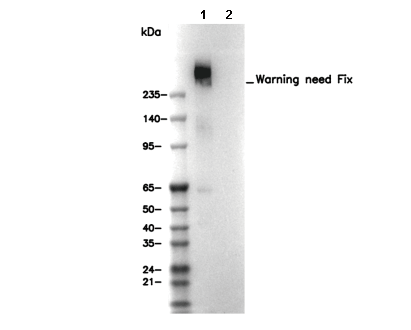 Lane 1: Mouse liver, Lane 2: Mouse liver (KO)