
Technische Daten
| Formel | C27H32N8O2 |
||||||
| Molekulargewicht | 500.6 | CAS-Nr. | 955365-80-7 | ||||
| Löslichkeit (25°C)* | In vitro | DMSO | 100 mg/mL (199.76 mM) | ||||
| Ethanol | 10 mg/mL (19.97 mM) | ||||||
| Water | Insoluble | ||||||
| In vivo (Lösungsmittel einzeln und der Reihe nach zum Produkt hinzufügen.) |
|
||||||
|
* <1 mg/ml bedeutet schwer löslich oder unlöslich. * Bitte beachten Sie, dass Selleck die Löslichkeit aller Verbindungen intern testet und die tatsächliche Löslichkeit geringfügig von veröffentlichten Werten abweichen kann. Dies ist normal und ist auf geringfügige Batch-zu-Batch-Variationen zurückzuführen. * Versand bei Raumtemperatur (Stabilitätstests zeigen, dass dieses Produkt ohne Kühlmaßnahmen versendet werden kann.) |
|||||||
Vorbereitung von Stammlösungen
Biologische Aktivität
| Beschreibung | Adavosertib (MK-1775, AZD1775) ist ein potenter und selektiver Wee1-Inhibitor mit einer IC50 von 5,2 nM in einem zellfreien Assay; behindert den G2-DNA-Schadens-Checkpoint. Phase 2. | ||
|---|---|---|---|
| Ziele |
|
||
| In vitro | Adavosertib (MK-1775) hemmt die Wee1-Kinase ATP-kompetitiv. Im Vergleich zu Wee1 zeigt es eine 2- bis 3-fach geringere Potenz gegen Yes mit einer IC50 von 14 nM, eine 10-fach geringere Potenz gegen sieben andere Kinasen mit >80%iger Hemmung bei 1 µM und eine >100-fache Selektivität gegenüber humanem Myt 1, einer weiteren Kinase, die die Cyclin-abhängige Kinase 1 (CDC2) durch Phosphorylierung an einer alternativen Stelle (Thr14) hemmt. Durch die Aufhebung des DNA-Schadens-Checkpoints durch Blockade der Wee1-Aktivität in WiDr-Zellen mit mutiertem p53 hemmt diese Verbindung die basale Phosphorylierung von CDC2 an Tyr15 (CDC2Y15) mit einer EC50 von 49 nM und unterdrückt die induzierte Phosphorylierung von CDC2 und den Zellzyklusarrest dosisabhängig mit einer EC50 von 82 nM und 81 nM, 180 nM und 163 nM sowie 159 nM und 160 nM. Eine alleinige Behandlung mit 30-100 nM hat keine signifikante antiproliferative Wirkung in WiDr- und H1299-Zellen, während bei 300 nM, ausreichend zur Hemmung von Wee1 um >80 %, moderate, aber signifikante antiproliferative Wirkungen von 34,1 % in WiDr-Zellen und 28,4 % in H1299-Zellen zeigt. |
||
| In vivo | Eine alleinige Adavosertib (MK-1775)-Behandlung mit ~20 mg/kg zeigt minimale Antitumorwirkungen gegen WiDr-Xenografts in Ratten mit einem T/C von 69 % an Tag 3. Ihre Antitumorwirksamkeit in den Nacktratten-Xenograftmodellen HeLa-luc und TOV21G-shp53 ist ebenfalls moderat. |
||
| Merkmale | Der erste berichtete Wee1-Inhibitor. |
Protokoll (aus Referenz)
| Kinase-Assay: |
|
|---|---|
| Zell-Assay: |
|
| Tierstudie: |
|
Referenzen
|
Kundenproduktvalidierung
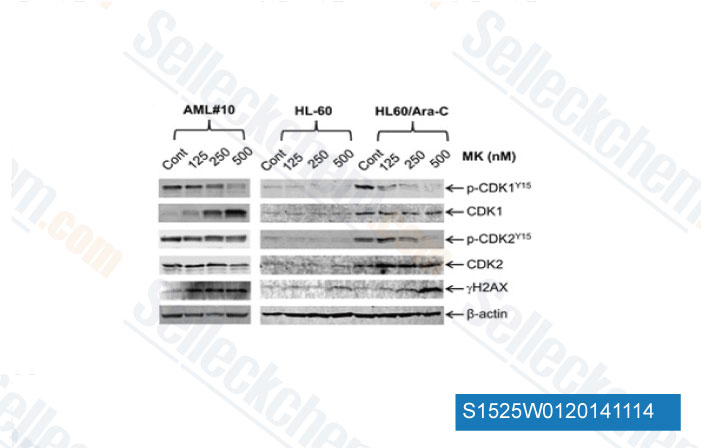
-
Daten von [ J Hematol Oncol , 2014 , 7:53 ]
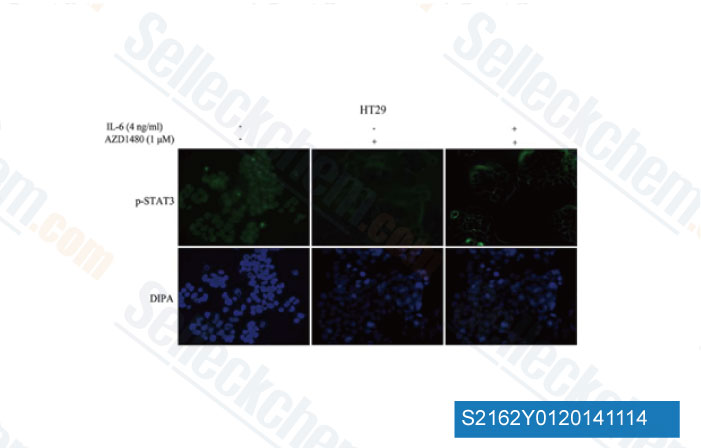
-
Daten von [ Oncol Rep , 2014 , 32(5), 1991-8 ]
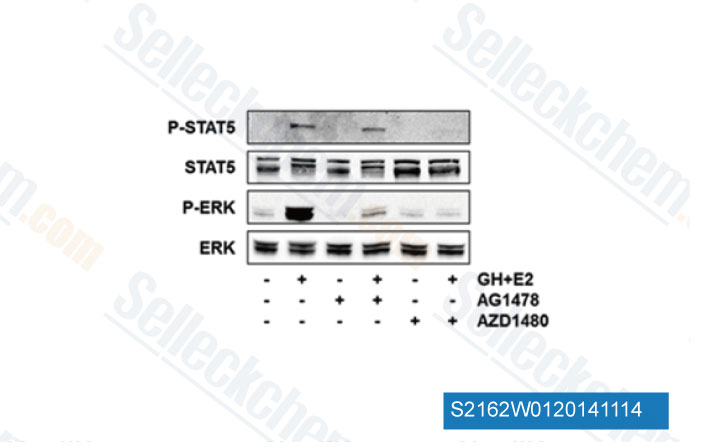
-
Daten von [ Endocrinology , 2013 , 154(9), 3219-27 ]
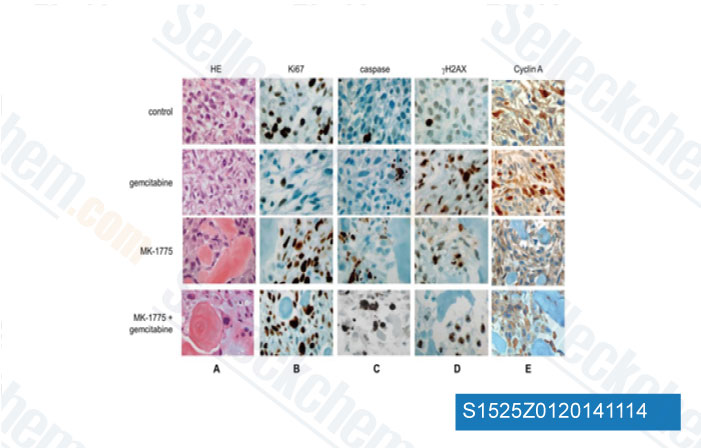
-
Daten von [ PLoS One , 2013 , 8(3), e57523 ]
Sellecks Adavosertib (AZD1775, MK-1775) Wurde zitiert von 247 Publikationen
| KEAP1 and STK11/LKB1 alterations enhance vulnerability to ATR inhibition in KRAS mutant non-small cell lung cancer [ Cancer Cell, 2025, 43(8):1530-1548.e9] | PubMed: 40645185 |
| Whole-exome tumor-agnostic ctDNA analysis enhances minimal residual disease detection and reveals relapse mechanisms in localized colon cancer [ Nat Cancer, 2025, 10.1038/s43018-025-00960-z] | PubMed: 40301653 |
| A patient-derived T cell lymphoma biorepository uncovers pathogenetic mechanisms and host-related therapeutic vulnerabilities [ Cell Rep Med, 2025, S2666-3791(25)00102-8] | PubMed: 40147445 |
| SETD2 loss-of-function uniquely sensitizes cells to epigenetic targeting of NSD1-directed H3K36 methylation [ Genome Biol, 2025, 26(1):22] | PubMed: 39910618 |
| Targeting CDK12/13 Drives Mitotic Arrest to Overcome Resistance to KRASG12C Inhibitors [ Cancer Res, 2025, 10.1158/0008-5472.CAN-25-0450] | PubMed: 41165466 |
| Cytoplasmic WEE1 promotes resistance to PD-1 blockade through hyperactivation of the HSP90A/TCL1/AKT signaling axis in NANOGhigh tumors [ Cancer Immunol Res, 2025, 10.1158/2326-6066.CIR-24-0379] | PubMed: 40067354 |
| Geometric deep learning and multiple-instance learning for 3D cell-shape profiling [ Cell Syst, 2025, 16(3):101229] | PubMed: 40112779 |
| WEE1 inhibitor exerts synergistic effect with KRAS G12C inhibitor via MYBL2-RRM2 axis in KRASG12C-mutant lung cancer [ Cell Death Dis, 2025, 16(1):661] | PubMed: 40885709 |
| Versatile enhancement of the killing potential of anti-cancer agents achieved by peptide mimetics of the PCNA interface towards specialized DNA polymerases [ Cell Death Dis, 2025, 16(1):503] | PubMed: 40628724 |
| Targeting Chk1 and Wee1 kinases enhances radiosensitivity of 2D and 3D head and neck cancer models to X-rays and low/high-LET protons [ Cell Death Dis, 2025, 16(1):128] | PubMed: 39994186 |
RÜCKGABERICHTLINIE
Die bedingungslose Rückgaberichtlinie von Selleck Chemical gewährleistet unseren Kunden ein reibungsloses Online-Einkaufserlebnis. Wenn Sie in irgendeiner Weise mit Ihrem Kauf unzufrieden sind, können Sie jeden Artikel innerhalb von 7 Tagen nach Erhalt zurückgeben. Im Falle von Produktqualitätsproblemen, sei es protokollbezogene oder produktbezogene Probleme, können Sie jeden Artikel innerhalb von 365 Tagen ab dem ursprünglichen Kaufdatum zurückgeben. Bitte befolgen Sie die nachstehenden Anweisungen, wenn Sie Produkte zurücksenden.
VERSAND UND LAGERUNG
Selleck-Produkte werden bei Raumtemperatur transportiert. Wenn Sie das Produkt bei Raumtemperatur erhalten, seien Sie versichert, dass die Qualitätskontrollabteilung von Selleck Experimente durchgeführt hat, um zu überprüfen, dass die normale Temperaturplatzierung von einem Monat die biologische Aktivität von Pulverprodukten nicht beeinträchtigt. Nach dem Sammeln lagern Sie das Produkt bitte gemäß den in der Datenblatt beschriebenen Anforderungen. Die meisten Selleck-Produkte sind unter den empfohlenen Bedingungen stabil.
NICHT FÜR DIE ANWENDUNG AM MENSCHEN, FÜR VETERINÄRMEDIZINISCHE DIAGNOSTIK ODER THERAPEUTISCHE ZWECKE.