SB203580 (Adezmapimod)

Katalog-Nr.S1076 Charge:S107612

Drucken

Technische Daten

Formel

C21H16FN3OS

Molekulargewicht 377.43 CAS-Nr. 152121-47-6
Löslichkeit (25°C)* In vitro DMSO 96 mg/mL (254.35 mM)
Ethanol 28 mg/mL (74.18 mM)
Water Insoluble
In vivo (Lösungsmittel einzeln und der Reihe nach zum Produkt hinzufügen.)
Homogeneous suspension
CMC-NA
≥5mg/ml Taking the 1 mL working solution as an example, add 5 mg of this product to 1 ml of CMC-Na solution, mix evenly to obtain a homogeneous suspension with a final concentration of 5 mg/ml.
Clear solution
5% DMSO 40% PEG 300 5%Tween80 50%ddH2O

Validiert von Selleck Labs. Sollten Sie Anpassungen an dieser Formulierung benötigen, wenden Sie sich an unser Vertriebsteam für kundenspezifische Tests.

5.000mg/ml (13.25mM) Taking the 1 mL working solution as an example, add 50 μL of 100 mg/ml clarified DMSO stock solution to 400 μL of PEG300, mix evenly to clarify it; add 50 μL of Tween80 to the above system, mix evenly to clarify; then continue to add 500 μL of ddH2O to adjust the volume to 1 mL. The mixed solution should be used immediately for optimal results. 
* <1 mg/ml bedeutet schwer löslich oder unlöslich.
* Bitte beachten Sie, dass Selleck die Löslichkeit aller Verbindungen intern testet und die tatsächliche Löslichkeit geringfügig von veröffentlichten Werten abweichen kann. Dies ist normal und ist auf geringfügige Batch-zu-Batch-Variationen zurückzuführen.
* Versand bei Raumtemperatur (Stabilitätstests zeigen, dass dieses Produkt ohne Kühlmaßnahmen versendet werden kann.)

Vorbereitung von Stammlösungen

Biologische Aktivität

Beschreibung Adezmapimod (SB203580, RWJ 64809, PB 203580) ist ein p38 MAPK-Inhibitor mit einer IC50 von 0,3-0,5 μM in THP-1-Zellen, 10-fach weniger empfindlich gegenüber SAPK3(106T) und SAPK4(106T) und blockiert die PKB-Phosphorylierung mit einer IC50 von 3-5 μM. SB203580 induziert mitophagy und autophagy.
Ziele
p38 MAPK
(THP-1 cells)
PKB
(THP-1 cells)
0.3 μM-0.5 μM 3 μM-5 μM
In vitro

Adezmapimod (SB203580) hemmt die IL-2-induzierte Proliferation primärer menschlicher T-Zellen, muriner CT6-T-Zellen oder BAF F7 B-Zellen mit einer IC50 von 3–5 μm. Es hemmt auch die IL-2-induzierte p70S6-Kinase-Aktivierung, obwohl die erforderliche Konzentration mit einer IC50 über 10 μm etwas höher ist. Diese Verbindung hemmt die Aktivität von PDK1 dosisabhängig mit einer IC50 im Bereich von 3–10 μm. Es hemmt die p38-MAPK-Stimulation von MAPKAPK2 mit einer IC50 von etwa 0,07 μM, während die gesamte SAPK/JNK-Aktivität mit einer IC50 von 3–10 μM gehemmt wird. Bei höheren Konzentrationen aktiviert es den ERK-Signalweg, was anschließend die NF-κB-Transkriptionsaktivität verstärkt. Es induziert auch die Autophagie in menschlichen hepatozellulären Karzinom (HCC)-Zellen.

In vivo

Adezmapimod (SB203580) schützt das Schweinemyokard in einem In-vivo-Modell vor ischämischer Schädigung. Es ist auch wirksam bei der Prävention und Behandlung der Krankheit im MRL/lpr-Mäusemodell des Systemischen Lupus erythematodes (SLE).

Merkmale Zuerst berichteter p38-Inhibitor.

Protokoll (aus Referenz)

Kinase-Assay:

[1]

  • Zellulärer Rezeptorkinase-Phosphorylierungs-Assay

    4 μg Schafs-Anti-PKBα werden über Nacht (oder 1,5 Stunden) auf 25 μL Protein G-Sepharose immobilisiert und in Puffer A (50 mm Tris, pH 7,5, 1 mm EDTA, 1 mm EGTA, 0,5 mm Na3VO4, 0,1 % β-Mercaptoethanol, 1 % Triton X-100, 50 mm Natriumfluorid, 5 mm Natriumpyrophosphat, 0,1 mm Phenylmethylsulfonylfluorid, 1 μg/mL Pepstatin, Leupeptin und 1 μm Microcystin) gewaschen. Das immobilisierte Anti-PKB wird dann 1,5 Stunden lang mit 0,5 ml Lysat (aus 5 × 10⁶ Zellen) inkubiert und dreimal in 0,5 ml Puffer A, ergänzt mit 0,5 m NaCl, zweimal in 0,5 ml Puffer B (50 mm Tris-HCl, pH 7,5, 0,03 % (w/v) Brij-35, 0,1 mm EGTA und 0,1 % β-Mercaptoethanol) und zweimal mit 100 μl Assay-Verdünnungspuffer gewaschen; 5× Assay-Verdünnungspuffer ist 100 mm MOPS, pH 7,2, 125 mm β-Glycerophosphat, 25 mm EGTA, 5 mm Natriumorthovanadat, 5 mm DTT. Zum PKB-Enzym-Immunkomplex werden 10 μL Assay-Verdünnungspuffer, 40 μm Proteinkinase-A-Inhibitorpeptid, 100 μm PKB-spezifisches Substratpeptid und 10 μCi [γ-32P]ATP gegeben, alles in Assay-Verdünnungspuffer hergestellt. Die Reaktion wird 20 Minuten lang bei Raumtemperatur unter Schütteln inkubiert, dann werden Proben kurz zentrifugiert und 40 μL Reaktionsvolumen in ein anderes Röhrchen überführt, dem 20 μL 40 %ige Trichloressigsäure zum Stoppen der Reaktion zugesetzt werden. Dies wird gemischt und 5 Minuten bei Raumtemperatur inkubiert, und 40 μL werden auf P81-Phosphocellulosepapier überführt und 30 Sekunden lang binden gelassen. Das P81-Stück wird dreimal in 0,75 %iger Phosphorsäure und dann in Aceton bei Raumtemperatur gewaschen. Die γ-32P-Inkorporation wird dann durch Szintillationszählung gemessen.

Zell-Assay:

[1]

  • Zelllinien

    CT6 cell , BA/F3 F7 cell

  • Konzentrationen

    0–30 μM

  • Inkubationszeit

    1 hour

  • Methode

    CT6 cell and BA/F3 F7 cell are rested by washing three times in RPMI and culturing overnight in RPMI, 5% fetal calf serum in the absence of growth factor, antibiotics, or β-mercaptoethanol supplements. 2–5 × 10⁶ rested CT6 cells are resuspended in 2 mL of RPMI, 5% fetal calf serum and preincubated with Adezmapimod (SB203580) or vehicle control as indicated in figure legends. Cells are then stimulated with 20 ng/ml recombinant human IL-2 for 5 minutes at 37  °C and pelleted in a minifuge for 30 seconds, medium is aspirated, and the pellet is lysed in the appropriate buffer. BA/F3 cells stably expressing deletion mutants of IL-2 receptor β chain are maintained in glutamine containing RPMI further supplemented with 5% fetal calf serum and 0.2 μg/mL G418. The cells are then washed extensively, rested overnight, and washed again before activating with IL-2; such cell preparations are >90% T cells. Cellular proliferation assays are performed by measurement of [3H]thymidine incorporation.

Tierstudie:

[5]

  • Tiermodelle

    Systemic lupus erythematosus (SLE) are established in female MRL/lpr mice and female C57BL/6 mice

  • Dosierungen

    0.1 M/day

  • Verabreichung

    Orally administered

Referenzen

  • https://pubmed.ncbi.nlm.nih.gov/10702313/
  • https://pubmed.ncbi.nlm.nih.gov/10960075/
  • https://pubmed.ncbi.nlm.nih.gov/22170404/
  • https://pubmed.ncbi.nlm.nih.gov/10710135/
  • https://pubmed.ncbi.nlm.nih.gov/21549858/

Kundenproduktvalidierung

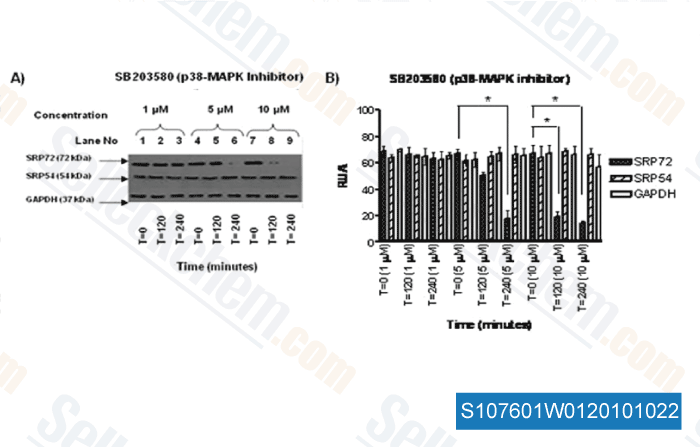
<p>A, effects of p38 inhibitor SB203580 (1, 5, and 10 μM) on SRP72 protein expression was evaluated by WB using antibodies against human SRP72,SRP54, and GAPDH. A decreased intensity of SRP72 bands was noted when using the inhibitor at 5 μM concentration at 240 min (lane 6) and 10 μM at 120 and 240 min (lanes 8 and 9). B, results were analyzed and RUA illustrated, finding significant results at 5 μM, 240 versus 0 min, and 10 μM, 240 versus 0 and 120 versus 0 min, respectively, (p<0.05).</p><div><div> </div></div><p> </p>

Daten von [ J Biol Chem , 2010 , 285, 32824-32833 ]
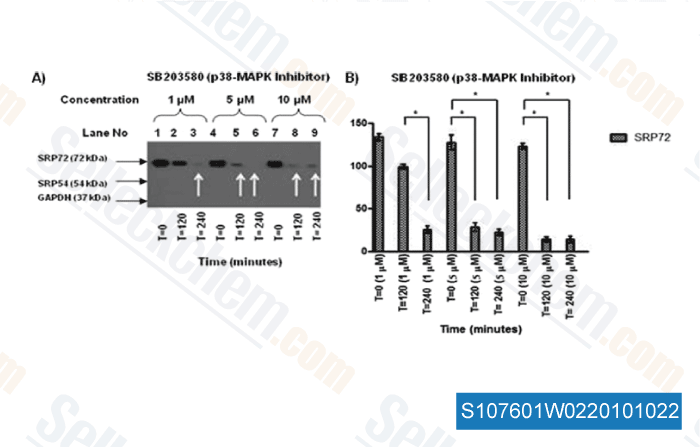
<p>A, effect of p38 MAPK inhibitor SB203580 (1, 5, and 10 μM) on SRP72 phosphorylation was evaluated. Jurkat cells were stimulated with rhIL-1, harvested at 0, 120, and 240 min, lysed, and immunoprecipitated using anti-human SRP19 andWBusing anti-phosphoserine antibodies. A decreased intensity of SRP72 band was found when using the inhibitor at concentration of 1μM at 240 min and 5 and 10 μM at 120 and 240 min. B, results were analyzed and RUA illustrated, finding significant results at 1 μM 240 versus 120, 5, and 10 μM at 120 versus 0 and 240 versus 0 min *, p<0.05.</p>

Daten von [ J Biol Chem , 2010 , 285, 32824–32833 ]

<p>We used real time RT-PCR to investigate the effects of SB203580 on SRP72 mRNA expression. All the samples were treated under the same experimental conditions used in protein tests done by WB, and phosphorylation was measured indirectly by IP-WB. The results did not show significant changes on the mRNA expression of SRP72 after the treatment with these inhibitors.</p>

Daten von [ J Biol Chem , 2010 , 285, 32824–32833 ]
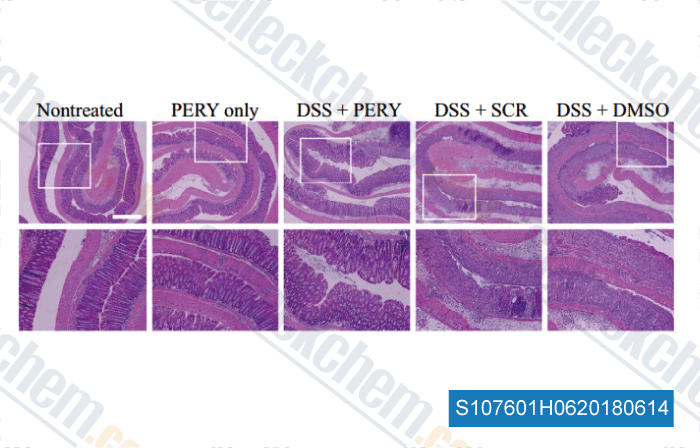
C57BL/6 male mice (8 weeks, Harlan) were pretreated with by intravenous injections with PERY or SCR peptides (15 mg/kg) or DMSO. The following day, mice were treated with 1.5% dextran sodium sulfate (DSS) in drinking water for 7 days followed by 3 days of normal drinking water. During DSS administration, mice were treated every other day (total of five intravenous injections). Control groups included nontreated mice (no DSS, no treatment) and mice receiving PERY peptide with normal drinking water (PERY only, no DSS). Mice were then euthanized and analyzed. Colitis was evaluated using (C) hematoxylin and eosin (H&E) histological sections of the colons (top) and their magnifications (bottom). Scale bar, 2 mm.

Daten von [ , , Science, 2018, 11(525), doi: 10.1126/scisignal.aao3428 ]

Sellecks SB203580 (Adezmapimod) Wurde zitiert von 1012 Publikationen

Oncogenic RAS induces a distinctive form of non-canonical autophagy mediated by the P38-ULK1-PI4KB axis [ Cell Res, 2025, 10.1038/s41422-025-01085-9] PubMed: 40055523
The intrinsic expression of NLRP3 in Th17 cells promotes their protumor activity and conversion into Tregs [ Cell Mol Immunol, 2025, 22(5):541-556] PubMed: 40195474
First-in-class ultralong-target-residence-time p38α inhibitors as a mitosis-targeted therapy for colorectal cancer [ Nat Cancer, 2025, 6(2):259-277] PubMed: 39820127
Gut Microbiota Modulates Obesity-Associated Skeletal Deterioration Through Macrophage Aging and Grancalcin Secretion [ Adv Sci (Weinh), 2025, 12(28):e2502634] PubMed: 40349163
Orosomucoid 1 Ameliorates Temporomandibular Joint Osteoarthritis by Maintaining Cartilage Homeostasis [ Adv Sci (Weinh), 2025, 12(36):e00028] PubMed: 40583170
A novel human specific lncRNA MEK6-AS1 regulates adipogenesis and fatty acid biosynthesis by stabilizing MEK6 mRNA [ J Biomed Sci, 2025, 32(1):6] PubMed: 39773638
Targeting Matrix Metalloproteinase-9 to Alleviate T Cell Exhaustion and Improve Sepsis Prognosis [ Research (Wash D C), 2025, 8:0996] PubMed: 41306770
Inhalable targeted CD8 + T cell nanoparticles loaded ferroptosis inhibitor ferrostatin-1 alleviate acute lung injury [ J Nanobiotechnology, 2025, 23(1):723] PubMed: 41261431
FNDC5/irisin-enriched sEVs conjugated with bone-targeting aptamer alleviate osteoporosis: a potential alternative to exercise [ J Nanobiotechnology, 2025, 23(1):504] PubMed: 40652239
LL37 complexed to double-stranded RNA induces RIG-I-like receptor signalling and Gasdermin E activation facilitating IL-36γ release from keratinocytes [ Cell Death Dis, 2025, 16(1):198] PubMed: 40121229

RÜCKGABERICHTLINIE
Die bedingungslose Rückgaberichtlinie von Selleck Chemical gewährleistet unseren Kunden ein reibungsloses Online-Einkaufserlebnis. Wenn Sie in irgendeiner Weise mit Ihrem Kauf unzufrieden sind, können Sie jeden Artikel innerhalb von 7 Tagen nach Erhalt zurückgeben. Im Falle von Produktqualitätsproblemen, sei es protokollbezogene oder produktbezogene Probleme, können Sie jeden Artikel innerhalb von 365 Tagen ab dem ursprünglichen Kaufdatum zurückgeben. Bitte befolgen Sie die nachstehenden Anweisungen, wenn Sie Produkte zurücksenden.

VERSAND UND LAGERUNG
Selleck-Produkte werden bei Raumtemperatur transportiert. Wenn Sie das Produkt bei Raumtemperatur erhalten, seien Sie versichert, dass die Qualitätskontrollabteilung von Selleck Experimente durchgeführt hat, um zu überprüfen, dass die normale Temperaturplatzierung von einem Monat die biologische Aktivität von Pulverprodukten nicht beeinträchtigt. Nach dem Sammeln lagern Sie das Produkt bitte gemäß den in der Datenblatt beschriebenen Anforderungen. Die meisten Selleck-Produkte sind unter den empfohlenen Bedingungen stabil.

NICHT FÜR DIE ANWENDUNG AM MENSCHEN, FÜR VETERINÄRMEDIZINISCHE DIAGNOSTIK ODER THERAPEUTISCHE ZWECKE.