
Technische Daten
| Formel | C24H25ClFN5O3 |
||||||
| Molekulargewicht | 485.94 | CAS-Nr. | 850140-72-6 | ||||
| Löslichkeit (25°C)* | In vitro | DMSO | 97 mg/mL (199.61 mM) | ||||
| Ethanol | 97 mg/mL (199.61 mM) | ||||||
| Water | Insoluble | ||||||
| In vivo (Lösungsmittel einzeln und der Reihe nach zum Produkt hinzufügen.) |
|
||||||
|
* <1 mg/ml bedeutet schwer löslich oder unlöslich. * Bitte beachten Sie, dass Selleck die Löslichkeit aller Verbindungen intern testet und die tatsächliche Löslichkeit geringfügig von veröffentlichten Werten abweichen kann. Dies ist normal und ist auf geringfügige Batch-zu-Batch-Variationen zurückzuführen. * Versand bei Raumtemperatur (Stabilitätstests zeigen, dass dieses Produkt ohne Kühlmaßnahmen versendet werden kann.) |
|||||||
Vorbereitung von Stammlösungen
Biologische Aktivität
| Beschreibung | Afatinib hemmt EGFR/ErbB irreversibel in vitro mit einer IC50 von 0,5, 0,4, 10, 14, 1 nM für EGFRwt, EGFR L858R , EGFR L858R/T790M ErbB2 (HER2) bzw. ErbB4 (HER4). Diese Verbindung induziert Autophagy. | ||||||||||
|---|---|---|---|---|---|---|---|---|---|---|---|
| Ziele |
|
||||||||||
| In vitro | BIBW2992 zeigt eine potente Aktivität sowohl gegen Wildtyp- als auch gegen mutierte Formen von EGFR und HER2. Es ist ähnlich wie Gefitinib in der Wirksamkeit gegen L858R EGFR, aber etwa 100-mal aktiver gegen die Gefitinib-resistente L858R-T790M EGFR Doppelmutante. Diese Verbindung zeigt potente Effekte auf die Phosphorylierung von EGFR und HER2 in vivo. Es schneidet in allen getesteten Zelltypen, wie der menschlichen epidermoiden Karzinomzelllinie A431, die wt EGFR exprimiert, murinen NIH-3T3-Zellen, die mit wt HER2 transfiziert sind, sowie der Brustkrebszelllinie BT-474 und der Magenkrebszelllinie NCI-N87, die endogenes HER2 exprimieren, besser ab als Referenzverbindungen (wie Lapatinib et al.). | ||||||||||
| In vivo | Die tägliche orale Verabreichung von BIBW2992 in einer Dosis von 20 mg/kg über 25 Tage führt zu einer dramatischen Tumorregression mit einem kumulativen Tumorvolumenverhältnis (T/C-Verhältnis) von 2 %. Eine reduzierte Phosphorylierung von EGFR und AKT wird durch immunhistochemische Färbung von Gewebeschnitten bestätigt. Daher ist diese Verbindung, wie Lapatinib und Neratinib, ein Tyrosine Kinase-Inhibitor (TKI) der nächsten Generation, der humane epidermale Wachstumsfaktorrezeptor 2 (Her2) und Epidermal Growth Factor Receptor (EGFR)-Kinasen irreversibel hemmt. Es ist nicht nur wirksam gegen EGFR-Mutationen, die von TKIs der ersten Generation wie Erlotinib oder Gefitinib angegriffen werden, sondern auch gegen solche, die gegen diese Standardtherapien unempfindlich sind. |
Protokoll (aus Referenz)
| Kinase-Assay: |
|
|---|---|
| Zell-Assay: |
|
| Tierstudie: |
|
Referenzen
|
Kundenproduktvalidierung
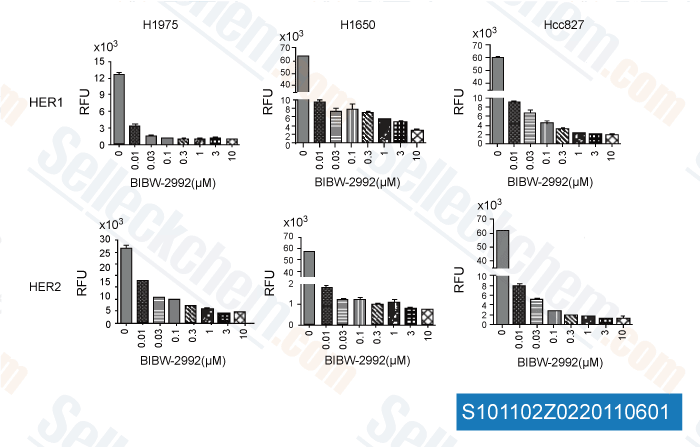
-
Daten von [ Int J Proteomics , 2011 , 2011, 215496 ]
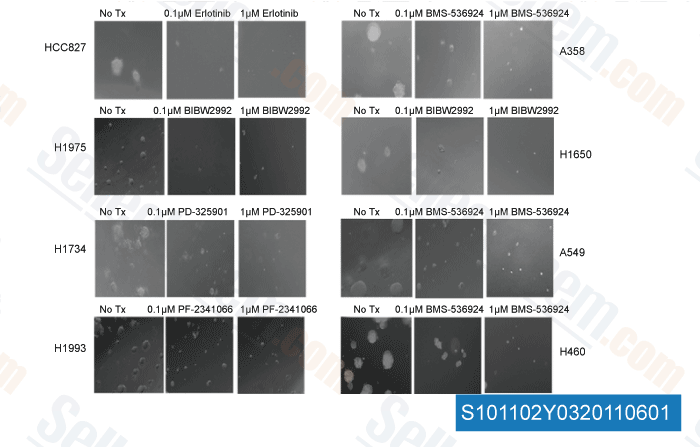
-
Daten von [ Int J Proteomics , 2011 , 2011, 215496 ]
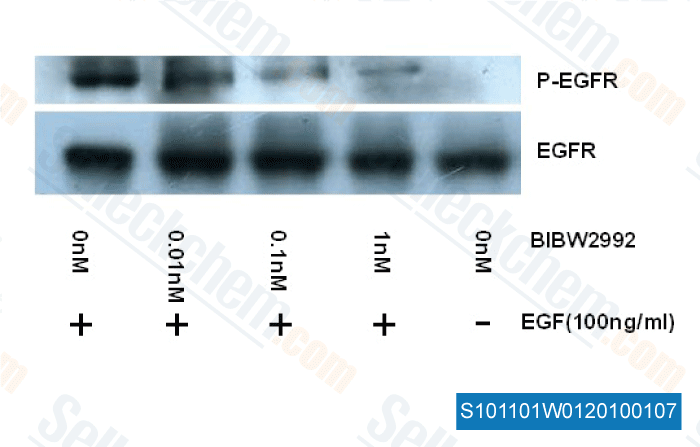
-
, , Dr. Zhang of Tianjin Medical University
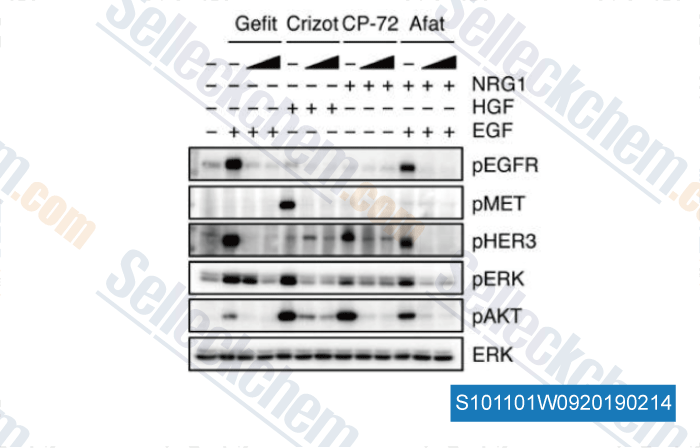
-
Daten von [ , , Nature, 2016, 534(7609):647-51 ]
Sellecks Afatinib (BIBW2992) Wurde zitiert von 453 Publikationen
| Lysosomal EGFR acts as a Rheb-GEF independent of its kinase activity to activate mTORC1 [ Cell Res, 2025, 10.1038/s41422-025-01110-x] | PubMed: 40259053 |
| Longitudinal single-cell multiomic atlas of high-risk neuroblastoma reveals chemotherapy-induced tumor microenvironment rewiring [ Nat Genet, 2025, 10.1038/s41588-025-02158-6] | PubMed: 40229600 |
| The potential of lazertinib and amivantamab combination therapy as a treatment strategy for uncommon EGFR-mutated NSCLC [ Cell Rep Med, 2025, 6(2):101929] | PubMed: 39874964 |
| AP1-mediated reprogramming of EGFR expression triggers resistance to BLU-667 and LOXO-292 in RET-rearranged tumors [ J Exp Clin Cancer Res, 2025, 44(1):154] | PubMed: 40405293 |
| Anti-galectin-9 therapy synergizes with EGFR inhibition to reprogram the tumor microenvironment and overcome immune evasion [ J Immunother Cancer, 2025, 13(7)e010926] | PubMed: 40664443 |
| Blocking cancer-fibroblast mutualism inhibits proliferation of endocrine therapy resistant breast cancer [ Mol Syst Biol, 2025, 10.1038/s44320-025-00104-6] | PubMed: 40341770 |
| PI3K-dependent GAB1/Erk phosphorylation renders head and neck squamous cell carcinoma sensitive to PI3Kα inhibitors [ Cell Death Dis, 2025, 16(1):457] | PubMed: 40533463 |
| Exercise-induced adipokine Nrg4 alleviates MASLD by disrupting hepatic cGAS-STING signaling [ Cell Rep, 2025, 44(2):115251] | PubMed: 39891907 |
| Rare mutations at EGFR L747 position: molecular characteristics and superior response to afatinib in NSCLC patients [ ESMO Open, 2025, 10(9):105558] | PubMed: 40834500 |
| PTEN loss and ERBB2/ERBB3-mediated AKT reactivation drive resistance to MET inhibition in MET-amplified hepatocellular carcinoma [ Cell Oncol (Dordr), 2025, 10.1007/s13402-025-01097-y] | PubMed: 40991144 |
RÜCKGABERICHTLINIE
Die bedingungslose Rückgaberichtlinie von Selleck Chemical gewährleistet unseren Kunden ein reibungsloses Online-Einkaufserlebnis. Wenn Sie in irgendeiner Weise mit Ihrem Kauf unzufrieden sind, können Sie jeden Artikel innerhalb von 7 Tagen nach Erhalt zurückgeben. Im Falle von Produktqualitätsproblemen, sei es protokollbezogene oder produktbezogene Probleme, können Sie jeden Artikel innerhalb von 365 Tagen ab dem ursprünglichen Kaufdatum zurückgeben. Bitte befolgen Sie die nachstehenden Anweisungen, wenn Sie Produkte zurücksenden.
VERSAND UND LAGERUNG
Selleck-Produkte werden bei Raumtemperatur transportiert. Wenn Sie das Produkt bei Raumtemperatur erhalten, seien Sie versichert, dass die Qualitätskontrollabteilung von Selleck Experimente durchgeführt hat, um zu überprüfen, dass die normale Temperaturplatzierung von einem Monat die biologische Aktivität von Pulverprodukten nicht beeinträchtigt. Nach dem Sammeln lagern Sie das Produkt bitte gemäß den in der Datenblatt beschriebenen Anforderungen. Die meisten Selleck-Produkte sind unter den empfohlenen Bedingungen stabil.
NICHT FÜR DIE ANWENDUNG AM MENSCHEN, FÜR VETERINÄRMEDIZINISCHE DIAGNOSTIK ODER THERAPEUTISCHE ZWECKE.