
Technische Daten
| Formel | C16H14ClN3O2 |
||||||||||||||
| Molekulargewicht | 315.75 | CAS-Nr. | 153436-53-4,175178-82-2 | ||||||||||||
| Löslichkeit (25°C)* | In vitro | DMSO | 25 mg/mL (79.17 mM) | ||||||||||||
| Ethanol | 13 mg/mL (41.17 mM) | ||||||||||||||
| Water | Insoluble | ||||||||||||||
| In vivo (Lösungsmittel einzeln und der Reihe nach zum Produkt hinzufügen.) |
|
||||||||||||||
|
* <1 mg/ml bedeutet schwer löslich oder unlöslich. * Bitte beachten Sie, dass Selleck die Löslichkeit aller Verbindungen intern testet und die tatsächliche Löslichkeit geringfügig von veröffentlichten Werten abweichen kann. Dies ist normal und ist auf geringfügige Batch-zu-Batch-Variationen zurückzuführen. * Versand bei Raumtemperatur (Stabilitätstests zeigen, dass dieses Produkt ohne Kühlmaßnahmen versendet werden kann.) |
|||||||||||||||
Vorbereitung von Stammlösungen
Biologische Aktivität
| Beschreibung | AG-1478 ist ein selektiver EGFR-Inhibitor mit einer IC50 von 3 nM in zellfreien Assays und weist fast keine Aktivität auf HER2-Neu, PDGFR, Trk, Bcr-Abl und InsR auf. Diese Verbindung hemmt das Enzephalomyokarditis-Virus (EMCV) und das Hepatitis-C-Virus (HCV), indem es auf die Phosphatidylinositol-4-Kinase III (PI4KA) abzielt. | ||
|---|---|---|---|
| Ziele |
|
||
| In vitro | AG-1478 ist hochselektiv gegenüber ErbB2 und PDGFR mit einer IC50 von >100 μM. Diese Verbindung hemmt bevorzugt U87MG-Zellen, die trunkierte EGFR exprimieren, mit einer IC50 von 8,7 μM, verglichen mit Zellen, die endogenes wt EGFR exprimieren oder exogenes wt EGFR überexprimieren, mit einer IC50 von 34,6 μM bzw. 48,4 μM, und hemmt die DNA-Synthese mit einer IC50 von 4,6 μM, 19,67 μM bzw. 35,2 μM. Diese Chemikalie hemmt auch bevorzugt die Protein Tyrosine Kinase-Aktivität und Autophosphorylierung des ΔEGFR im Vergleich zu endogenem oder überexprimiertem exogenem wt EGFR. Es (0,25 μM) unterdrückt die durch Ang II, einen Ca2+-Ionophor sowie EGF, aber nicht durch einen Phorbolester oder platelet-derived growth factor-BB in den VSMC induzierte MAPK-Aktivierung. Diese Verbindung hemmt die EGF-induzierte Mitogenese der BaF/ERX- und LIM1215-Zellen mit einer IC50 von 0,07 μM bzw. 0,2 μM. Es ist in der Lage, die Funktion von ATP-binding cassette (ABC)-Transportern wie ABCB1 und ABCG2 zu hemmen, mit einem ausgeprägteren Effekt auf ABCG2. |
||
| In vivo | Die Verabreichung von AG-1478 blockiert die Phosphorylierung des EGFR an der Tumorstelle und hemmt das Wachstum von A431-Xenografts, die WT EGFR überexprimieren, und Gliom-Xenografts, die de2-7 EGFR exprimieren. Selbst subtherapeutische Dosen dieser Verbindung verbessern die Wirksamkeit zytotoxischer Medikamente erheblich, wobei die Kombination dieser Chemikalie eine synergistische Antitumoraktivität gegen menschliche Gliom-Xenografts zeigt. Die Kombination dieser Verbindung und eines Anti-EGFR-Antikörpers (mAb 806) zeigt eine additive und in einigen Fällen synergistische Antitumoraktivität gegen Tumor-Xenografts, die den EGFR überexprimieren. Die Kombination dieser Verbindung (0,4 mg) mit einer Einzeldosis von 25 μCi 90Y-CHX-A''-DTPA-hu3S193 führt zu einer signifikanten Steigerung der Wirksamkeit im Vergleich zu jedem Wirkstoff allein. |
Protokoll (aus Referenz)
| Zell-Assay: |
|
|---|---|
| Tierstudie: |
|
Referenzen
|
Kundenproduktvalidierung
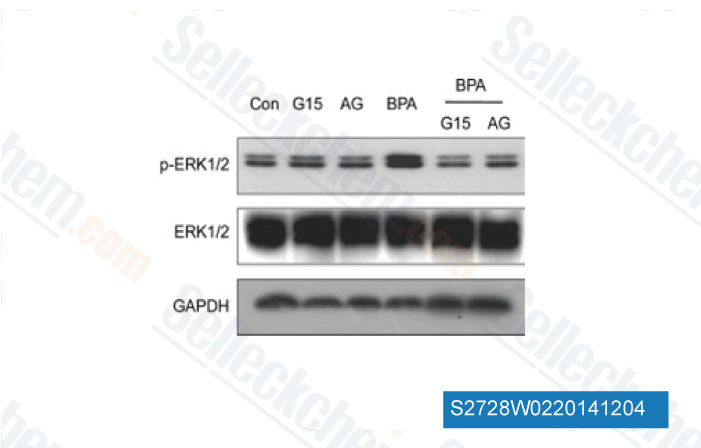
-
Daten von [ Biomed Pharmacother , 2014 , 10.1016/j.biopha.2014.09.003 ]
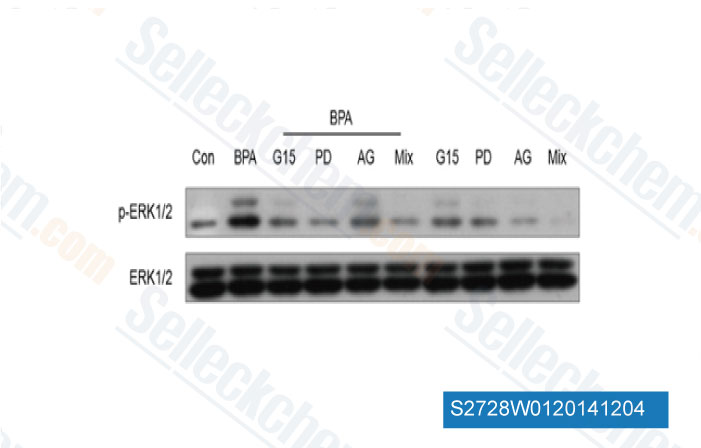
-
Daten von [ Toxicol Lett , 2014 , 226(1), 81-9 ]
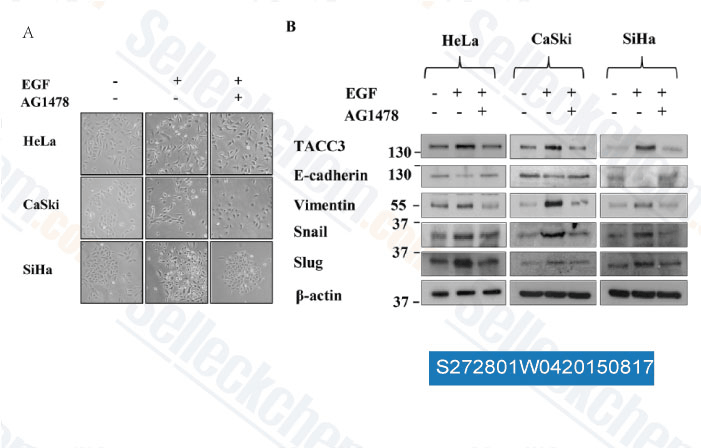
-
Daten von [ , , PLoS One, 2013, 8(8): e70353 ]
Sellecks AG-1478 Wurde zitiert von 100 Publikationen
| p66Shc deletion confers apoptotic resistance to loss of EGFR-ERK signalling in neural stem cells [ Cell Death Dis, 2025, 16(1):479] | PubMed: 40593476 |
| Activation of GPER1 alleviates white matter injury by promoting microglia M2 polarization through EGFR/Stat3 pathway in intracerebral hemorrhage mice [ J Stroke Cerebrovasc Dis, 2025, 34(6):108315] | PubMed: 40228567 |
| Polypharmacological profiling across protein target families and cellular pathways using the multiplexed cell-based assay platform safetyProfiler reveals efficacy, potency and side effects of drugs [ Biomed Pharmacother, 2024, 180:117523] | PubMed: 39405910 |
| Calpain-2 mediates SARS-CoV-2 entry via regulating ACE2 levels [ mBio, 2024, e0228723.] | PubMed: 38349185 |
| AREG Upregulation in Cancer Cells via Direct Interaction with Cancer-Associated Fibroblasts Promotes Esophageal Squamous Cell Carcinoma Progression Through EGFR-Erk/p38 MAPK Signaling [ Cells, 2024, 13(20)1733] | PubMed: 39451251 |
| Profiling of ERBB receptors and downstream pathways reveals selectivity and hidden properties of ERBB4 antagonists [ iScience, 2024, 27(2):108839] | PubMed: 38303712 |
| Transforming Growth Factor α Evokes Aromatase Expression in Gastric Parietal Cells during Rat Postnatal Development [ Int J Mol Sci, 2024, 25(4)2119] | PubMed: 38396796 |
| The Electric Field Guided HaCaT Cell Migration Through the EGFR/p38 MAPK/Akt Pathway [ Curr Issues Mol Biol, 2024, 47(1)16] | PubMed: 39852131 |
| Crosstalk between cancer cells and macrophages promotes OSCC cell migration and invasion through a CXCL1/EGF positive feedback loop [ Discov Oncol, 2024, 15(1):145] | PubMed: 38713320 |
| Protocol for identifying properties of ERBB receptor antagonists using the barcoded ERBBprofiler assay [ STAR Protoc, 2024, 5(2):102987] | PubMed: 38635397 |
RÜCKGABERICHTLINIE
Die bedingungslose Rückgaberichtlinie von Selleck Chemical gewährleistet unseren Kunden ein reibungsloses Online-Einkaufserlebnis. Wenn Sie in irgendeiner Weise mit Ihrem Kauf unzufrieden sind, können Sie jeden Artikel innerhalb von 7 Tagen nach Erhalt zurückgeben. Im Falle von Produktqualitätsproblemen, sei es protokollbezogene oder produktbezogene Probleme, können Sie jeden Artikel innerhalb von 365 Tagen ab dem ursprünglichen Kaufdatum zurückgeben. Bitte befolgen Sie die nachstehenden Anweisungen, wenn Sie Produkte zurücksenden.
VERSAND UND LAGERUNG
Selleck-Produkte werden bei Raumtemperatur transportiert. Wenn Sie das Produkt bei Raumtemperatur erhalten, seien Sie versichert, dass die Qualitätskontrollabteilung von Selleck Experimente durchgeführt hat, um zu überprüfen, dass die normale Temperaturplatzierung von einem Monat die biologische Aktivität von Pulverprodukten nicht beeinträchtigt. Nach dem Sammeln lagern Sie das Produkt bitte gemäß den in der Datenblatt beschriebenen Anforderungen. Die meisten Selleck-Produkte sind unter den empfohlenen Bedingungen stabil.
NICHT FÜR DIE ANWENDUNG AM MENSCHEN, FÜR VETERINÄRMEDIZINISCHE DIAGNOSTIK ODER THERAPEUTISCHE ZWECKE.