
Technische Daten
| Formel | C34H29N7O |
||||||
| Molekulargewicht | 551.64 | CAS-Nr. | 612847-09-3 | ||||
| Löslichkeit (25°C)* | In vitro | DMSO | 22 mg/mL (39.88 mM) | ||||
| Water | Insoluble | ||||||
| Ethanol | Insoluble | ||||||
| In vivo (Lösungsmittel einzeln und der Reihe nach zum Produkt hinzufügen.) |
|
||||||
|
* <1 mg/ml bedeutet schwer löslich oder unlöslich. * Bitte beachten Sie, dass Selleck die Löslichkeit aller Verbindungen intern testet und die tatsächliche Löslichkeit geringfügig von veröffentlichten Werten abweichen kann. Dies ist normal und ist auf geringfügige Batch-zu-Batch-Variationen zurückzuführen. * Versand bei Raumtemperatur (Stabilitätstests zeigen, dass dieses Produkt ohne Kühlmaßnahmen versendet werden kann.) |
|||||||
Vorbereitung von Stammlösungen
Biologische Aktivität
| Beschreibung | Akti-1/2 (Akt Inhibitor VIII) ist ein hochselektiver Akt1/Akt2-Inhibitor mit einer IC50 von 58 nM/210 nM und einer etwa 36-fachen Selektivität für Akt1 gegenüber Akt3. Diese Verbindung induziert Apoptose. | ||||||
|---|---|---|---|---|---|---|---|
| Ziele |
|
||||||
| In vitro | In einem zellbasierten IPKA (C33A)-Assay hemmt Akti-1/2 Akt1 und Akt2 mit einer IC50 von 305 nM bzw. 2086 nM. In HT29-, MCF7- und A2780-Zellen induziert diese Verbindung die Zellapoptose durch eine dramatische Erhöhung der Caspase-3-Aktivität. In Leberzellen blockiert diese Chemikalie die Regulierung der PEPCK-, G6Pase-Expression und der FOXO1-Aktivität. Sie verstärkt auch stark die PAR-1-vermittelte Thrombozytenaggregation durch Blockierung von PKB. In HCC827-, NCI-H522-, NCI-1651- und PC-9-Zellen hemmt dieser Inhibitor das Zellwachstum mit einer IC50 von 4,7 μM, 7,25 μM und 9,5 μM. In Kombination führt er zu einer verstärkten Hemmung des Zellwachstums und der Apoptose. |
||||||
| In vivo | Bei Mäusen hemmt Akti-1/2 (50 mg/kg, i.p.) die basale und IGF-stimulierte Akt1- und Akt2-Phosphorylierung in der Lunge. |
Protokoll (aus Referenz)
| Kinase-Assay: |
|
|---|---|
| Zell-Assay: |
|
| Tierstudie: |
|
Referenzen
|
Kundenproduktvalidierung
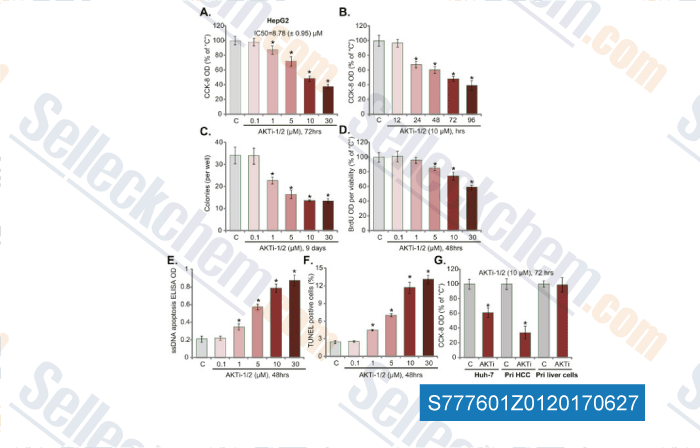
-
Daten von [ , , Biochem Biophys Res Commun, 2016, 480(3):334-340 ]
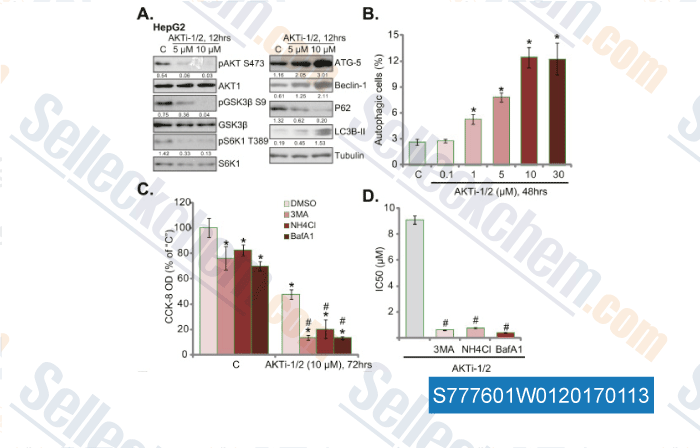
-
Daten von [ , , Biochem Biophys Res Commun, 2016, 480(3):334-340. ]
Sellecks Akti-1/2 Wurde zitiert von 29 Publikationen
| USP5 stabilizes YTHDF1 to control cancer immune surveillance through mTORC1-mediated phosphorylation [ Nat Commun, 2025, 16(1):1313] | PubMed: 39900921 |
| A DEL-1/αvβ3 integrin axis promotes brown adipocyte progenitor proliferation and cold-induced brown adipose tissue adaptation [ Mol Metab, 2025, 100:102229] | PubMed: 40754227 |
| Amino acid-dependent TSC2 dephosphorylation by lysosome-PP2A regulates mTORC1 signaling transduction [ Life Sci Alliance, 2025, 8(11)e202503206] | PubMed: 40897470 |
| Combined inhibition of HER2 and VEGFR synergistically improves therapeutic efficacy via PI3K-AKT pathway in advanced ovarian cancer [ J Exp Clin Cancer Res, 2024, 43(1):56] | PubMed: 38403634 |
| Targeting ERBB3 and AKT to overcome adaptive resistance in EML4-ALK-driven non-small cell lung cancer [ Cell Death Dis, 2024, 15(12):912] | PubMed: 39695132 |
| Necrosulfonamide causes oxidation of PCM1 and impairs ciliogenesis and autophagy [ iScience, 2024, 27(4):109580] | PubMed: 38600973 |
| Jnk1 and downstream signalling hubs regulate anxiety-like behaviours in a zebrafish larvae phenotypic screen [ Sci Rep, 2024, 14(1):11174] | PubMed: 38750129 |
| Low intensity mechanical signals promote proliferation in a cell-specific manner: Tailoring a non-drug strategy to enhance biomanufacturing yields [ Mechanobiol Med, 2024, 2(4)100080] | PubMed: 39717386 |
| P. gingivalis Infection Upregulates PD-L1 Expression on Dendritic Cells, Suppresses CD8+ T-cell Responses, and Aggravates Oral Cancer [ Cancer Immunol Res, 2023, 11(3):290-305] | PubMed: 36633576 |
| AKT regulates IL-1β-induced proliferation and activation of hepatic stellate cells [ BIOCELL, 2023, 47(3): 669-676] | PubMed: none |
RÜCKGABERICHTLINIE
Die bedingungslose Rückgaberichtlinie von Selleck Chemical gewährleistet unseren Kunden ein reibungsloses Online-Einkaufserlebnis. Wenn Sie in irgendeiner Weise mit Ihrem Kauf unzufrieden sind, können Sie jeden Artikel innerhalb von 7 Tagen nach Erhalt zurückgeben. Im Falle von Produktqualitätsproblemen, sei es protokollbezogene oder produktbezogene Probleme, können Sie jeden Artikel innerhalb von 365 Tagen ab dem ursprünglichen Kaufdatum zurückgeben. Bitte befolgen Sie die nachstehenden Anweisungen, wenn Sie Produkte zurücksenden.
VERSAND UND LAGERUNG
Selleck-Produkte werden bei Raumtemperatur transportiert. Wenn Sie das Produkt bei Raumtemperatur erhalten, seien Sie versichert, dass die Qualitätskontrollabteilung von Selleck Experimente durchgeführt hat, um zu überprüfen, dass die normale Temperaturplatzierung von einem Monat die biologische Aktivität von Pulverprodukten nicht beeinträchtigt. Nach dem Sammeln lagern Sie das Produkt bitte gemäß den in der Datenblatt beschriebenen Anforderungen. Die meisten Selleck-Produkte sind unter den empfohlenen Bedingungen stabil.
NICHT FÜR DIE ANWENDUNG AM MENSCHEN, FÜR VETERINÄRMEDIZINISCHE DIAGNOSTIK ODER THERAPEUTISCHE ZWECKE.