
Technische Daten
| Formel | C18H22FN3O3 |
||||||
| Molekulargewicht | 347.38 | CAS-Nr. | 836620-48-5 | ||||
| Löslichkeit (25°C)* | In vitro | DMSO | 23 mg/mL (66.2 mM) | ||||
| Water | Insoluble | ||||||
| Ethanol | Insoluble | ||||||
| In vivo (Lösungsmittel einzeln und der Reihe nach zum Produkt hinzufügen.) |
|
||||||
|
* <1 mg/ml bedeutet schwer löslich oder unlöslich. * Bitte beachten Sie, dass Selleck die Löslichkeit aller Verbindungen intern testet und die tatsächliche Löslichkeit geringfügig von veröffentlichten Werten abweichen kann. Dies ist normal und ist auf geringfügige Batch-zu-Batch-Variationen zurückzuführen. * Versand bei Raumtemperatur (Stabilitätstests zeigen, dass dieses Produkt ohne Kühlmaßnahmen versendet werden kann.) |
|||||||
Vorbereitung von Stammlösungen
Biologische Aktivität
| Beschreibung | AS1842856 ist ein zellgängiger Inhibitor, der die Transkriptionsaktivität von Foxo1 mit einer IC50 von 33 nM blockiert. Es kann direkt an das aktive Foxo1 binden, nicht aber an die Ser256-phosphorylierte Form. AS1842856 unterdrückt die Autophagy. | ||
|---|---|---|---|
| Ziele |
|
||
| In vitro | AS1842856 unterdrückt vorwiegend die Foxo1-vermittelte Transaktivierung durch direkte Bindung an Foxo1. In HepG2-Zellen, die transient mit einem Foxo1-Expressionsvektor transfiziert wurden, unterdrückt diese Verbindung die Foxo1-vermittelte Promotoraktivität dosisabhängig, ähnlich wie bei einer Insulinbehandlung. Diese bei 0,1 μM verabreichte Chemikalie hemmt die Foxo3a- und Foxo4-vermittelte Promotoraktivität um 3 bzw. 20 %. Im Gegensatz dazu wird die Foxo1-vermittelte Promotoraktivität um 70 % reduziert. Dieser Inhibitor kann die endogenen G6Pase- und PEPCK-Aktivitäten unterdrücken, indem er deren mRNA-Spiegel senkt, was zu einer Hemmung der Glukoseproduktion in Fao-Zellen führen kann. |
||
| In vivo | Die orale Verabreichung von AS1842856 an diabetische db/db-Mäuse führt zu einem drastischen Rückgang des Nüchternplasmaglukosespiegels durch die Hemmung hepatischer gluconeogener Gene, während die Verabreichung an normale Mäuse keinen Einfluss auf den Nüchternplasmaglukosespiegel hat. Die Behandlung mit dieser Verbindung unterdrückt auch einen Anstieg des Plasmaglukosespiegels, der durch Pyruvat-Injektion sowohl bei normalen als auch bei db/db-Mäusen verursacht wird. |
Protokoll (aus Referenz)
| Zell-Assay: |
|
|---|---|
| Tierstudie: |
|
Referenzen
|
Kundenproduktvalidierung
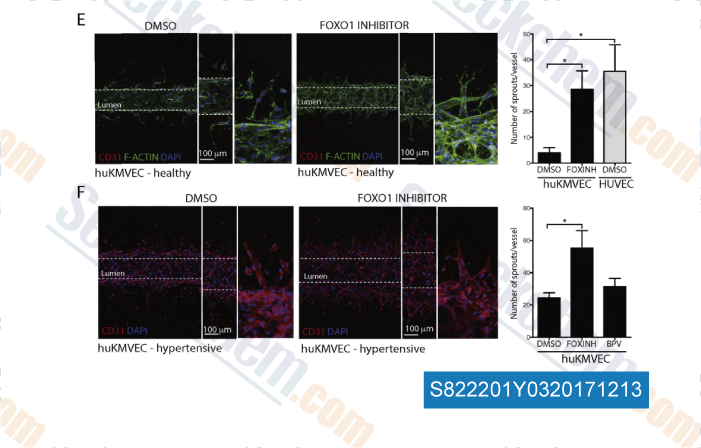
-
Daten von [ , , Biomaterials, 2017, 141:314-329 ]
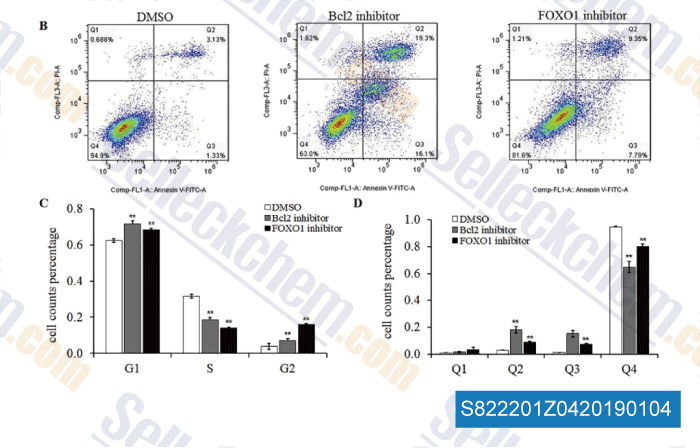
-
Daten von [ , , Biochim Biophys Acta Gene Regul Mech, 2017, 1860(6):674-684 ]
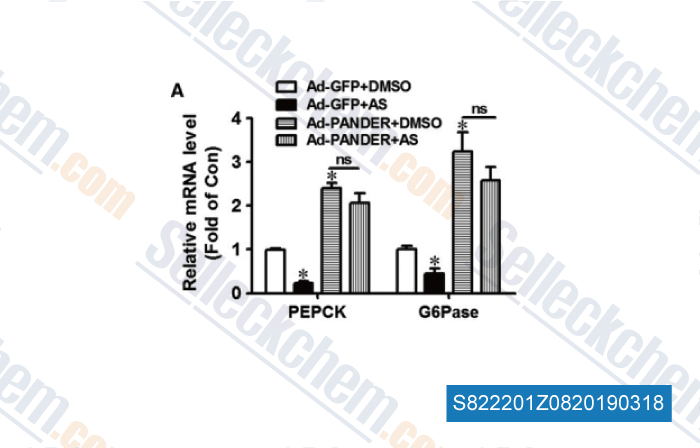
-
Daten von [ , , J Cell Mol Med, 2018, doi:10.1111/jcmm.14073 ]
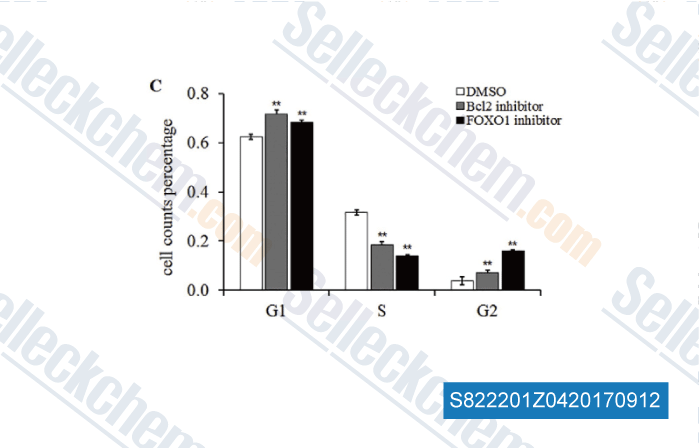
-
Daten von [ , , Biochim Biophys Acta, 2017, 1860(6):674-684 ]
Sellecks AS1842856 Wurde zitiert von 46 Publikationen
| Synthetic organochlorines exert bone anabolic activity by modulating CCN3 signaling in osteoblasts [ Environ Int, 2025, 205:109862] | PubMed: 41124813 |
| 1,25-dihydroxyvitamin D3 attenuates type 1 diabetes-related myocardial apoptosis and fibrosis by influencing the interaction of FoxO1 and p-Smad3 [ Int Immunopharmacol, 2025, 162:115128] | PubMed: 40555153 |
| FOXO1 enhances G6PD expression to promote cancer cell antioxidative capacity [ J Mol Cell Biol, 2025, mjaf021] | PubMed: 41124013 |
| Propofol in combination with salvianolic acid A protect against lipopolysaccharide-induced cardiac dysfunction and ferroptosis through activating the SIRT1/FoxO1 signaling under diabetic condition [ Ann Med, 2025, 57(1):2570796] | PubMed: 41066684 |
| The interplay between FOXO1 and glucocorticoid signaling in promoting the terminal differentiation of somatotropes [ Mol Cell Endocrinol, 2025, 606:112573] | PubMed: 40381980 |
| Fibulin1 as a Novel Target for Promoting the Biological Function of Bone Marrow Mesenchymal Stem Cells and Implant Osseointegration in Diabetic Patients [ Int Dent J, 2025, 75(6):103928] | PubMed: 41075460 |
| GYY4137 protects against type 2 diabetes mellitus-associated myocardial autophagy by suppressing FOXO1 signal pathway [ Anim Cells Syst (Seoul), 2025, 29(1):13-23] | PubMed: 39777025 |
| FoxO1/Rictor axis induces a nongenetic adaptation to ibrutinib via Akt activation in chronic lymphocytic leukemia [ J Clin Invest, 2024, 134(23)e173770] | PubMed: 39436708 |
| Genetic and pharmacological targeting of XBP1 alleviates hepatic ischemia reperfusion injury by enhancing FoxO1-dependent mitophagy [ Transl Res, 2024, S1931-5244(24)00051-3] | PubMed: 38494125 |
| Hyperglycemia-induced Sirt3 downregulation increases microglial aerobic glycolysis and inflammation in diabetic neuropathic pain pathogenesis [ CNS Neurosci Ther, 2024, 30(8):e14913] | PubMed: 39123294 |
RÜCKGABERICHTLINIE
Die bedingungslose Rückgaberichtlinie von Selleck Chemical gewährleistet unseren Kunden ein reibungsloses Online-Einkaufserlebnis. Wenn Sie in irgendeiner Weise mit Ihrem Kauf unzufrieden sind, können Sie jeden Artikel innerhalb von 7 Tagen nach Erhalt zurückgeben. Im Falle von Produktqualitätsproblemen, sei es protokollbezogene oder produktbezogene Probleme, können Sie jeden Artikel innerhalb von 365 Tagen ab dem ursprünglichen Kaufdatum zurückgeben. Bitte befolgen Sie die nachstehenden Anweisungen, wenn Sie Produkte zurücksenden.
VERSAND UND LAGERUNG
Selleck-Produkte werden bei Raumtemperatur transportiert. Wenn Sie das Produkt bei Raumtemperatur erhalten, seien Sie versichert, dass die Qualitätskontrollabteilung von Selleck Experimente durchgeführt hat, um zu überprüfen, dass die normale Temperaturplatzierung von einem Monat die biologische Aktivität von Pulverprodukten nicht beeinträchtigt. Nach dem Sammeln lagern Sie das Produkt bitte gemäß den in der Datenblatt beschriebenen Anforderungen. Die meisten Selleck-Produkte sind unter den empfohlenen Bedingungen stabil.
NICHT FÜR DIE ANWENDUNG AM MENSCHEN, FÜR VETERINÄRMEDIZINISCHE DIAGNOSTIK ODER THERAPEUTISCHE ZWECKE.