
Technische Daten
| Formel | C32H43N5O4 |
||||||
| Molekulargewicht | 561.71 | CAS-Nr. | 1071992-99-8 | ||||
| Löslichkeit (25°C)* | In vitro | DMSO | 112 mg/mL (199.39 mM) | ||||
| Ethanol | 112 mg/mL (199.39 mM) | ||||||
| Water | Insoluble | ||||||
| In vivo (Lösungsmittel einzeln und der Reihe nach zum Produkt hinzufügen.) |
|
||||||
|
* <1 mg/ml bedeutet schwer löslich oder unlöslich. * Bitte beachten Sie, dass Selleck die Löslichkeit aller Verbindungen intern testet und die tatsächliche Löslichkeit geringfügig von veröffentlichten Werten abweichen kann. Dies ist normal und ist auf geringfügige Batch-zu-Batch-Variationen zurückzuführen. * Versand bei Raumtemperatur (Stabilitätstests zeigen, dass dieses Produkt ohne Kühlmaßnahmen versendet werden kann.) |
|||||||
Vorbereitung von Stammlösungen
Biologische Aktivität
| Beschreibung | Xevinapant (AT406, ARRY-334543, Debio1143, SM-406) ist ein potenter Smac-Mimetikum und ein Antagonist von IAP (Inhibitor des Apoptose-Proteins über E3 Ubiquitinligase), der an XIAP-BIR3, cIAP1-BIR3 und cIAP2-BIR3 mit Ki von 66,4 nM, 1,9 nM und 5,1 nM bindet, 50- bis 100-fach höhere Affinitäten als das Smac AVPI-Peptid. Phase 1. | ||||||
|---|---|---|---|---|---|---|---|
| Ziele |
|
||||||
| In vitro | AT-406 ist ein Smac-Mimetikum und scheint das AVPI-Peptid sowohl in Wasserstoffbrückenbindungen als auch in hydrophoben Wechselwirkungen mit XIAP genau nachzuahmen, mit zusätzlichen hydrophoben Kontakten mit W323 von XIAP. AT-406 ist empfindlicher gegenüber diesen IAPs als das Smac AVPI-Peptid, mit 50-100-fach höheren Bindungsaffinitäten. AT-406 (bei 1 μM) stellt die Aktivität von Caspase-9 vollständig wieder her, die durch 500 nM XIAP BIR3 in einem zellfreien System unterdrückt wird. In MDA-MB-231-Zellen induziert AT-406 einen schnellen zellulären cIAP1-Abbau und zieht auch das zelluläre XIAP-Protein herunter. AT-406 hemmt effektiv viele menschliche Krebszelllinien und zeigt IC50-Werte von 144 und 142 nM in MDA-MB-231-Zellen und SK-OV-3-Ovarialzellen, mit geringer Toxizität gegenüber normalen menschlichen Brustepithelzellen (MCF-12F) und primären menschlichen normalen Prostataepithelzellen. AT-406 induziert Apoptosis in MDA-MB-231-Zellen durch Induktion der Aktivierung von Caspase-3 und Spaltung von PARP. | ||||||
| In vivo | AT-406 weist gute pharmakokinetische (PK) Eigenschaften und eine orale Bioverfügbarkeit bei Mäusen, Ratten, nicht-humanen Primaten und Hunden auf. Im MDA-MB-231-Xenograft induziert AT-406 effektiv den cIAP1-Abbau und die Prozessierung von Procaspase-8 sowie die Spaltung von PARP in Tumorgeweben bei 100 mg/kg mit guter Verträglichkeit sogar bei 200 mg/kg. AT-406 induziert eine signifikante Tumorwachstumshemmung mit p von 0,0012 bei 100 mg/kg. |
Protokoll (aus Referenz)
| Kinase-Assay: |
|
|---|---|
| Zell-Assay: |
|
| Tierstudie: |
|
Referenzen
|
Kundenproduktvalidierung
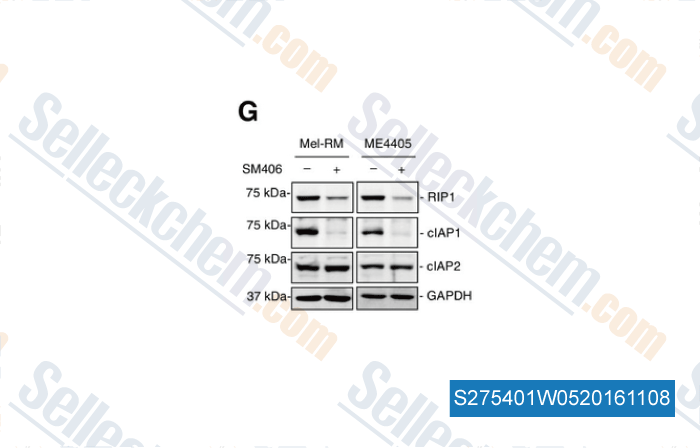
-
, , Cancer Res, 2015, 75(8):1736-48.
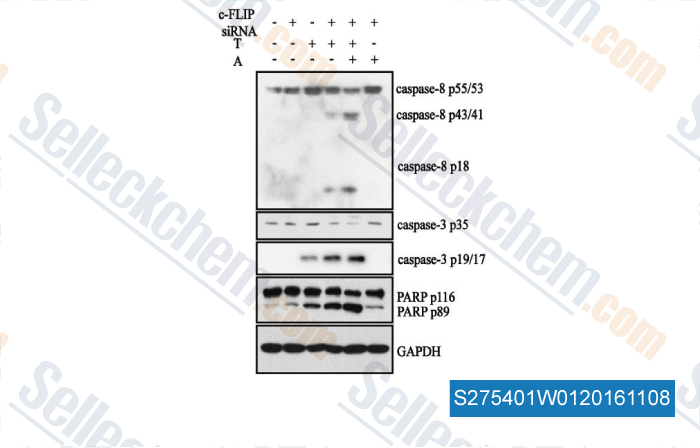
-
, , Int J Oncol, 2016, 49(1):153-63.
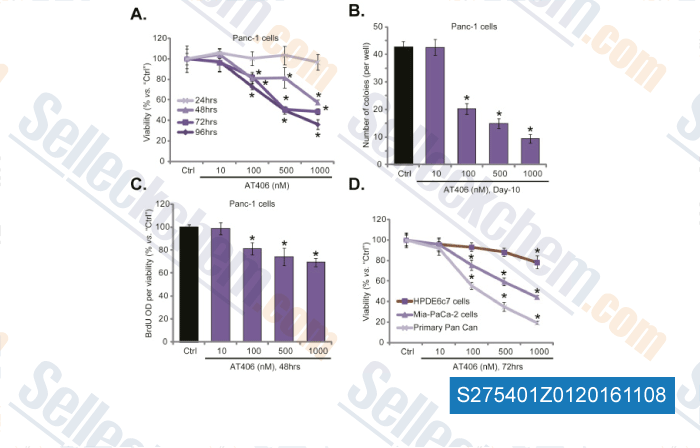
-
, , Biochem Biophys Res Commun, 2016, 478(1):293-9.
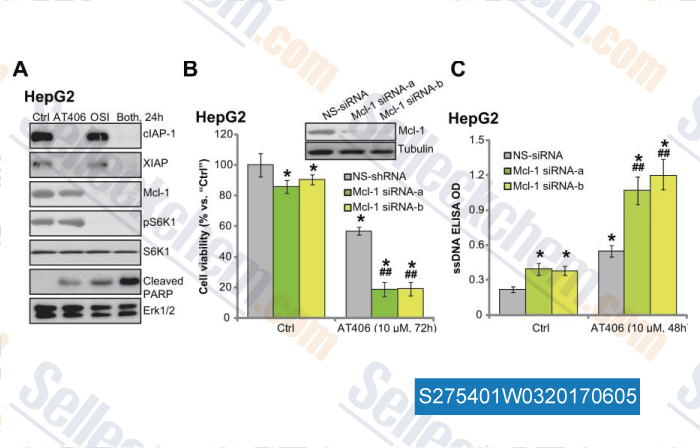
-
Daten von [ , , Oncotarget, 2017, 8(6):9466-9475 ]
Sellecks Xevinapant (AT406) Wurde zitiert von 39 Publikationen
| Caspase 9-induced apoptosis enables efficient fetal cell ablation and disease modeling [ Nat Commun, 2025, 16(1):2572] | PubMed: 40089478 |
| The cancer-associated SF3B1K700E spliceosome mutation confers enhanced sensitivity to BV-6-induced cytotoxicity [ Cell Death Dis, 2025, 16(1):476] | PubMed: 40595498 |
| Potentiating CAR-T bystander killing by enhanced Fas/FasL signaling mitigates antigen escape in heterogeneous tumors [ bioRxiv, 2025, 2025.09.22.677496] | PubMed: 41040218 |
| Complex IIa formation and ABC transporters determine sensitivity of OSCC to Smac mimetics [ Cell Death Dis, 2024, 15(11):855] | PubMed: 39578442 |
| Combination Treatment of Resistant Acute Promyelocytic Leukemia Cells with Arsenic Trioxide and Anti-Apoptotic Gene Inhibitors [ Pharmaceuticals (Basel), 2024, 17(11)1529] | PubMed: 39598439 |
| The Effect of Xevinapant Combined with Ionizing Radiation on HNSCC and Normal Tissue Cells and the Impact of Xevinapant on Its Targeted Proteins cIAP1 and XIAP [ Cells, 2023, 12(12)1653] | PubMed: 37371123 |
| Mycoplasma hyorhinis infection promotes TNF-α signaling and SMAC mimetic-mediated apoptosis in human prostate cancer [ Heliyon, 2023, 9(10):e20655] | PubMed: 37867861 |
| CD137 (4-1BB) requires physically associated cIAPs for signal transduction and antitumor effects [ Sci Adv, 2023, 9(33):eadf6692] | PubMed: 37595047 |
| CD4+ T cell-mimicking nanoparticles encapsulating DIABLO/SMAC mimetics broadly neutralize HIV-1 and selectively kill HIV-1-infected cells [ Theranostics, 2021, 11(18):9009-9021] | PubMed: 34522224 |
| Targeting c-IAP1, c-IAP2, and Bcl-2 Eliminates Senescent Glioblastoma Cells Following Temozolomide Treatment [ Cancers (Basel), 2021, 13(14)3585] | PubMed: 34298797 |
RÜCKGABERICHTLINIE
Die bedingungslose Rückgaberichtlinie von Selleck Chemical gewährleistet unseren Kunden ein reibungsloses Online-Einkaufserlebnis. Wenn Sie in irgendeiner Weise mit Ihrem Kauf unzufrieden sind, können Sie jeden Artikel innerhalb von 7 Tagen nach Erhalt zurückgeben. Im Falle von Produktqualitätsproblemen, sei es protokollbezogene oder produktbezogene Probleme, können Sie jeden Artikel innerhalb von 365 Tagen ab dem ursprünglichen Kaufdatum zurückgeben. Bitte befolgen Sie die nachstehenden Anweisungen, wenn Sie Produkte zurücksenden.
VERSAND UND LAGERUNG
Selleck-Produkte werden bei Raumtemperatur transportiert. Wenn Sie das Produkt bei Raumtemperatur erhalten, seien Sie versichert, dass die Qualitätskontrollabteilung von Selleck Experimente durchgeführt hat, um zu überprüfen, dass die normale Temperaturplatzierung von einem Monat die biologische Aktivität von Pulverprodukten nicht beeinträchtigt. Nach dem Sammeln lagern Sie das Produkt bitte gemäß den in der Datenblatt beschriebenen Anforderungen. Die meisten Selleck-Produkte sind unter den empfohlenen Bedingungen stabil.
NICHT FÜR DIE ANWENDUNG AM MENSCHEN, FÜR VETERINÄRMEDIZINISCHE DIAGNOSTIK ODER THERAPEUTISCHE ZWECKE.