
|
Wie zu zitieren 1. Für Zitate im Text (Materialien & Methoden): 2. Für die Tabelle der Schlüsselressourcen: |
||
|
Gebührenfrei: (877) 796-6397 -- Nur USA und Kanada -- |
Fax: +1-832-582-8590 Bestellungen: +1-832-582-8158 |
Technischer Support: +1-832-582-8158 Ext:3 Bitte geben Sie Ihre Bestellnummer in der E-Mail an. Wir bemühen uns, alle E-Mail-Anfragen innerhalb eines Werktages zu beantworten. |
Technische Daten
| CAS-Nr. | 1380723-44-3 |
|---|---|
| Formel | 100 mM Pro-Ac, 20mM Arg, pH5.0 |
| Isotyp | Human IgG1 |
| Quelle | CHO cells |
| Lagerung (Ab dem Datum des Erhalts) |
Store the undiluted solution at 4°C in the dark to avoid freeze-thaw cycles |
| Reinheit | 99% |
| Proteinkonzentration: | 7.249mg/ml |
| Endotoxinspiegel | <1EU/mg |
Biologische Aktivität
| Beschreibung | Atezolizumab (anti-PD-L1) ist ein vollständig humanisierter, monoklonaler IgG1-Antikörper, der die Interaktion von PD-L1 mit sowohl PD-1 als auch B7.1 blockiert, aber nicht die Interaktion von PD-L2 mit PD-1. MW: 145 KD. | ||
|---|---|---|---|
| Ziele |
|
||
| In vitro | Die Behandlung mit Atezolizumab als Einzelwirkstoff zeigte eine moderate antiproliferative Wirkung mit ~ 30 % Zelltod in allen Modellen. |
||
| In vivo | Wenn dual beladene, Core-Shell-Nanopartikel (DLTPT) in Kombination mit anti-PD-L1 verwendet werden, wird das Tumorwachstum gehemmt, was eine Immunantwort gegen die Tumormetastasierung induziert. |
Protokoll (nur als Referenz)
| Zell-Assay: |
|
|---|---|
| Tierstudie: |
|
| Referenzen |
|
|---|
Kundenproduktvalidierung
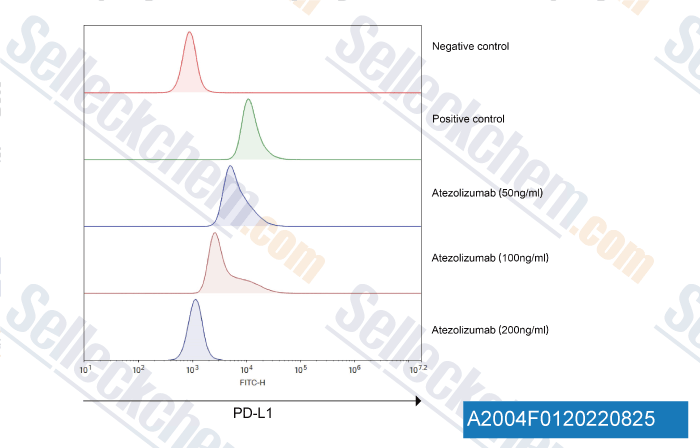
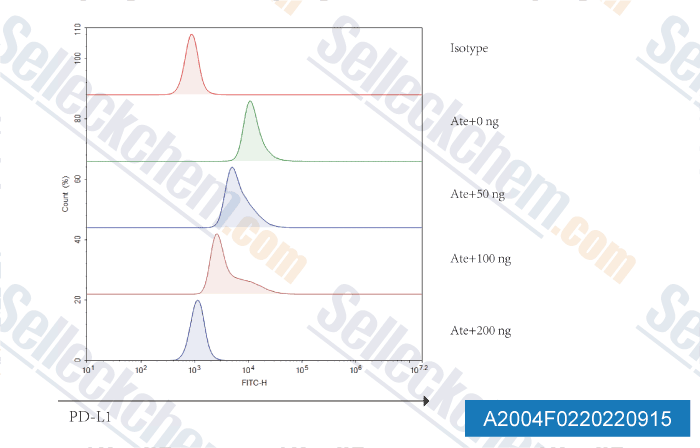
.gif)
Sellecks Atezolizumab (anti-PD-L1) Wurde zitiert von 73 Publikationen
| Tebentafusp, a T cell engager, promotes macrophage reprogramming and in combination with IL-2 overcomes macrophage immunosuppression in cancer [ Nat Commun, 2025, 16(1):2374] |
https://www.ncbi.nlm.nih.gov/pubmed/?term=40064880 |
| Harnessing the FGFR2/NF2/YAP signaling-dependent necroptosis to develop an FGFR2/IL-8 dual blockade therapeutic strategy [ Nat Commun, 2025, 16(1):4128] |
https://www.ncbi.nlm.nih.gov/pubmed/?term=40319089 |
| DCC-2036 induces repolarization of TAMs to M1 type and enhances CD8+ T cell immunity in TNBC [ Mol Ther, 2025, S1525-0016(25)00863-9] |
https://www.ncbi.nlm.nih.gov/pubmed/?term=41137391 |
| PD-L1 regulates c-MET phosphorylation and contributes to MET-dependent resistance to osimertinib in EGFR-mutant NSCLC [ J Biomed Sci, 2025, 32(1):94] |
https://www.ncbi.nlm.nih.gov/pubmed/?term=41068729 |
| In situ and dynamic screening of extracellular vesicles as predictive biomarkers in immune-checkpoint inhibitor therapies [ J Nanobiotechnology, 2025, 23(1):411] |
https://www.ncbi.nlm.nih.gov/pubmed/?term=40457452 |
| IGM-7354, an Immunocytokine with IL15 Fused to an Anti-PD-L1 IgM, Induces NK and CD8+ T cell-Mediated Cytotoxicity of PD-L1-Positive Tumor Cells [ Cancer Immunol Res, 2025, 13(8):1172-1189] |
https://www.ncbi.nlm.nih.gov/pubmed/?term=40402523 |
| Addition of metformin to anti-PD-1/PD-L1 drugs activates anti-tumor immune response in peripheral immune cells of NSCLC patients [ Cell Death Dis, 2025, 16(1):286] |
https://www.ncbi.nlm.nih.gov/pubmed/?term=40221409 |
| Using extension-based mRNA display to design antibody-like proteinogenic peptides for human PD-L1 [ Protein Sci, 2025, 34(9):e70268] |
https://www.ncbi.nlm.nih.gov/pubmed/?term=40852896 |
| PD-L1 and IFN-γ modulate Non-Small Cell Lung Cancer (NSCLC) cell plasticity associated to immune checkpoint inhibitor (ICI)-mediated hyperprogressive disease (HPD) [ J Transl Med, 2025, 23(1):2] |
https://www.ncbi.nlm.nih.gov/pubmed/?term=39748404 |
| NSUN2/ALYREF axis-driven m5C methylation enhances PD-L1 expression and facilitates immune evasion in non-small-cell lung cancer [ Cancer Immunol Immunother, 2025, 74(4):132] |
https://www.ncbi.nlm.nih.gov/pubmed/?term=40029463 |
NUR FÜR FORSCHUNGSZWECKE. NICHT ZUR ANWENDUNG AM MENSCHEN.
Spezifische Lagerungs- und Handhabungsinformationen für jedes Produkt sind auf dem Produktdatenblatt angegeben. Die meisten Selleck-Produkte sind unter den empfohlenen Bedingungen stabil. Produkte werden manchmal bei einer Temperatur versandt, die von der empfohlenen Lagertemperatur abweicht. Die kurzfristige Lagerung vieler Produkte ist kurzfristig bei Temperaturen stabil, die von der für die Langzeitlagerung erforderlichen Temperatur abweichen.
Wir stellen sicher, dass das Produkt unter Bedingungen versandt wird, die die Qualität der Reagenzien aufrechterhalten. Befolgen Sie nach Erhalt des Produkts die Lagerungsempfehlungen auf dem Produktdatenblatt.