
Technische Daten
| Formel | C55H85N17O25S4 |
||||||
| Molekulargewicht | 1512.62 | CAS-Nr. | 9041-93-4 | ||||
| Löslichkeit (25°C)* | In vitro | DMSO | 100 mg/mL (66.11 mM) | ||||
| Water | 25 mg/mL (16.52 mM) | ||||||
| Ethanol | Insoluble | ||||||
| In vivo (Lösungsmittel einzeln und der Reihe nach zum Produkt hinzufügen.) |
|
||||||
|
* <1 mg/ml bedeutet schwer löslich oder unlöslich. * Bitte beachten Sie, dass Selleck die Löslichkeit aller Verbindungen intern testet und die tatsächliche Löslichkeit geringfügig von veröffentlichten Werten abweichen kann. Dies ist normal und ist auf geringfügige Batch-zu-Batch-Variationen zurückzuführen. * Versand bei Raumtemperatur (Stabilitätstests zeigen, dass dieses Produkt ohne Kühlmaßnahmen versendet werden kann.) |
|||||||
Vorbereitung von Stammlösungen
Biologische Aktivität
| Beschreibung | Bleomycin sulfate ist ein Glycopeptid-Antibiotikum und ein DNA synthesis inhibitor sowie ein Antikrebsmittel für Plattenepithelkarzinome (SCC) mit einer IC50 von 4 nM in UT-SCC-19A-Zellen. Bleomycin sulfate ist ein DNA synthesis inhibitor. Bleomycin (NSC125066) sulfate kann zur Induktion von Tiermodellen der Lungenfibrose verwendet werden. |
|---|---|
| In vitro | UT-SCC-12A und UT-SCC-12B sind beide resistenter gegenüber Bleomycin sulfate mit IC50 von 14,2 nM bzw. 13 nM. Alveoläre Makrophagen, die 18 Stunden lang mit 0,01 μg/mL bis 1μg/mL dieser Verbindung inkubiert wurden, sezernieren signifikant mehr Fibroblasten-Wachstumsfaktor als Makrophagen, die ohne diese Chemikalie inkubiert wurden. Makrophagen, die mit dieser Verbindung stimuliert wurden, produzieren weiterhin signifikante Mengen an Fibroblasten-Wachstumsfaktor, selbst nachdem diese Chemikalie entfernt und durch frisches (Bleomycin sulfate-freies) Medium ersetzt wurde. Die Sekretion von Fibroblasten-Wachstumsfaktor durch diese Verbindung-stimulierte alveoläre Makrophagen wird durch Cycloheximid und die 5-Lipoxygenase-Inhibitoren NDGA (Nordihydroguajaretsäure) und BW755c gehemmt, was nicht nur einen Bedarf an Proteinsynthese, sondern auch an Metaboliten des 5-Lipoxygenase-Wegs des Arachidonsäurestoffwechsels für die volle Expression der Aktivität anzeigt. Diese Chemikalie (400 µg/mL) Inkubation für 24 Stunden verringert die Lebensfähigkeit von NTera-2-Zellen und erhöht die Caspase-3-, -8- und -9-Aktivitäten, Bax- und zytoplasmatische Cytochrom c-Spiegel und verringert die Bcl-2-Spiegel. Bei instabilen Aberrationen bleibt die klastogene Wirkung dieser Verbindung auf ADIPO-P2-Zellen mindestens 10 Tage nach der Exposition bestehen. Die durch diese Chemikalie induzierte Telomerinstabilität in Säugetierzellen hält nach der Exposition mehrere Generationen an. Darüber hinaus deutet das Auftreten von Telomerfusionen in den mit dieser Verbindung exponierten Zellen 10 Tage nach der Behandlung darauf hin, dass diese Chemikalie eine verzögerte Telomerinstabilität induzieren kann. |
| In vivo | Tag 7 nach Bleomycin sulfate, CD45+ Zellen in BALf in NOX-/- sind 1,7-fach > WT, von denen 57% Mf sind, die bis Tag 21 in WT um 67% und in NOX-/- um 83% abnehmen. |
Protokoll (aus Referenz)
| Zell-Assay: |
|
|---|---|
| Tierstudie: |
|
Referenzen
|
Kundenproduktvalidierung
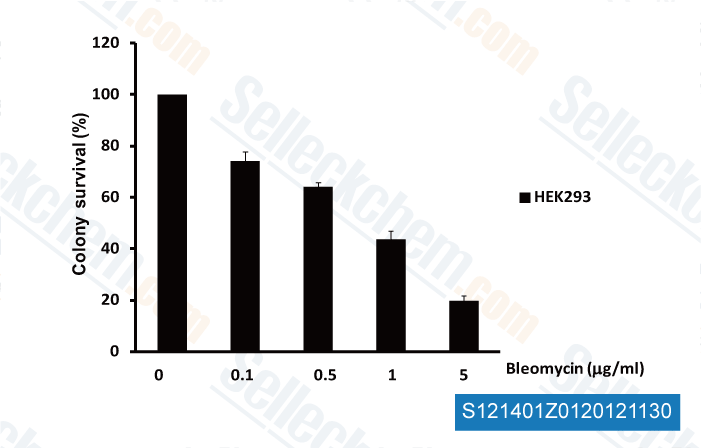
-
Daten von [ AACR Elizabeth williamson from university of florida. , 2011 ]
Sellecks Bleomycin sulfate Wurde zitiert von 165 Publikationen
| Nuclear pores safeguard the integrity of the nuclear envelope [ Nat Cell Biol, 2025, 10.1038/s41556-025-01648-3] | PubMed: 40205196 |
| S1PR1-biased activation drives the resolution of endothelial dysfunction-associated inflammatory diseases by maintaining endothelial integrity [ Nat Commun, 2025, 16(1):1826] | PubMed: 39979282 |
| The CCL20-integrin α5β1 interaction enhances TGF-β/Smad signaling to promote fibroblast activation in pulmonary fibrosis [ Nat Commun, 2025, 16(1):9183] | PubMed: 41102188 |
| Senescent Fibroblasts Drive FAP/OLN Imbalance Through mTOR Signaling to Exacerbate Inflammation and Bone Resorption in Periodontitis [ Adv Sci (Weinh), 2025, 12(7):e2409398] | PubMed: 39716898 |
| Cathepsin K Aggravates Pulmonary Fibrosis Through Promoting Fibroblast Glutamine Metabolism and Collagen Synthesis [ Adv Sci (Weinh), 2025, 12(34):e13017] | PubMed: 40605618 |
| Methylated circPTK2 as a driver of fibroblast activation in pulmonary fibrosis [ Mol Ther, 2025, S1525-0016(25)01036-6] | PubMed: 41376162 |
| Histone methyltransferase KMT2A promotes pulmonary fibrogenesis via targeting pro-fibrotic factor PU.1 in fibroblasts [ Clin Transl Med, 2025, 15(2):e70217] | PubMed: 39888275 |
| Inhibition of 11β-hydroxysteroid dehydrogenase 1 alleviates pulmonary fibrosis through inhibition of endothelial-to-mesenchymal transition and M2 macrophage polarization by upregulating heme oxygenase-1 [ Cell Death Dis, 2025, 16(1):196] | PubMed: 40118823 |
| CITK modulates BRCA1 recruitment at DNA double strand breaks sites through HDAC6 [ Cell Death Dis, 2025, 16(1):320] | PubMed: 40254670 |
| Analysis of the therapeutic effect and potential mechanism of Fe3O4-polydopamine nanoparticles in enhancing mesenchymal stem cells therapy for pulmonary fibrosis [ Mater Today Bio, 2025, 34:102098] | PubMed: 40735701 |
RÜCKGABERICHTLINIE
Die bedingungslose Rückgaberichtlinie von Selleck Chemical gewährleistet unseren Kunden ein reibungsloses Online-Einkaufserlebnis. Wenn Sie in irgendeiner Weise mit Ihrem Kauf unzufrieden sind, können Sie jeden Artikel innerhalb von 7 Tagen nach Erhalt zurückgeben. Im Falle von Produktqualitätsproblemen, sei es protokollbezogene oder produktbezogene Probleme, können Sie jeden Artikel innerhalb von 365 Tagen ab dem ursprünglichen Kaufdatum zurückgeben. Bitte befolgen Sie die nachstehenden Anweisungen, wenn Sie Produkte zurücksenden.
VERSAND UND LAGERUNG
Selleck-Produkte werden bei Raumtemperatur transportiert. Wenn Sie das Produkt bei Raumtemperatur erhalten, seien Sie versichert, dass die Qualitätskontrollabteilung von Selleck Experimente durchgeführt hat, um zu überprüfen, dass die normale Temperaturplatzierung von einem Monat die biologische Aktivität von Pulverprodukten nicht beeinträchtigt. Nach dem Sammeln lagern Sie das Produkt bitte gemäß den in der Datenblatt beschriebenen Anforderungen. Die meisten Selleck-Produkte sind unter den empfohlenen Bedingungen stabil.
NICHT FÜR DIE ANWENDUNG AM MENSCHEN, FÜR VETERINÄRMEDIZINISCHE DIAGNOSTIK ODER THERAPEUTISCHE ZWECKE.