
Technische Daten
| Formel | C28H24FN3O5.C4H6O5 |
||||||
| Molekulargewicht | 635.59 | CAS-Nr. | 1140909-48-3 | ||||
| Löslichkeit (25°C)* | In vitro | DMSO | 100 mg/mL (157.33 mM) | ||||
| Water | Insoluble | ||||||
| Ethanol | Insoluble | ||||||
| In vivo (Lösungsmittel einzeln und der Reihe nach zum Produkt hinzufügen.) |
|
||||||
|
* <1 mg/ml bedeutet schwer löslich oder unlöslich. * Bitte beachten Sie, dass Selleck die Löslichkeit aller Verbindungen intern testet und die tatsächliche Löslichkeit geringfügig von veröffentlichten Werten abweichen kann. Dies ist normal und ist auf geringfügige Batch-zu-Batch-Variationen zurückzuführen. * Versand bei Raumtemperatur (Stabilitätstests zeigen, dass dieses Produkt ohne Kühlmaßnahmen versendet werden kann.) |
|||||||
Vorbereitung von Stammlösungen
Biologische Aktivität
| Beschreibung | Cabozantinib malate (XL184) ist das Malat von Cabozantinib, einem potenten VEGFR2-Inhibitor mit einer IC50 von 0,035 nM, der auch c-Met, Ret (c-Ret), Kit (c-Kit), Flt-1/3/4, Tie2 und AXL mit einer IC50 von 1,3 nM, 4 nM, 4,6 nM, 12 nM/11,3 nM/6 nM, 14,3 nM bzw. 7 nM in zellfreien Assays hemmt. Diese Verbindung induziert Apoptose. | |||||||||||
|---|---|---|---|---|---|---|---|---|---|---|---|---|
| Ziele |
|
|||||||||||
| In vitro | Cabozantinib malate hat eine schwache hemmende Aktivität gegen RON und PDGFRβ mit einer IC50 von 124 nM bzw. 234 nM und eine geringe Aktivität gegen FGFR1 mit einer IC50 von 5,294 μM. Diese Verbindung ist in geringer Konzentration (0,1-0,5 μM) ausreichend, um eine ausgeprägte Hemmung der konstitutiven und induzierbaren Met-Phosphorylierung und der daraus resultierenden nachgeschalteten Signalübertragung in MPNST-Zellen zu induzieren und die HGF-induzierte Migration und Invasion von MPNST-Zellen zu hemmen. Sie induziert auch eine ausgeprägte Hemmung der Met- und VEGFR2-Phosphorylierung in Zytokin-stimulierten humanen Nabelschnurvenen-Endothelzellen (HUVECs). Obwohl diese Chemikalie bei 0,1 μM keinen signifikanten Effekt auf das MPNST-Zellwachstum hat, hemmt sie bei 5-10 μM das MPNST-Zellwachstum signifikant. | |||||||||||
| In vivo | Die Behandlung mit Cabozantinib malate bei 30 mg/kg in RIP-Tag2-Mäusen mit spontanen Pankreasinselzelltumoren stört 83% der Tumorgefäße, reduziert Perizyten und leere Basalmembranhülsen, verursacht weit verbreitete intratumorale Hypoxie und ausgedehnte Tumorzellapoptose und verlangsamt das Nachwachsen der Tumorgefäße nach dem Entzug des Medikaments, signifikant stärker im Vergleich zu XL999, das VEGFR, aber nicht c-Met blockiert und nur eine 43%ige Reduktion der Vaskularität bewirkt. Dies deutet darauf hin, dass die gleichzeitige Hemmung von VEGFR und anderen funktionell relevanten Rezeptor-Tyrosinkinasen (RTK) die Angiogenesehemmung verstärkt. Diese Verbindung verringert auch die Invasivität primärer Tumoren und reduziert die Metastasierung. Diese Chemikalie hemmt bei 30 mg/kg/Tag signifikant das Wachstum von humanen MPNST-Xenotransplantaten und die Metastasierung in SCID-Mäusen. Die Verabreichung dieser Verbindung induziert eine dosisabhängige Hemmung des Tumorwachstums in Brust-, Lungen- und Gliom-Tumormodellen, verbunden mit einer verminderten Proliferation von Tumor- und Endothelzellen sowie einer erhöhten Apoptose. Eine einzelne orale Dosis dieser Chemikalie ist ausreichend, um eine anhaltende Hemmung des Tumorwachstums in MDA-MB-231-tumortragenden Mäusen und C6-tumortragenden Ratten bei 100 mg/kg bzw. 10 mg/kg zu induzieren. |
Protokoll (aus Referenz)
| Zell-Assay: |
|
|---|---|
| Tierstudie: |
|
Referenzen
|
Kundenproduktvalidierung
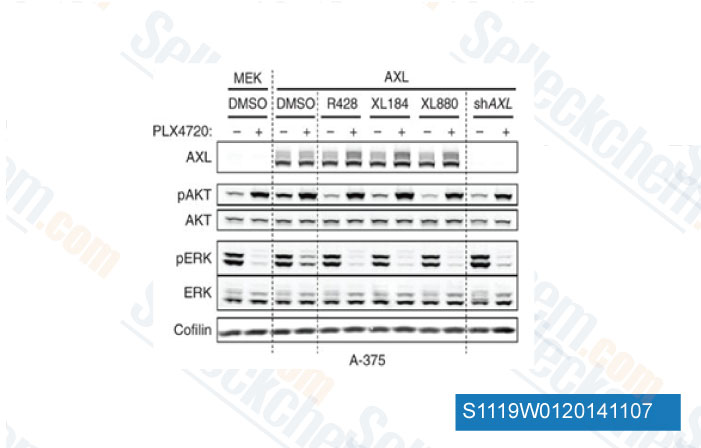
-
Daten von [ Cancer Discov , 2014 , 4(7), 816-27 ]
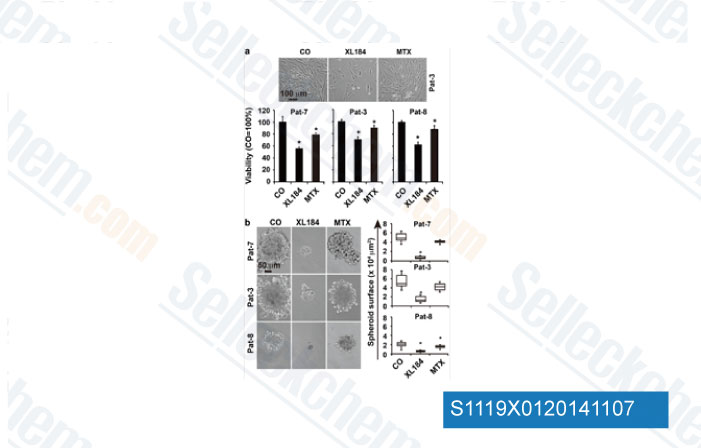
-
Daten von [ Cell Death Dis , 2014 , 5, e1471 ]
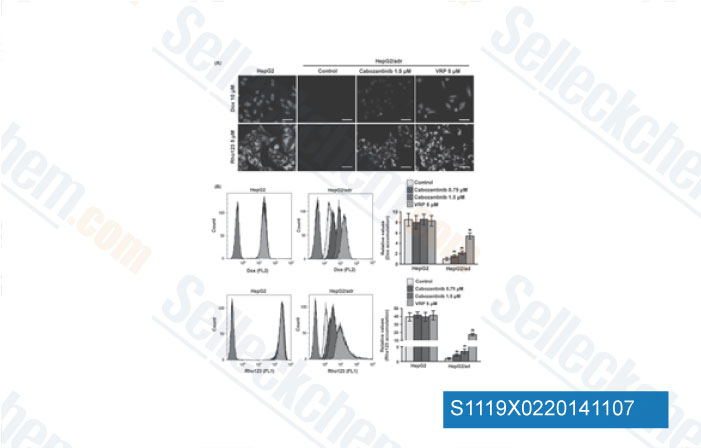
-
Daten von [ Liver Int , 2014 , 10.1111/liv.12524 ]
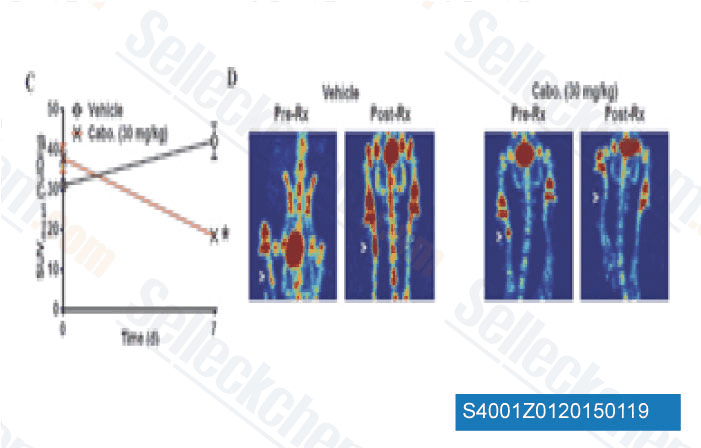
-
Daten von [ Mol Imaging , 2014 , 10.2310/7290.2014.00026 ]
Sellecks Cabozantinib malate Wurde zitiert von 110 Publikationen
| Biofabrication of pheochromocytoma and paraganglioma tumor organoids and assessment of response to systemic therapy [ Sci Rep, 2025, 15(1):35889] | PubMed: 41087622 |
| Tyrosine kinase inhibitors affect sweet taste and dysregulate fate selection of specific taste cell subtypes via KIT inhibition [ bioRxiv, 2025, 2025.08.15.670608] | PubMed: 40894646 |
| Piezo1 regulates meningeal lymphatic vessel drainage and alleviates excessive CSF accumulation [ Nat Neurosci, 2024, 10.1038/s41593-024-01604-8] | PubMed: 38528202 |
| Patient-derived rhabdomyosarcoma cells recapitulate the genetic and transcriptomic landscapes of primary tumors [ iScience, 2024, 27(10):110862] | PubMed: 39319271 |
| A subset of VEGFR-TKIs activates AMPK in LKB1-mutant lung cancer [ Cancer Sci, 2023, 114(4):1651-1662] | PubMed: 36459496 |
| Identification of therapeutic sensitivities in a spheroid drug combination screen of Neurofibromatosis Type I associated High Grade Gliomas [ PLoS One, 2023, 18(2):e0277306] | PubMed: 36730269 |
| Rapid Profiling of Tumor-Immune Interaction Using Acoustically Assembled Patient-Derived Cell Clusters [ Adv Sci (Weinh), 2022, e2201478] | PubMed: 35611994 |
| CIC-mediated modulation of MAPK signaling opposes receptor tyrosine kinase inhibitor response in kinase-addicted sarcoma [ Cancer Res, 2022, canres.1397.2021] | PubMed: 35074756 |
| Targeting PEA3 transcription factors to mitigate small cell lung cancer progression [ Oncogene, 2022, 10.1038/s41388-022-02558-6] | PubMed: 36509998 |
| Plasma extracellular vesicle long RNA profiles in the diagnosis and prediction of treatment response for breast cancer [ Cancers (Basel), 2022, 14(7)1683] | PubMed: 35406455 |
RÜCKGABERICHTLINIE
Die bedingungslose Rückgaberichtlinie von Selleck Chemical gewährleistet unseren Kunden ein reibungsloses Online-Einkaufserlebnis. Wenn Sie in irgendeiner Weise mit Ihrem Kauf unzufrieden sind, können Sie jeden Artikel innerhalb von 7 Tagen nach Erhalt zurückgeben. Im Falle von Produktqualitätsproblemen, sei es protokollbezogene oder produktbezogene Probleme, können Sie jeden Artikel innerhalb von 365 Tagen ab dem ursprünglichen Kaufdatum zurückgeben. Bitte befolgen Sie die nachstehenden Anweisungen, wenn Sie Produkte zurücksenden.
VERSAND UND LAGERUNG
Selleck-Produkte werden bei Raumtemperatur transportiert. Wenn Sie das Produkt bei Raumtemperatur erhalten, seien Sie versichert, dass die Qualitätskontrollabteilung von Selleck Experimente durchgeführt hat, um zu überprüfen, dass die normale Temperaturplatzierung von einem Monat die biologische Aktivität von Pulverprodukten nicht beeinträchtigt. Nach dem Sammeln lagern Sie das Produkt bitte gemäß den in der Datenblatt beschriebenen Anforderungen. Die meisten Selleck-Produkte sind unter den empfohlenen Bedingungen stabil.
NICHT FÜR DIE ANWENDUNG AM MENSCHEN, FÜR VETERINÄRMEDIZINISCHE DIAGNOSTIK ODER THERAPEUTISCHE ZWECKE.