
Technische Daten
| Formel | C28H24FN3O5 |
||||||
| Molekulargewicht | 501.51 | CAS-Nr. | 849217-68-1 | ||||
| Löslichkeit (25°C)* | In vitro | DMSO | 100 mg/mL (199.39 mM) | ||||
| Water | Insoluble | ||||||
| Ethanol | Insoluble | ||||||
| In vivo (Lösungsmittel einzeln und der Reihe nach zum Produkt hinzufügen.) |
|
||||||
|
* <1 mg/ml bedeutet schwer löslich oder unlöslich. * Bitte beachten Sie, dass Selleck die Löslichkeit aller Verbindungen intern testet und die tatsächliche Löslichkeit geringfügig von veröffentlichten Werten abweichen kann. Dies ist normal und ist auf geringfügige Batch-zu-Batch-Variationen zurückzuführen. * Versand bei Raumtemperatur (Stabilitätstests zeigen, dass dieses Produkt ohne Kühlmaßnahmen versendet werden kann.) |
|||||||
Vorbereitung von Stammlösungen
Biologische Aktivität
| Beschreibung | Als potenter VEGFR2-Inhibitor mit einer IC50 von 0,035 nM hemmt Cabozantinib (XL184) auch c-Met, Ret, Kit, Flt-1/3/4, Tie2 und AXL mit einer IC50 von 1,3 nM, 4 nM, 4,6 nM, 12 nM/11,3 nM/6 nM, 14,3 nM bzw. 7 nM in zellfreien Assays. Es induziert PUMA-abhängige apoptosis in Darmkrebszellen über den AKT/GSK-3β/NF-κB-Signalweg. | ||||||
|---|---|---|---|---|---|---|---|
| Ziele |
|
||||||
| In vitro | Cabozantinib (XL184) zeigt eine schwache hemmende Aktivität gegen RON und PDGFRβ mit einer IC50 von 124 nM bzw. 234 nM und eine geringe Aktivität gegen FGFR1 mit einer IC50 von 5,294 μM. Bei niedriger Konzentration (0,1-0,5 μM) reicht es aus, eine deutliche Hemmung der konstitutiven und induzierbaren Met-Phosphorylierung und der daraus resultierenden nachgeschalteten Signalgebung in MPNST-Zellen zu induzieren und die HGF-induzierte Migration und Invasion von MPNST-Zellen zu hemmen. Diese Verbindung induziert auch eine deutliche Hemmung der Met- und VEGFR2-Phosphorylierung in Zytokin-stimulierten humanen Nabelschnurvenen-Endothelzellen (HUVECs). Obwohl es bei 0,1 μM keinen signifikanten Effekt auf das Wachstum von MPNST-Zellen hat, hemmt XL184 bei 5-10 μM das Wachstum von MPNST-Zellen signifikant. | ||||||
| In vivo | Die Cabozantinib (XL184)-Behandlung mit 30 mg/kg bei RIP-Tag2-Mäusen mit spontanen Pankreasinselzelltumoren stört 83 % der Tumorvaskulatur, reduziert Perizyten und leere Basalmembranhülsen, verursacht ausgedehnte intratumorale Hypoxie und extensive Tumorzell-apoptosis und verlangsamt das Nachwachsen der Tumorvaskulatur nach Absetzen des Medikaments, was im Vergleich zu XL999, das VEGFR, aber nicht c-Met blockiert, signifikanter ist und zu einer Reduktion der Vaskularität von nur 43 % führt. Dies deutet darauf hin, dass die gleichzeitige Hemmung von VEGFR und anderen funktionell relevanten Rezeptor-Tyrosinkinasen (RTK) die Angiogenesehemmung verstärkt. Diese Verbindung verringert auch die Invasivität primärer Tumoren und reduziert die Metastasierung. Bei 30 mg/kg/Tag hemmt es signifikant das Wachstum und die Metastasierung menschlicher MPNST-Xenotransplantate in SCID-Mäusen. Die Verabreichung von XL184 induziert eine dosisabhängige Hemmung des Tumorwachstums in Brust-, Lungen- und Gliom-Tumormodellen, verbunden mit einer verminderten Proliferation von Tumor- und Endothelzellen sowie einer erhöhten Apoptose. Eine einzelne orale Dosis reicht aus, um eine anhaltende Hemmung des Tumorwachstums bei MDA-MB-231-Tumor-tragenden Mäusen und C6-Tumor-tragenden Ratten bei 100 mg/kg bzw. 10 mg/kg zu induzieren. |
Protokoll (aus Referenz)
| Zell-Assay: |
|
|---|---|
| Tierstudie: |
|
Referenzen
|
Kundenproduktvalidierung
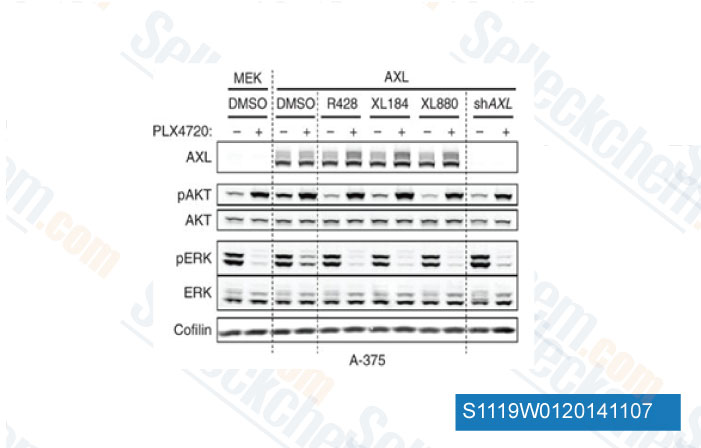
-
Daten von [ Cancer Discov , 2014 , 4(7), 816-27 ]
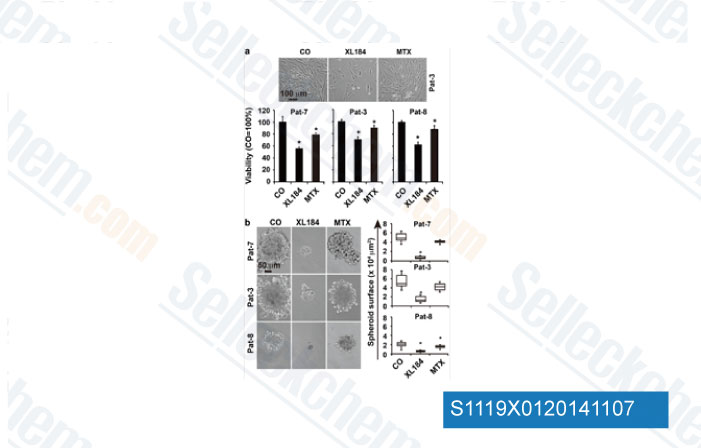
-
Daten von [ Cell Death Dis , 2014 , 5, e1471 ]
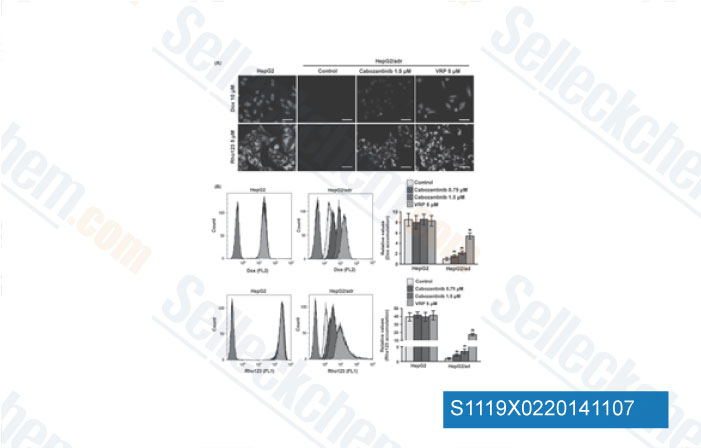
-
Daten von [ Liver Int , 2014 , 10.1111/liv.12524 ]

-
, , Christina W Yde/CDM Danish Cancer Society Research Center Denmark
Sellecks Cabozantinib (XL184) Wurde zitiert von 169 Publikationen
| S100P is a ferroptosis suppressor to facilitate hepatocellular carcinoma development by rewiring lipid metabolism [ Nat Commun, 2025, 16(1):509] | PubMed: 39779666 |
| ARID1A loss enhances sensitivity to c-MET inhibition by dual targeting of GPX4 and iron homeostasis, inducing ferroptosis [ Cell Death Differ, 2025, 10.1038/s41418-025-01510-x] | PubMed: 40369167 |
| Inhibition of TFF3 synergizes with c-MET inhibitors to decrease the CSC-like phenotype and metastatic burden in ER+HER2+ mammary carcinoma [ Cell Death Dis, 2025, 16(1):76] | PubMed: 39920140 |
| Relevance of transportome among the mechanisms of chemoresistance in hepatoblastoma [ Biochem Pharmacol, 2025, 237:116914] | PubMed: 40185314 |
| A Robust Marine Collagen Peptide-Agarose 3D Culture System for In Vitro Modeling of Hepatocellular Carcinoma and Anti-Cancer Therapeutic Development [ Mar Drugs, 2025, 23(10)386] | PubMed: 41149589 |
| Characterisation of an autochthonous mouse ccRCC model of immune checkpoint inhibitor therapy resistance [ Sci Rep, 2025, 15(1):19818] | PubMed: 40473819 |
| Sensitizing cholangiocarcinoma to chemotherapy by inhibition of the drug-export pump MRP3 [ Biomed Pharmacother, 2024, 180:117533] | PubMed: 39405909 |
| Construction of disulfidptosis-based immune response prediction model with artificial intelligence and validation of the pivotal grouping oncogene c-MET in regulating T cell exhaustion [ Front Immunol, 2024, 15:1258475] | PubMed: 38352883 |
| Novel therapeutic strategies targeting bypass pathways and mitochondrial dysfunction to combat resistance to RET inhibitors in NSCLC [ Biochim Biophys Acta Mol Basis Dis, 2024, 1870(6):167249] | PubMed: 38768929 |
| Patient-derived rhabdomyosarcoma cells recapitulate the genetic and transcriptomic landscapes of primary tumors [ iScience, 2024, 27(10):110862] | PubMed: 39319271 |
RÜCKGABERICHTLINIE
Die bedingungslose Rückgaberichtlinie von Selleck Chemical gewährleistet unseren Kunden ein reibungsloses Online-Einkaufserlebnis. Wenn Sie in irgendeiner Weise mit Ihrem Kauf unzufrieden sind, können Sie jeden Artikel innerhalb von 7 Tagen nach Erhalt zurückgeben. Im Falle von Produktqualitätsproblemen, sei es protokollbezogene oder produktbezogene Probleme, können Sie jeden Artikel innerhalb von 365 Tagen ab dem ursprünglichen Kaufdatum zurückgeben. Bitte befolgen Sie die nachstehenden Anweisungen, wenn Sie Produkte zurücksenden.
VERSAND UND LAGERUNG
Selleck-Produkte werden bei Raumtemperatur transportiert. Wenn Sie das Produkt bei Raumtemperatur erhalten, seien Sie versichert, dass die Qualitätskontrollabteilung von Selleck Experimente durchgeführt hat, um zu überprüfen, dass die normale Temperaturplatzierung von einem Monat die biologische Aktivität von Pulverprodukten nicht beeinträchtigt. Nach dem Sammeln lagern Sie das Produkt bitte gemäß den in der Datenblatt beschriebenen Anforderungen. Die meisten Selleck-Produkte sind unter den empfohlenen Bedingungen stabil.
NICHT FÜR DIE ANWENDUNG AM MENSCHEN, FÜR VETERINÄRMEDIZINISCHE DIAGNOSTIK ODER THERAPEUTISCHE ZWECKE.