
Technische Daten
| Formel | C17H16O4 |
||||||||||||||
| Molekulargewicht | 284.31 | CAS-Nr. | 104594-70-9 | ||||||||||||
| Löslichkeit (25°C)* | In vitro | DMSO | 57 mg/mL (200.48 mM) | ||||||||||||
| Ethanol | 57 mg/mL (200.48 mM) | ||||||||||||||
| Water | Insoluble | ||||||||||||||
| In vivo (Lösungsmittel einzeln und der Reihe nach zum Produkt hinzufügen.) |
|
||||||||||||||
|
* <1 mg/ml bedeutet schwer löslich oder unlöslich. * Bitte beachten Sie, dass Selleck die Löslichkeit aller Verbindungen intern testet und die tatsächliche Löslichkeit geringfügig von veröffentlichten Werten abweichen kann. Dies ist normal und ist auf geringfügige Batch-zu-Batch-Variationen zurückzuführen. * Versand bei Raumtemperatur (Stabilitätstests zeigen, dass dieses Produkt ohne Kühlmaßnahmen versendet werden kann.) |
|||||||||||||||
Vorbereitung von Stammlösungen
Biologische Aktivität
| Beschreibung | Caffeic acid phenethyl ester (CAPE, Phenylethyl Caffeate) ist ein potenter und spezifischer Inhibitor der NF-κB-Aktivierung und zeigt zudem antioxidative, immunmodulatorische und entzündungshemmende Aktivitäten. | |
|---|---|---|
| Ziele |
|
|
| In vitro | Caffeic acid phenethyl ester blockiert die durch Phorbolester, Ceramid, Okadainsäure und Wasserstoffperoxid induzierte NF-κB-Aktivierung, indem es die Translokation der p65-Untereinheit von NF-κB in den Zellkern verhindert. In einer Reihe von Tumorzelllinien zeigt Caffeic acid phenethyl ester vielversprechende antiproliferative Aktivität mit EC50-Werten von 1,76, 3,16, 13,7 und 44,0 μM gegen murine Kolon-26-L5-, murine B16-BL6-Melanom-, menschliche HT-1080-Fibrosarkom- und menschliche Lungen-A549-Adenokarzinom-Zelllinien. Caffeic acid phenethyl ester übt als potentes Antioxidans seine anti-apoptotische Wirkung in zerebellären Körnerzellen aus, indem es die ROS-Bildung blockiert und die Caspase-Aktivität hemmt. Darüber hinaus mildert Caffeic acid phenethyl ester den proinflammatorischen Phänotyp von LPS-stimulierten HSCs und die LPS-induzierte Sensibilisierung von HSCs gegenüber fibrogenen Zytokinen durch Hemmung der NF-κB-Signalübertragung. | |
| In vivo | In vivo hemmt Caffeic acid phenethyl ester (10 mg/kg, i.p.) das Wachstum und die Angiogenese von Primärtumoren in C57BL/6- und BALB/c-Mäusen, die mit Lewis-Lungenkarzinom-, Kolonkarzinom- und Melanomzellen inokuliert wurden. Caffeic acid phenethyl ester (5, 10, 20 mg/kg) zeigt auch immunmodulatorische Effekte in vivo, indem es das Thymusgewicht und/oder die Zellzahl von Thymus und Milz verringert. |
Protokoll (aus Referenz)
| Zell-Assay: |
|
|---|---|
| Tierstudie: |
|
Referenzen
|
Kundenproduktvalidierung
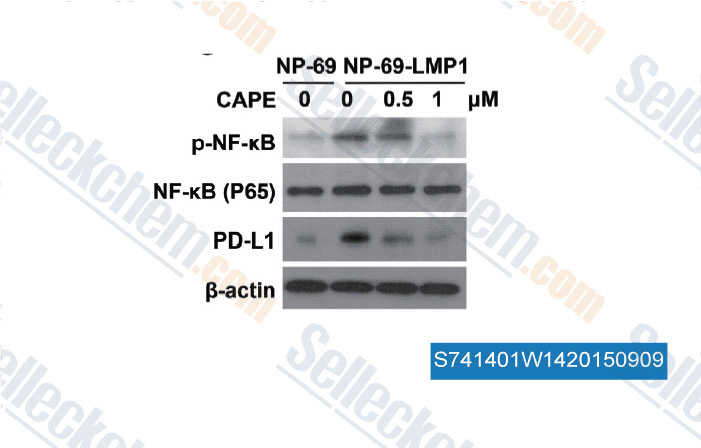
-
Daten von [ , , Oncotarget, 2014, 5(23): 12189-202 ]
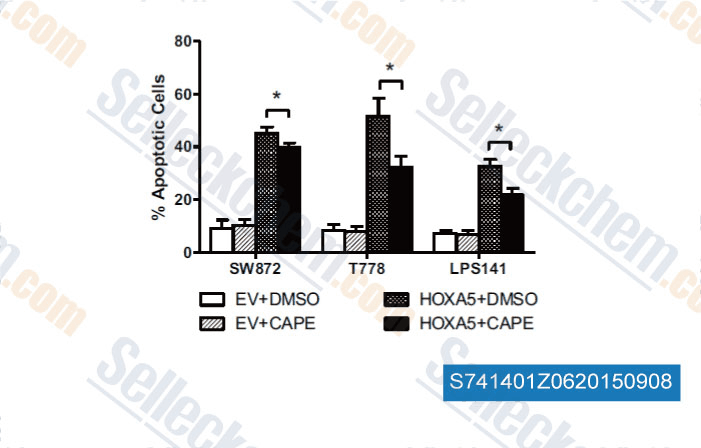
-
Daten von [ , , Sci Rep, 2015, 5: 12580 ]
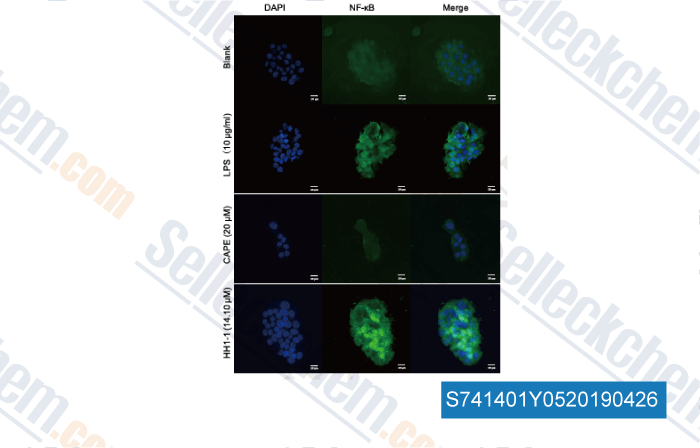
-
Daten von [ , , Carbohydr Polym, 2018, 202:134-142 ]
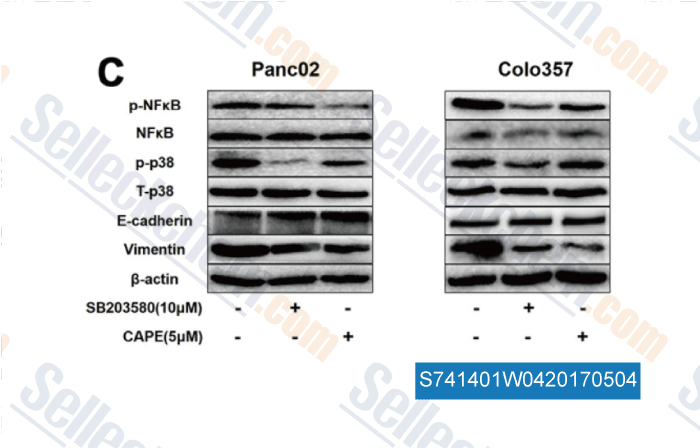
-
Daten von [ , , Oncotarget, 2016, 7(25):38539-38550 ]
Sellecks Caffeic Acid Phenethyl Ester Wurde zitiert von 56 Publikationen
| Caffeic acid phenethyl ester protects renal tubular epithelial cells against ferroptosis in diabetic kidney disease via restoring PINK1-mediated mitophagy [ Mol Med, 2025, 31(1):264] | PubMed: 40702453 |
| Growth differentiation factor 15 is a glucose-downregulated gene acting as the cross talk between stroma and cancer cells of the human bladder [ Am J Physiol Cell Physiol, 2025, 328(2):C557-C573] | PubMed: 39804805 |
| Caffeic Acid Phenethyl Ester Protects Neurons Against Oxidative Stress and Neurodegeneration During Traumatic Brain Injury [ Biomolecules, 2025, 15(1)80] | PubMed: 39858474 |
| Osteopontin deficiency promotes cartilaginous endplate degeneration by enhancing the NF-κB signaling to recruit macrophages and activate the NLRP3 inflammasome [ Bone Res, 2024, 12(1):53] | PubMed: 39242551 |
| Calpain-2 mediates SARS-CoV-2 entry via regulating ACE2 levels [ mBio, 2024, e0228723.] | PubMed: 38349185 |
| Clarithromycin Modulates Neutrophilic Inflammation Induced by Prevotella intermedia in Human Airway Epithelial Cells [ Antibiotics (Basel), 2024, 13(9)909] | PubMed: 39335081 |
| CAPE activates AMPK and Foxo3 signaling to induce growth inhibition and ferroptosis in triple-negative breast cancer [ PLoS One, 2024, 19(12):e0315037] | PubMed: 39729481 |
| Caffeic acid phenethyl ester restores mitochondrial homeostasis against peritoneal fibrosis induced by peritoneal dialysis through the AMPK/SIRT1 pathway [ Ren Fail, 2024, 46(1):2350235] | PubMed: 38721924 |
| Caffeic Acid Phenethyl Ester Suppresses Oxidative Stress and Regulates M1/M2 Microglia Polarization via Sirt6/Nrf2 Pathway to Mitigate Cognitive Impairment in Aged Mice following Anesthesia and Surgery [ Antioxidants (Basel), 2023, 12(3)714] | PubMed: 36978961 |
| Caffeic acid phenethyl ester suppresses metastasis of breast cancer cells by inactivating FGFR1 via MD2 [ PLoS One, 2023, 18(7):e0289031] | PubMed: 37490511 |
RÜCKGABERICHTLINIE
Die bedingungslose Rückgaberichtlinie von Selleck Chemical gewährleistet unseren Kunden ein reibungsloses Online-Einkaufserlebnis. Wenn Sie in irgendeiner Weise mit Ihrem Kauf unzufrieden sind, können Sie jeden Artikel innerhalb von 7 Tagen nach Erhalt zurückgeben. Im Falle von Produktqualitätsproblemen, sei es protokollbezogene oder produktbezogene Probleme, können Sie jeden Artikel innerhalb von 365 Tagen ab dem ursprünglichen Kaufdatum zurückgeben. Bitte befolgen Sie die nachstehenden Anweisungen, wenn Sie Produkte zurücksenden.
VERSAND UND LAGERUNG
Selleck-Produkte werden bei Raumtemperatur transportiert. Wenn Sie das Produkt bei Raumtemperatur erhalten, seien Sie versichert, dass die Qualitätskontrollabteilung von Selleck Experimente durchgeführt hat, um zu überprüfen, dass die normale Temperaturplatzierung von einem Monat die biologische Aktivität von Pulverprodukten nicht beeinträchtigt. Nach dem Sammeln lagern Sie das Produkt bitte gemäß den in der Datenblatt beschriebenen Anforderungen. Die meisten Selleck-Produkte sind unter den empfohlenen Bedingungen stabil.
NICHT FÜR DIE ANWENDUNG AM MENSCHEN, FÜR VETERINÄRMEDIZINISCHE DIAGNOSTIK ODER THERAPEUTISCHE ZWECKE.