
Technische Daten
| Formel | C21H25ClN6O2 |
||||||
| Molekulargewicht | 428.92 | CAS-Nr. | 1143532-39-1 | ||||
| Löslichkeit (25°C)* | In vitro | DMSO | 86 mg/mL (200.5 mM) | ||||
| Ethanol | 22 mg/mL (51.29 mM) | ||||||
| Water | Insoluble | ||||||
| In vivo (Lösungsmittel einzeln und der Reihe nach zum Produkt hinzufügen.) |
|
||||||
|
* <1 mg/ml bedeutet schwer löslich oder unlöslich. * Bitte beachten Sie, dass Selleck die Löslichkeit aller Verbindungen intern testet und die tatsächliche Löslichkeit geringfügig von veröffentlichten Werten abweichen kann. Dies ist normal und ist auf geringfügige Batch-zu-Batch-Variationen zurückzuführen. * Versand bei Raumtemperatur (Stabilitätstests zeigen, dass dieses Produkt ohne Kühlmaßnahmen versendet werden kann.) |
|||||||
Vorbereitung von Stammlösungen
Biologische Aktivität
| Beschreibung | Capivasertib (AZD5363) hemmt potent alle Isoformen von Akt (Akt1/Akt2/Akt3) mit IC50 von 3 nM/8 nM/8 nM in zellfreien Assays, ähnlich wie P70S6K/PKA und geringerer Aktivität gegenüber ROCK1/2. Phase 2. | ||||||||
|---|---|---|---|---|---|---|---|---|---|
| Ziele |
|
||||||||
| In vitro | Capivasertib (AZD5363) ist ein potenter Akt-Inhibitor mit IC50 von 3 nM, 8 nM und 8 nM für Akt1, Akt2 bzw. Akt3. Es hemmt die Phosphorylierung von Akt-Substraten in Zellen mit einer Potenz von etwa 0,3 bis 0,8 μM. Diese Verbindung hemmt die Proliferation von 41 von 182 soliden und hämatologischen Tumorzelllinien mit einer Potenz von < 3 μM. Aktivierende Mutationen in PIK3CA, Verlust oder Inaktivierung des Tumorsuppressors PTEN oder HER2-Amplifikation sind alle signifikant prädiktiv für das Ansprechen auf AZD5363. Zusätzlich wird auch eine Korrelation zwischen dem RAS-Mutationsstatus von Zelllinien und der Resistenz dagegen beobachtet. |
||||||||
| In vivo | Die orale Verabreichung von Capivasertib (AZD5363) (100, 300 mg/kg) an Nacktmäuse führt zu dosis- und zeitabhängigen Reduktionen der PRAS40-, GSK3β- und S6-Phosphorylierung in BT474c-Xenotransplantaten, reversiblen Erhöhungen der Blutglukosekonzentrationen und dosisabhängigen Abnahmen der 2[18F]Fluor-2-deoxy-d-glukose (18F-FDG)-Aufnahme in U87-MG-Xenotransplantaten. Die chronische orale Verabreichung dieser Verbindung (130, 200 und 300 mg/kg) führt zu einer dosisabhängigen Wachstumshemmung von Xenotransplantaten, die von verschiedenen Tumortypen stammen, einschließlich HER2+-Brustkrebsmodellen. |
||||||||
| Merkmale | Moderate präklinische Verträglichkeit und PD-Eigenschaften eines Akt-Inhibitors. Deutlich unterschiedliches Profil zu anderen Akt-Inhibitoren in der klinischen Entwicklung. |
Protokoll (aus Referenz)
| Kinase-Assay: |
|
|---|---|
| Zell-Assay: |
|
| Tierstudie: |
|
Referenzen
|
Kundenproduktvalidierung
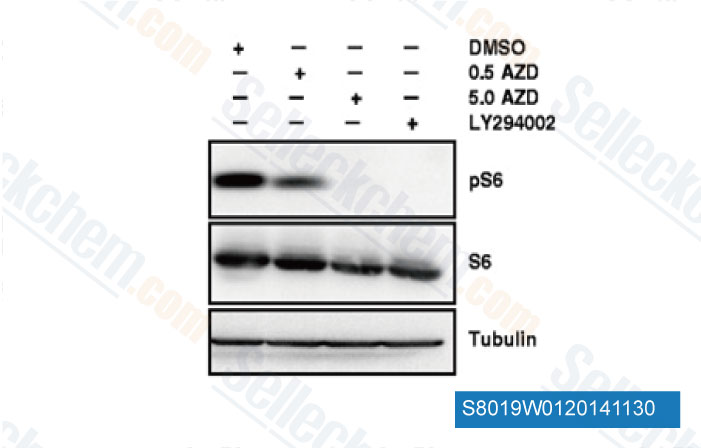
-
Daten von [ Cell Commun Signal , 2014 , 12(1), 61 ]
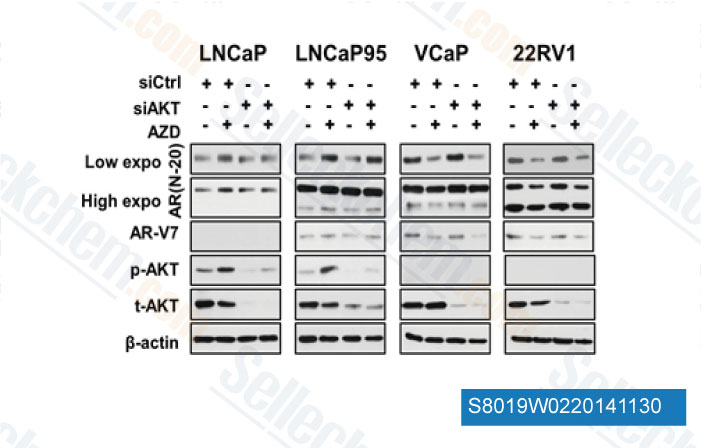
-
Daten von [ PLoS One , 2014 , 9(10), e108780 ]

-
Daten von [ , , Clin Cancer Res, 2016, 22(4):1018-27 ]
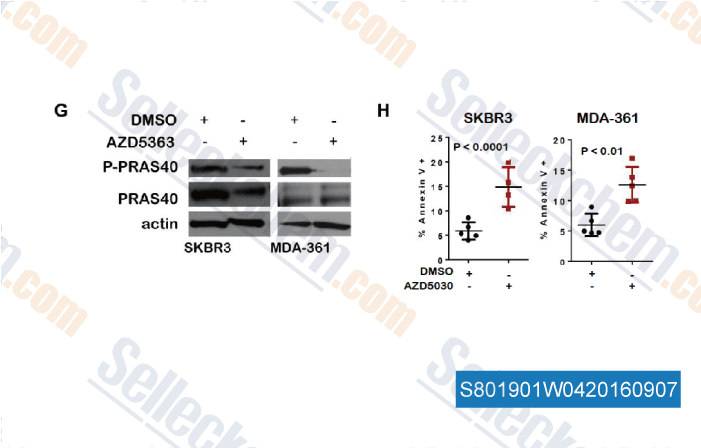
-
Daten von [ , , Cancer Res, 2016, 76(16):4752-64. ]
Sellecks AZD5363 (Capivasertib) Wurde zitiert von 158 Publikationen
| Macrophage-derived amphiregulin induces myofibroblast transition in adipogenic lineage precursors near Staphylococcus aureus abscess in bone marrow [ Nat Commun, 2025, 16(1):8409] | PubMed: 40998791 |
| Combined inhibition of KAT6A/B and Menin reverses estrogen receptor-driven gene expression programs in breast cancer [ Cell Rep Med, 2025, 6(7):102192] | PubMed: 40516531 |
| A bedside-to-bench translational analysis of NF1 alterations and CDK4/6 inhibitor resistance in hormone receptor-positive metastatic breast cancer [ EBioMedicine, 2025, 118:105828] | PubMed: 40578027 |
| FABP4 expression in neutrophils as a predictor of sepsis and SI-ARDS based on BALF transcriptome and peripheral blood validation [ Chin Med J (Engl), 2025, 10.1097/CM9.0000000000003447] | PubMed: 40169352 |
| Intratumor heterogeneity in KRAS signaling shapes treatment resistance [ iScience, 2025, 28(2):111662] | PubMed: 39898020 |
| Functional Analysis of the PI3K/AKT/mTOR Pathway Inhibitor, Gedatolisib, Plus Fulvestrant with and Without Palbociclib in Breast Cancer Models [ Int J Mol Sci, 2025, 26(12)5844] | PubMed: 40565304 |
| Low-Dose Perifosine, a Phase II Phospholipid Akt Inhibitor, Selectively Sensitizes Drug-Resistant ABCB1-Overexpressing Cancer Cells [ Biomol Ther (Seoul), 2025, 33(1):170-181] | PubMed: 39632683 |
| 3-O-acetylrubiarbonol B preferentially targets EGFR and MET over rubiarbonol B to inhibit NSCLC cell growth [ PLoS One, 2025, 20(9):e0329706] | PubMed: 40920675 |
| ZO-2 is a scaffold at the centriole and mitotic spindle poles that enhances microtubule stability and supports the proper development of mitotic spindles and cilia [ Cell Tissue Res, 2025, 10.1007/s00441-025-03992-0] | PubMed: 40728639 |
| Development of Acquired Resistance in Alpelisib-treated Gastric Cancer Cells With PIK3CA Mutations and Overcoming Strategies [ Anticancer Res, 2025, 45(5):1877-1896] | PubMed: 40295072 |
RÜCKGABERICHTLINIE
Die bedingungslose Rückgaberichtlinie von Selleck Chemical gewährleistet unseren Kunden ein reibungsloses Online-Einkaufserlebnis. Wenn Sie in irgendeiner Weise mit Ihrem Kauf unzufrieden sind, können Sie jeden Artikel innerhalb von 7 Tagen nach Erhalt zurückgeben. Im Falle von Produktqualitätsproblemen, sei es protokollbezogene oder produktbezogene Probleme, können Sie jeden Artikel innerhalb von 365 Tagen ab dem ursprünglichen Kaufdatum zurückgeben. Bitte befolgen Sie die nachstehenden Anweisungen, wenn Sie Produkte zurücksenden.
VERSAND UND LAGERUNG
Selleck-Produkte werden bei Raumtemperatur transportiert. Wenn Sie das Produkt bei Raumtemperatur erhalten, seien Sie versichert, dass die Qualitätskontrollabteilung von Selleck Experimente durchgeführt hat, um zu überprüfen, dass die normale Temperaturplatzierung von einem Monat die biologische Aktivität von Pulverprodukten nicht beeinträchtigt. Nach dem Sammeln lagern Sie das Produkt bitte gemäß den in der Datenblatt beschriebenen Anforderungen. Die meisten Selleck-Produkte sind unter den empfohlenen Bedingungen stabil.
NICHT FÜR DIE ANWENDUNG AM MENSCHEN, FÜR VETERINÄRMEDIZINISCHE DIAGNOSTIK ODER THERAPEUTISCHE ZWECKE.