
Technische Daten
| Formel | C18H13ClF6N2O3 |
||||||||||||||
| Molekulargewicht | 454.75 | CAS-Nr. | 285986-88-1 | ||||||||||||
| Löslichkeit (25°C)* | In vitro | DMSO | 90 mg/mL (197.91 mM) | ||||||||||||
| Ethanol | 4 mg/mL (8.79 mM) | ||||||||||||||
| Water | Insoluble | ||||||||||||||
| In vivo (Lösungsmittel einzeln und der Reihe nach zum Produkt hinzufügen.) |
|
||||||||||||||
|
* <1 mg/ml bedeutet schwer löslich oder unlöslich. * Bitte beachten Sie, dass Selleck die Löslichkeit aller Verbindungen intern testet und die tatsächliche Löslichkeit geringfügig von veröffentlichten Werten abweichen kann. Dies ist normal und ist auf geringfügige Batch-zu-Batch-Variationen zurückzuführen. * Versand bei Raumtemperatur (Stabilitätstests zeigen, dass dieses Produkt ohne Kühlmaßnahmen versendet werden kann.) |
|||||||||||||||
Vorbereitung von Stammlösungen
Biologische Aktivität
| Beschreibung | CCG-1423 ist ein spezifischer RhoA-Signalweg-Inhibitor, der die SRF-vermittelte Transkription hemmt. | |
|---|---|---|
| Ziele |
|
|
| In vitro | CCG-1423 hemmt selektiv die SRF-vermittelte Transkription, die durch die Rho-Signalweg-Signalisierung aktiviert wird, und hemmt spezifisch die LPA-stimulierte DNA-Synthese. Diese Verbindung hemmt auch selektiv die Proliferation von RhoC-überexprimierenden Melanomzellen (A375M2 und SK-Mel-147) und unterdrückt stark die Rho-abhängige Invasion von PC-3-Zellen. In Kombination mit LY294002 verbessert es die Differenzierung von Mäuse-Embryonalstammzellen in intermediäres Mesoderm durch BMP7-positive Zellen. In H9c2-Zellen hemmt diese Chemikalie die MRTF-Kernlokalisation und blockiert vollständig die proximale STARS-Reporteraktivität. Diese Verbindung unterdrückt als Rho/MRTF/SRF-Signalweg-Inhibitor auch sowohl die Matrixsteifigkeits- als auch die TGF-beta-induzierte Fibrogenese in menschlichen kolorektalen Myofibroblasten. |
Protokoll (aus Referenz)
| Zell-Assay:[1] |
|
|---|
Referenzen
|
Kundenproduktvalidierung
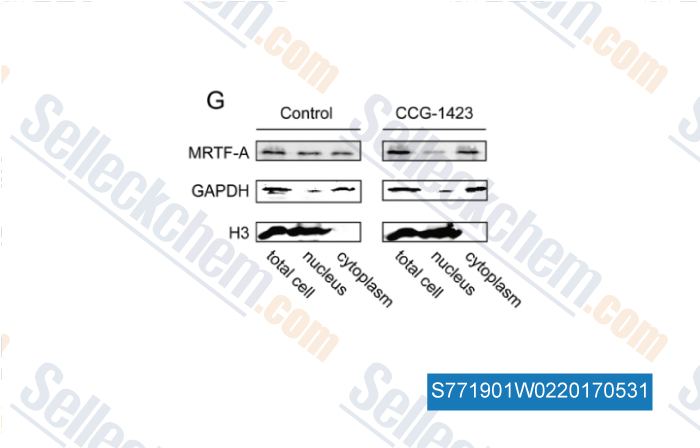
-
Daten von [ , , Cell Signal, 2017, 31:87-95 ]
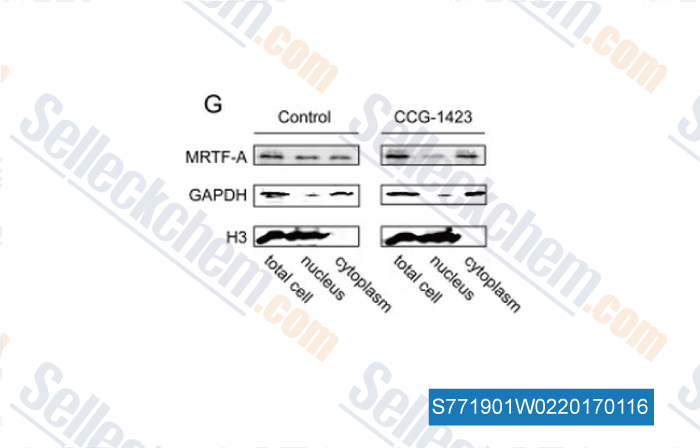
-
Daten von [ , , Cellular Signalling, 2017, 31:87-95. ]
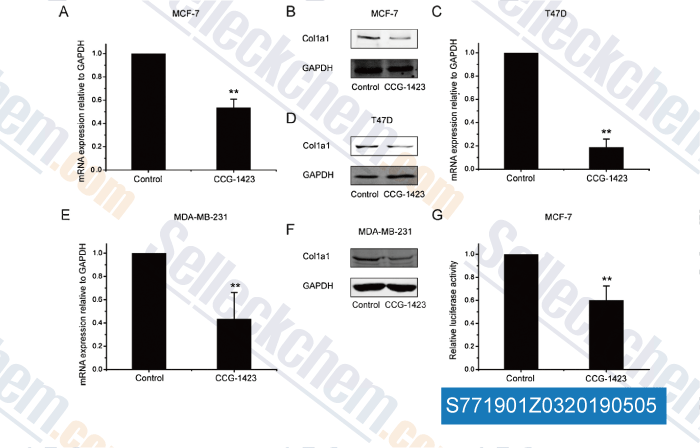
-
Daten von [ , , Biomed Pharmacother, 2018, 104:718-728 ]
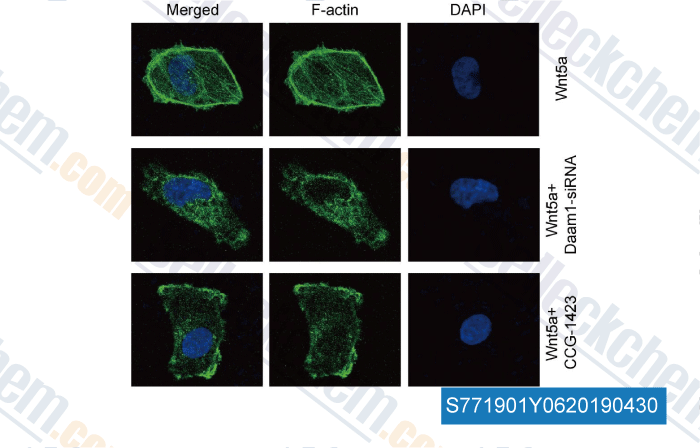
-
Daten von [ , , Oncol Rep, 2018, 39(2):465-472 ]
Sellecks CCG-1423 Wurde zitiert von 38 Publikationen
| Fibulin-4 and latent-transforming growth factor beta-binding protein-4 interactions with syndecan-2 and syndecan-3 are required for elastogenesis [ FASEB J, 2025, 39(7):e70505] | PubMed: 40168061 |
| IQGAP1 and NWASP promote human cancer cell dissemination and metastasis by regulating β1-integrin via FAK and MRTF/SRF [ Cell Rep, 2024, 43(4):113989] | PubMed: 38536816 |
| 3D printed pore morphology mediates bone marrow stem cell behaviors via RhoA/ROCK2 signaling pathway for accelerating bone regeneration [ Bioact Mater, 2023, 26:413-424] | PubMed: 36969106 |
| The collateral activity of RfxCas13d can induce lethality in a RfxCas13d knock-in mouse model [ Genome Biol, 2023, 24(1):20] | PubMed: 36726140 |
| Osteogenesis-Inducing Chemical Cues Enhance the Mechanosensitivity of Human Mesenchymal Stem Cells for Osteogenic Differentiation on a Microtopographically Patterned Surface [ Adv Sci (Weinh), 2022, e2200053] | PubMed: 35373921 |
| Increased Expression of LMCD1 in Scleroderma-Associated Interstitial Lung Disease is Critical for Profibrotic Characteristics of Lung Myofibroblasts [ Arthritis Rheumatol, 2022, 10.1002/art.42344] | PubMed: 36103378 |
| Exosomes derived from human umbilical cord mesenchymal stem cells reduce tendon injuries via the miR-27b-3p/ARHGAP5/RhoA signaling pathway [ Acta Biochim Biophys Sin (Shanghai), 2022, 54(2):232-242] | PubMed: 35130628 |
| Lovastatin Inhibits RhoA to Suppress Canonical Wnt/β-Catenin Signaling and Alternative Wnt-YAP/TAZ Signaling in Colon Cancer [ Cell Transplant, 2022, 31:9636897221075749] | PubMed: 35168393 |
| Phosphorylation of MICAL2 by ARG promotes head and neck cancer tumorigenesis by regulating skeletal rearrangement [ Oncogene, 2021, 10.1038/s41388-021-02101-z] | PubMed: 34750518 |
| RhoA enhances osteosarcoma resistance to MPPa-PDT via the Hippo/YAP signaling pathway [ Cell Biosci, 2021, 11(1):179] | PubMed: 34627383 |
RÜCKGABERICHTLINIE
Die bedingungslose Rückgaberichtlinie von Selleck Chemical gewährleistet unseren Kunden ein reibungsloses Online-Einkaufserlebnis. Wenn Sie in irgendeiner Weise mit Ihrem Kauf unzufrieden sind, können Sie jeden Artikel innerhalb von 7 Tagen nach Erhalt zurückgeben. Im Falle von Produktqualitätsproblemen, sei es protokollbezogene oder produktbezogene Probleme, können Sie jeden Artikel innerhalb von 365 Tagen ab dem ursprünglichen Kaufdatum zurückgeben. Bitte befolgen Sie die nachstehenden Anweisungen, wenn Sie Produkte zurücksenden.
VERSAND UND LAGERUNG
Selleck-Produkte werden bei Raumtemperatur transportiert. Wenn Sie das Produkt bei Raumtemperatur erhalten, seien Sie versichert, dass die Qualitätskontrollabteilung von Selleck Experimente durchgeführt hat, um zu überprüfen, dass die normale Temperaturplatzierung von einem Monat die biologische Aktivität von Pulverprodukten nicht beeinträchtigt. Nach dem Sammeln lagern Sie das Produkt bitte gemäß den in der Datenblatt beschriebenen Anforderungen. Die meisten Selleck-Produkte sind unter den empfohlenen Bedingungen stabil.
NICHT FÜR DIE ANWENDUNG AM MENSCHEN, FÜR VETERINÄRMEDIZINISCHE DIAGNOSTIK ODER THERAPEUTISCHE ZWECKE.