
Technische Daten
| Formel | C18H26ClN3.2H3O4P |
|||
| Molekulargewicht | 515.86 | CAS-Nr. | 50-63-5 | |
| Löslichkeit (25°C)* | In vitro | Water | 100 mg/mL (193.85 mM) | |
| DMSO | Insoluble | |||
| Ethanol | Insoluble | |||
|
* <1 mg/ml bedeutet schwer löslich oder unlöslich. * Bitte beachten Sie, dass Selleck die Löslichkeit aller Verbindungen intern testet und die tatsächliche Löslichkeit geringfügig von veröffentlichten Werten abweichen kann. Dies ist normal und ist auf geringfügige Batch-zu-Batch-Variationen zurückzuführen. * Versand bei Raumtemperatur (Stabilitätstests zeigen, dass dieses Produkt ohne Kühlmaßnahmen versendet werden kann.) |
||||
Vorbereitung von Stammlösungen
Biologische Aktivität
| Beschreibung | Chloroquine diphosphate ist ein 4-Aminoquinolin-Antimalaria- und Antirheumatikum, das auch als ATM-Aktivator wirkt. Chloroquine ist auch ein Inhibitor von toll-like receptors (TLRs). | |||||
|---|---|---|---|---|---|---|
| Ziele |
|
|||||
| In vitro | Chloroquine ist ein Chemotherapeutikum zur klinischen Behandlung von Malaria. Chloroquine ist in der Lage, an die DNA zu binden und die DNA-Replikation und RNA-Synthese zu hemmen, was wiederum zum Zelltod führt. Die Wirkung von Chloroquine kann auch mit der Bildung eines toxischen Häm-Chloroquine-Komplexes zusammenhängen. Chloroquine hemmt den Hämoglobinabbau von Trophozoiten durch Erhöhung des vakuolären pH-Werts und Hemmung der Aktivität von vakuolärer Phospholipase, vakuolären Proteasen und Häm-Polymerase. Chloroquine besitzt definitive antirheumatische Eigenschaften. Chloroquine hat immunmodulatorische Wirkungen, die die Produktion/Freisetzung von Tumornekrosefaktor und Interleukin 6 unterdrücken. Darüber hinaus übt Chloroquine direkte antivirale Wirkungen aus, indem es pH-abhängige Schritte der Replikation mehrerer Viren hemmt, darunter Mitglieder der Flaviviren, Retroviren und Coronaviren. Ihre am besten untersuchten Wirkungen sind die gegen die HIV-Replikation. Chloroquine kann sich durch Ionenfallen im Makrophagen-Phagolysosom ansammeln, wo es eine starke antimykotische Aktivität gegen Histoplasma capsulatum und Cryptococcus neoformans durch unterschiedliche Mechanismen ausübt. Chloroquine hemmt das Wachstum von H. capsulatum durch pH-abhängigen Eisenmangel, während es direkt toxisch für C. neoformans ist. |
|||||
| In vivo | Chloroquine hat tumorhemmende und tumorfördernde Wirkungen bei dreifach negativem Brustkrebs. |
Protokoll (aus Referenz)
| Zell-Assay: |
|
|---|---|
| Tierstudie: |
|
Referenzen
|
Kundenproduktvalidierung
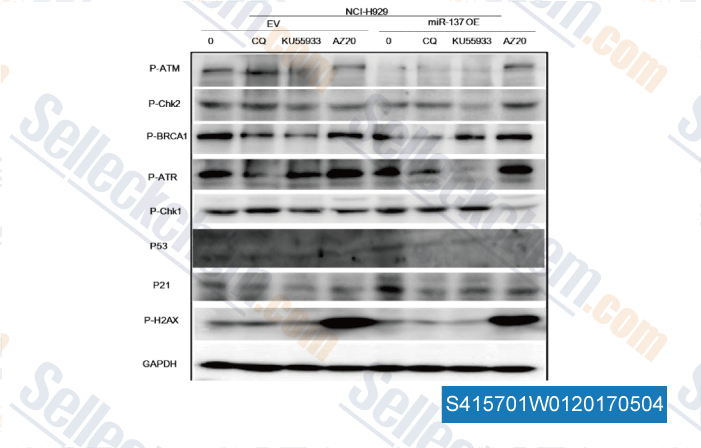
-
, , Leukemia, 2017, 31(5):1123-1135
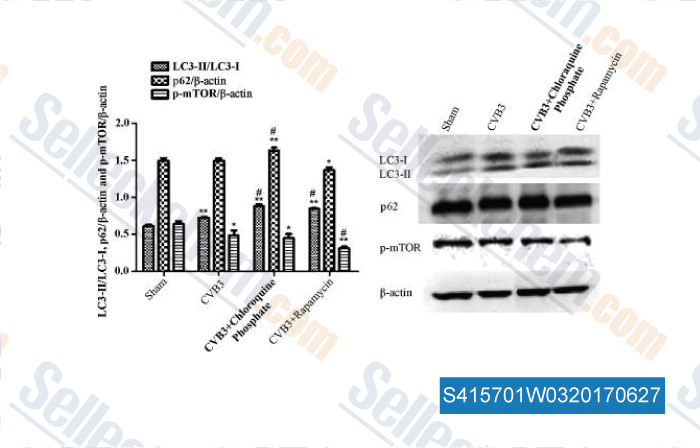
-
, , Int J Mol Med, 2017, 40(1):182-192
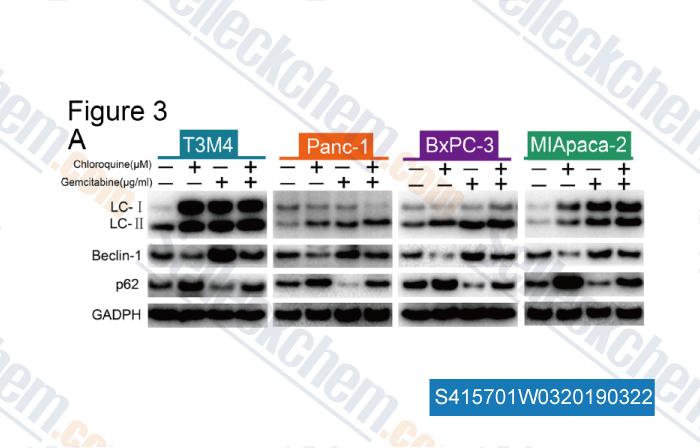
-
Daten von [ , , Cancer Lett, 2018, 436:129-138 ]
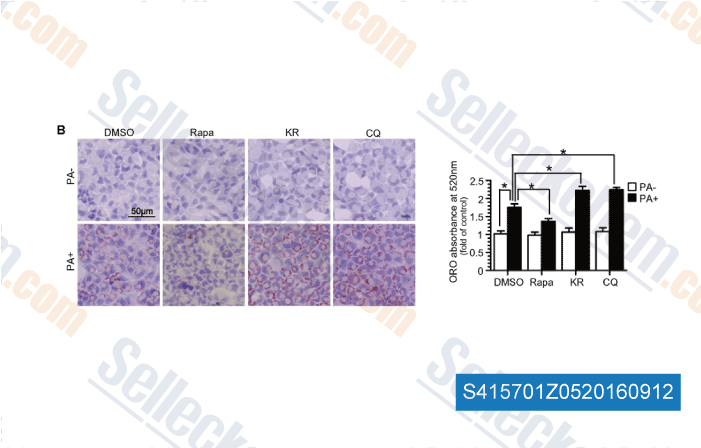
-
Daten von [ , , Cell Signal, 2016, 28(8):1086-98. ]
Sellecks Chloroquine diphosphate Wurde zitiert von 215 Publikationen
| Melatonin ameliorates zearalenone-induced ovarian damage in mice through antioxidative effects [ Front Vet Sci, 2025, 12:1587391] | PubMed: 40860911 |
| Noncanonical function of folate through folate receptor 1 during neural tube formation [ Nat Commun, 2024, 15(1):1642] | PubMed: 38388461 |
| Macroautophagy/autophagy promotes resistance to KRASG12D-targeted therapy through glutathione synthesis [ Cancer Lett, 2024, 604:217258] | PubMed: 39276914 |
| Shaoyao-Gancao Decoction, a famous Chinese medicine formula, protects against APAP-induced liver injury by promoting autophagy/mitophagy [ Phytomedicine, 2024, 135:156053] | PubMed: 39326138 |
| KIFC1 depends on TRIM37-mediated ubiquitination of PLK4 to promote centrosome amplification in endometrial cancer [ Cell Death Discov, 2024, 10(1):419] | PubMed: 39349439 |
| Inducing Receptor Degradation as a Novel Approach to Target CC Chemokine Receptor 2 (CCR2) [ Int J Mol Sci, 2024, 25(16)8984] | PubMed: 39201670 |
| Targeting autophagy as a therapeutic strategy in pediatric acute lymphoblastic leukemia [ Sci Rep, 2024, 14(1):4000] | PubMed: 38369625 |
| A high-throughput response to the SARS-CoV-2 pandemic [ SLAS Discov, 2024, 29(5):100160] | PubMed: 38761981 |
| Lysosomes mediate the mitochondrial UPR via mTORC1-dependent ATF4 phosphorylation [ Cell Discov, 2023, 9(1):92] | PubMed: 37679337 |
| Genome homeostasis defects drive enlarged cells into senescence [ Mol Cell, 2023, 10.1016/j.molcel.2023.10.018] | PubMed: 37977116 |
RÜCKGABERICHTLINIE
Die bedingungslose Rückgaberichtlinie von Selleck Chemical gewährleistet unseren Kunden ein reibungsloses Online-Einkaufserlebnis. Wenn Sie in irgendeiner Weise mit Ihrem Kauf unzufrieden sind, können Sie jeden Artikel innerhalb von 7 Tagen nach Erhalt zurückgeben. Im Falle von Produktqualitätsproblemen, sei es protokollbezogene oder produktbezogene Probleme, können Sie jeden Artikel innerhalb von 365 Tagen ab dem ursprünglichen Kaufdatum zurückgeben. Bitte befolgen Sie die nachstehenden Anweisungen, wenn Sie Produkte zurücksenden.
VERSAND UND LAGERUNG
Selleck-Produkte werden bei Raumtemperatur transportiert. Wenn Sie das Produkt bei Raumtemperatur erhalten, seien Sie versichert, dass die Qualitätskontrollabteilung von Selleck Experimente durchgeführt hat, um zu überprüfen, dass die normale Temperaturplatzierung von einem Monat die biologische Aktivität von Pulverprodukten nicht beeinträchtigt. Nach dem Sammeln lagern Sie das Produkt bitte gemäß den in der Datenblatt beschriebenen Anforderungen. Die meisten Selleck-Produkte sind unter den empfohlenen Bedingungen stabil.
NICHT FÜR DIE ANWENDUNG AM MENSCHEN, FÜR VETERINÄRMEDIZINISCHE DIAGNOSTIK ODER THERAPEUTISCHE ZWECKE.