
Technische Daten
| Formel | C15H15N3O2 |
||||||||||
| Molekulargewicht | 269.3 | CAS-Nr. | 112522-64-2 | ||||||||
| Löslichkeit (25°C)* | In vitro | DMSO | 54 mg/mL (200.51 mM) | ||||||||
| Water | Insoluble | ||||||||||
| Ethanol | Insoluble | ||||||||||
| In vivo (Lösungsmittel einzeln und der Reihe nach zum Produkt hinzufügen.) |
|
||||||||||
|
* <1 mg/ml bedeutet schwer löslich oder unlöslich. * Bitte beachten Sie, dass Selleck die Löslichkeit aller Verbindungen intern testet und die tatsächliche Löslichkeit geringfügig von veröffentlichten Werten abweichen kann. Dies ist normal und ist auf geringfügige Batch-zu-Batch-Variationen zurückzuführen. * Versand bei Raumtemperatur (Stabilitätstests zeigen, dass dieses Produkt ohne Kühlmaßnahmen versendet werden kann.) |
|||||||||||
Vorbereitung von Stammlösungen
Biologische Aktivität
| Beschreibung | Tacedinaline (CI994, PD-123654, GOE-5549, Acetyldinaline) ist ein selektiver Klasse-I-HDAC-Inhibitor mit IC50-Werten von 0,9, 0,9, 1,2 und >20 μM für humane HDAC 1, 2, 3 bzw. 8. Phase 3. | ||||||
|---|---|---|---|---|---|---|---|
| Ziele |
|
||||||
| In vitro | CI-994 (< 160 mM) zeigt eine zytostatische Wirkung mit gleichzeitigem Anstieg in der G0/G1-Phase, einer Reduktion des S-Phasen-Niveaus und erhöhter Apoptose in A-549- und LX-1-Zellen. CI-994 hemmt das Wachstum von LNCaP-Zellen mit einer IC50 von 7,4 μM. CI-994 zeigt Aktivität gegen mehrere Tumorzelllinien mit größerer Zytotoxizität gegen solide Tumoren im Vergleich zu Leukämie- und normalen Fibroblasten-Zelllinien. CI-994 hemmt das Wachstum von Ratten-Leukämie-BCLO-Zellen mit einer IC50 von 2,5 μM. | ||||||
| In vivo | CI-994 zeigt eine nachgewiesene Antitumoraktivität gegen verschiedene Tumormodelle, einschließlich des chemoresistenten Maus-Pankreas-Duktal-Karzinoms sowie des humanen Prostatatumormodells LNCaP. |
Protokoll (aus Referenz)
| Zell-Assay: |
|
|---|---|
| Tierstudie: |
|
Referenzen
|
Kundenproduktvalidierung
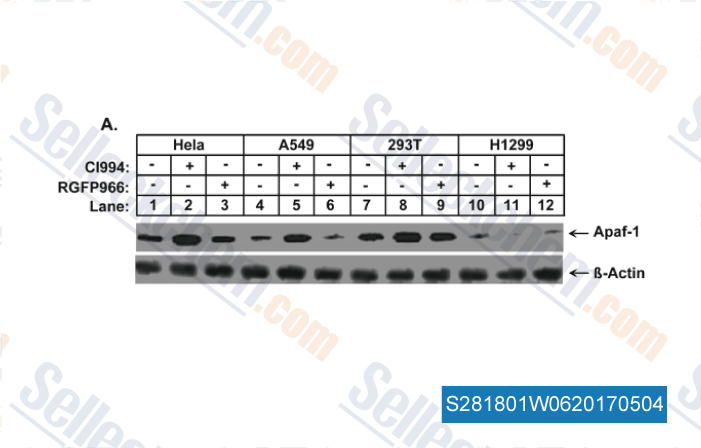
-
Daten von [ , , J Biol Chem, 2016, 291(14):7386-95 ]
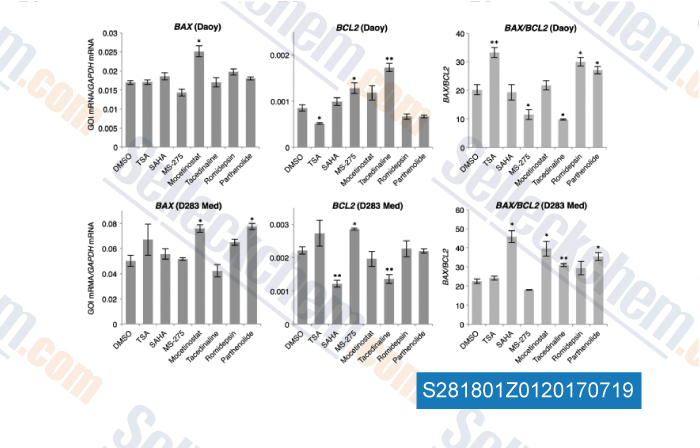
-
Daten von [ , , Cell Oncol (Dordr), 2017, 40(3):263-279 ]
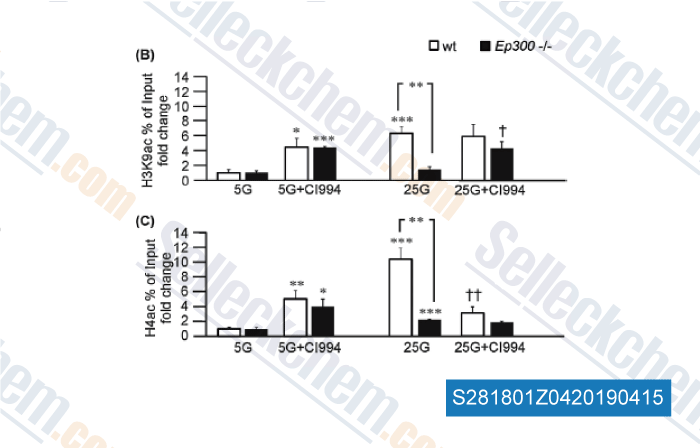
-
Daten von [ , , Int J Biochem Cell Biol, 2016, 81(Pt A):82-91 ]
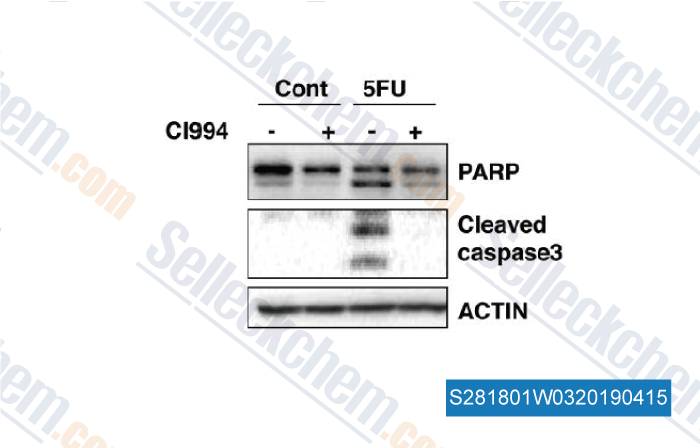
-
Daten von [ , , Anticancer Res, 2018, 38(1):271-277 ]
Sellecks Tacedinaline (CI994) Wurde zitiert von 42 Publikationen
| HSD17B4 deficiency causes dysregulation of primary cilia and is alleviated by acetyl-CoA [ Nat Commun, 2025, 16(1):2663] | PubMed: 40102401 |
| Loss of OVOL2 in Triple-Negative Breast Cancer Promotes Fatty Acid Oxidation Fueling Stemness Characteristics [ Adv Sci (Weinh), 2024, 11(24):e2308945] | PubMed: 38627980 |
| In-Cell Testing of Zinc-Dependent Histone Deacetylase Inhibitors in the Presence of Class-Selective Fluorogenic Substrates: Potential and Limitations of the Method [ Biomedicines, 2024, 12(6)1203] | PubMed: 38927410 |
| CUDC-907, a dual PI3K/histone deacetylase inhibitor, increases meta-iodobenzylguanidine uptake (123/131I-mIBG) in vitro and in vivo: a promising candidate for advancing theranostics in neuroendocrine tumors [ J Transl Med, 2023, 21(1):604] | PubMed: 37679770 |
| Histone deacetylase III interactions with BK polyomavirus large tumor antigen may affect protein stability [ Virol J, 2023, 20(1):155] | PubMed: 37464367 |
| MyoD is a 3D genome structure organizer for muscle cell identity [ Nat Commun, 2022, 13(1):205] | PubMed: 35017543 |
| Development of Human Adrenocortical Adenoma (HAA1) Cell Line from Zona Reticularis [ Int J Mol Sci, 2022, 24(1)584] | PubMed: 36614027 |
| Rb-E2F-HDAC Repressor Complexes Control Interferon-Induced Repression of Adenovirus To Promote Persistent Infection [ J Virol, 2022, e0044222] | PubMed: 35546119 |
| Pre-Senescence Induction in Hepatoma Cells Favors Hepatitis C Virus Replication and Can Be Used in Exploring Antiviral Potential of Histone Deacetylase Inhibitors [ Int J Mol Sci, 2021, 22(9)4559] | PubMed: 33925399 |
| Combination Treatment of CI-994 With Etoposide Potentiates Anticancer Effects Through a Topoisomerase II-Dependent Mechanism in Atypical Teratoid/Rhabdoid Tumor (AT/RT) [ Front Oncol, 2021, 11:648023] | PubMed: 34367950 |
RÜCKGABERICHTLINIE
Die bedingungslose Rückgaberichtlinie von Selleck Chemical gewährleistet unseren Kunden ein reibungsloses Online-Einkaufserlebnis. Wenn Sie in irgendeiner Weise mit Ihrem Kauf unzufrieden sind, können Sie jeden Artikel innerhalb von 7 Tagen nach Erhalt zurückgeben. Im Falle von Produktqualitätsproblemen, sei es protokollbezogene oder produktbezogene Probleme, können Sie jeden Artikel innerhalb von 365 Tagen ab dem ursprünglichen Kaufdatum zurückgeben. Bitte befolgen Sie die nachstehenden Anweisungen, wenn Sie Produkte zurücksenden.
VERSAND UND LAGERUNG
Selleck-Produkte werden bei Raumtemperatur transportiert. Wenn Sie das Produkt bei Raumtemperatur erhalten, seien Sie versichert, dass die Qualitätskontrollabteilung von Selleck Experimente durchgeführt hat, um zu überprüfen, dass die normale Temperaturplatzierung von einem Monat die biologische Aktivität von Pulverprodukten nicht beeinträchtigt. Nach dem Sammeln lagern Sie das Produkt bitte gemäß den in der Datenblatt beschriebenen Anforderungen. Die meisten Selleck-Produkte sind unter den empfohlenen Bedingungen stabil.
NICHT FÜR DIE ANWENDUNG AM MENSCHEN, FÜR VETERINÄRMEDIZINISCHE DIAGNOSTIK ODER THERAPEUTISCHE ZWECKE.