
Technische Daten
| Formel | C27H28F3N7O3 |
||||||
| Molekulargewicht | 555.55 | CAS-Nr. | 1374640-70-6 | ||||
| Löslichkeit (25°C)* | In vitro | DMSO | 100 mg/mL (180.0 mM) | ||||
| Water | Insoluble | ||||||
| Ethanol | Insoluble | ||||||
| In vivo (Lösungsmittel einzeln und der Reihe nach zum Produkt hinzufügen.) |
|
||||||
|
* <1 mg/ml bedeutet schwer löslich oder unlöslich. * Bitte beachten Sie, dass Selleck die Löslichkeit aller Verbindungen intern testet und die tatsächliche Löslichkeit geringfügig von veröffentlichten Werten abweichen kann. Dies ist normal und ist auf geringfügige Batch-zu-Batch-Variationen zurückzuführen. * Versand bei Raumtemperatur (Stabilitätstests zeigen, dass dieses Produkt ohne Kühlmaßnahmen versendet werden kann.) |
|||||||
Vorbereitung von Stammlösungen
Biologische Aktivität
| Beschreibung | Rociletinib (CO-1686, AVL-301) ist ein irreversibler, mutationsselektiver EGFR-Inhibitor mit einem Ki von 21,5 nM und 303,3 nM für EGFRL858R/T790M bzw. EGFRWT in zellfreien Assays. Diese Verbindung befindet sich in Phase 2. | ||||
|---|---|---|---|---|---|
| Ziele |
|
||||
| In vitro | Rociletinib (CO-1686) hemmt p-EGFR mit IC50-Werten von 62 bis 187 nM in mutanten EGFR-exprimierenden Zellen, während es die EGFR-Phosphorylierung mit einem IC50-Wert von > 2.000 nM in den drei WT-EGFR-exprimierenden Zellen hemmt. Diese Verbindung hemmt selektiv das Wachstum von NSCLC-Zellen, die mutantes EGFR exprimieren, mit GI50-Werten von 7 bis 32 nM und induziert Apoptose. CO-1686-resistente NSCLC-Zelllinien zeigen Anzeichen einer epithelial-mesenchymalen Transition und eine erhöhte Empfindlichkeit gegenüber AKT-Inhibitoren. | ||||
| In vivo | Rociletinib (CO-1686) verursacht eine dosisabhängige und signifikante Tumorwachstumshemmung in allen EGFR-Mutantenmodellen sowie bei transgenen Mäusen, die humanes EGFRL858R und EGFRL858R/T790M exprimieren. |
Protokoll (aus Referenz)
| Kinase-Assay:[1] |
|
|---|---|
| Zell-Assay:[1] |
|
| Tierstudie:[1] |
|
Referenzen
|
Kundenproduktvalidierung
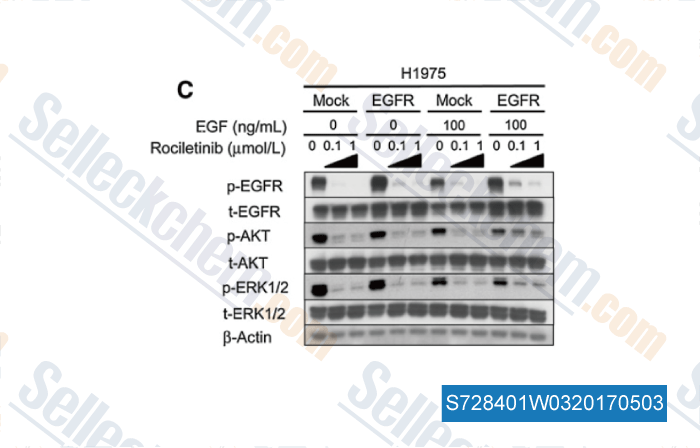
-
, , Cancer Res, 2017, 77(8):2078-2089
-S728402Y0120150901.gif)
-
Daten von [ , , Cancer Discov, 2015, 5(7): 713-22 ]
-S728402W0120150901.gif)
-
Daten von [ , , Cancer Discov, 2015, 5(7): 713-22 ]
-S728402W0220150831.gif)
-
Daten von [ , , Clin Cancer Res, 2015, 10.1158/1078-0432.CCR-15-0560 ]
Sellecks Rociletinib (CO-1686) Wurde zitiert von 38 Publikationen
| Patient-derived rhabdomyosarcoma cells recapitulate the genetic and transcriptomic landscapes of primary tumors [ iScience, 2024, 27(10):110862] | PubMed: 39319271 |
| Establishment and Characterization of NCC-PMP1-C1: A Novel Patient-Derived Cell Line of Metastatic Pseudomyxoma Peritonei [ J Pers Med, 2022, 12(2)258] | PubMed: 35207746 |
| Establishment and characterization of NCC-UPS4-C1: a novel cell line of undifferentiated pleomorphic sarcoma from a patient with Li-Fraumeni syndrome [ Hum Cell, 2022, 10.1007/s13577-022-00671-y] | PubMed: 35118583 |
| Targeting Aurora B kinase prevents and overcomes resistance to EGFR inhibitors in lung cancer by enhancing BIM- and PUMA-mediated apoptosis [ Cancer Cell, 2021, S1535-6108(21)00383-4] | PubMed: 34388376 |
| Overexpression of BIRC6 driven by EGF-JNK-HECTD1 signaling is a potential therapeutic target for triple-negative breast cancer [ Mol Ther Nucleic Acids, 2021, 26:798-812] | PubMed: 34729249 |
| Trametinib overcomes KRAS-G12V-induced osimertinib resistance in a leptomeningeal carcinomatosis model of EGFR-mutant lung cancer [ Cancer Sci, 2021, 112(9):3784-3795] | PubMed: 34145930 |
| Establishment and characterization of the NCC-GCTB4-C1 cell line: a novel patient-derived cell line from giant cell tumor of bone [ Hum Cell, 2021, 10.1007/s13577-021-00639-4] | PubMed: 34731453 |
| Establishment and characterization of NCC-MFS4-C1: a novel patient-derived cell line of myxofibrosarcoma [ Hum Cell, 2021, 34(6):1911-1918] | PubMed: 34383271 |
| Establishment and characterization of novel patient-derived cell lines from giant cell tumor of bone [ Hum Cell, 2021, 10.1007/s13577-021-00579-z] | PubMed: 34304386 |
| Comprehensive pharmacogenomic characterization of gastric cancer. [ Genome Med, 2020, 18;12(1):17] | PubMed: 32070411 |
RÜCKGABERICHTLINIE
Die bedingungslose Rückgaberichtlinie von Selleck Chemical gewährleistet unseren Kunden ein reibungsloses Online-Einkaufserlebnis. Wenn Sie in irgendeiner Weise mit Ihrem Kauf unzufrieden sind, können Sie jeden Artikel innerhalb von 7 Tagen nach Erhalt zurückgeben. Im Falle von Produktqualitätsproblemen, sei es protokollbezogene oder produktbezogene Probleme, können Sie jeden Artikel innerhalb von 365 Tagen ab dem ursprünglichen Kaufdatum zurückgeben. Bitte befolgen Sie die nachstehenden Anweisungen, wenn Sie Produkte zurücksenden.
VERSAND UND LAGERUNG
Selleck-Produkte werden bei Raumtemperatur transportiert. Wenn Sie das Produkt bei Raumtemperatur erhalten, seien Sie versichert, dass die Qualitätskontrollabteilung von Selleck Experimente durchgeführt hat, um zu überprüfen, dass die normale Temperaturplatzierung von einem Monat die biologische Aktivität von Pulverprodukten nicht beeinträchtigt. Nach dem Sammeln lagern Sie das Produkt bitte gemäß den in der Datenblatt beschriebenen Anforderungen. Die meisten Selleck-Produkte sind unter den empfohlenen Bedingungen stabil.
NICHT FÜR DIE ANWENDUNG AM MENSCHEN, FÜR VETERINÄRMEDIZINISCHE DIAGNOSTIK ODER THERAPEUTISCHE ZWECKE.