
Technische Daten
| Formel | C24H27N5O2 |
||||||
| Molekulargewicht | 417.5 | CAS-Nr. | 343787-29-1 | ||||
| Löslichkeit (25°C)* | In vitro | Ethanol | 83 mg/mL (198.8 mM) | ||||
| DMSO | 28 mg/mL (67.06 mM) | ||||||
| Water | Insoluble | ||||||
| In vivo (Lösungsmittel einzeln und der Reihe nach zum Produkt hinzufügen.) |
|
||||||
|
* <1 mg/ml bedeutet schwer löslich oder unlöslich. * Bitte beachten Sie, dass Selleck die Löslichkeit aller Verbindungen intern testet und die tatsächliche Löslichkeit geringfügig von veröffentlichten Werten abweichen kann. Dies ist normal und ist auf geringfügige Batch-zu-Batch-Variationen zurückzuführen. * Versand bei Raumtemperatur (Stabilitätstests zeigen, dass dieses Produkt ohne Kühlmaßnahmen versendet werden kann.) |
|||||||
Vorbereitung von Stammlösungen
Biologische Aktivität
| Beschreibung | CP-673451 ist ein selektiver Inhibitor von PDGFRα/β mit einer IC50 von 10 nM/1 nM in zellfreien Assays, zeigt eine >450-fache Selektivität gegenüber anderen angiogenen Rezeptoren und hat antiangiogene und antitumorale Aktivität. | ||||
|---|---|---|---|---|---|
| Ziele |
|
||||
| In vitro | CP 673451 ist ein selektiver Inhibitor von PDGFRα/β mit einer IC50 von 10 nM/1 nM und zeigt eine >450-fache Selektivität gegenüber anderen angiogenen Rezeptoren. Bei Glioblastom-Tumoren bewirkt diese Verbindung (33 mg/kg) eine >50%ige Hemmung des PDGFR-β-Rezeptors über 4 Stunden, was einer EC50 von 120 ng/mL im Plasma bei Cmax entspricht. In einem Schwamm-Angiogenese-Modell hemmt dieser Inhibitor 70% der PDGF-BB-stimulierten Angiogenese bei einer Dosis von 3 mg/kg (q.d. ×5, p.o., entsprechend 5,5 ng/mL bei Cmax). Diese Chemikalie verringert die Zellproliferationsrate durch Mechanismen, die eine reduzierte Phosphorylierung von GSK-3α und GSK-3β umfassen. In sowohl RD- als auch RUCH2-Kulturen beeinträchtigt sie die Rhabdosphären-bildende Kapazität und die Zelldifferenzierung und führt zu einer erhöhten Seneszenz. |
||||
| In vivo | CP 673451 (einmal tägliche p.o. ?-Tage-Dosierung routinemäßig) hemmt das Tumorwachstum (ED50 < 33 mg/kg) in einer Reihe von humanen Tumor-Xenografts, die s.c. in athymischen Mäusen gezüchtet wurden, einschließlich H460 humanes Lungenkarzinom, Colo205 und LS174T humane Kolonkarzinome und U87MG humanes Glioblastoma multiforme. In RUCH2-Xenograft-tragenden Mäusen reduziert diese Verbindung das Tumorwachstum und die Infiltration von Stromazellen. |
Protokoll (aus Referenz)
| Kinase-Assay: |
|
|---|---|
| Zell-Assay: |
|
| Tierstudie: |
|
Referenzen
|
Kundenproduktvalidierung
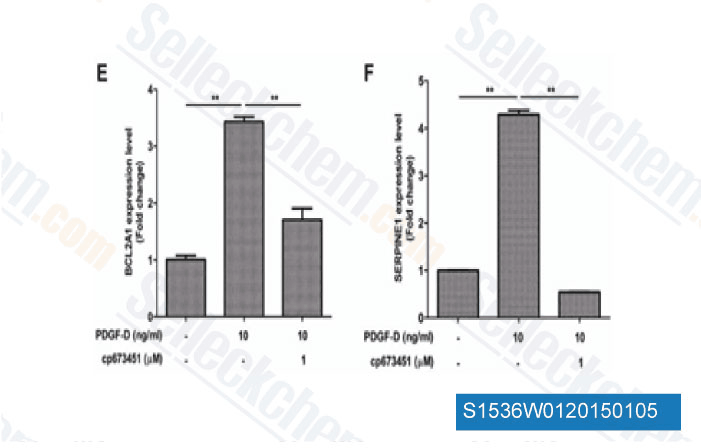
-
Daten von [ Stem Cells , 2014 , 10.1002/stem.1865 ]
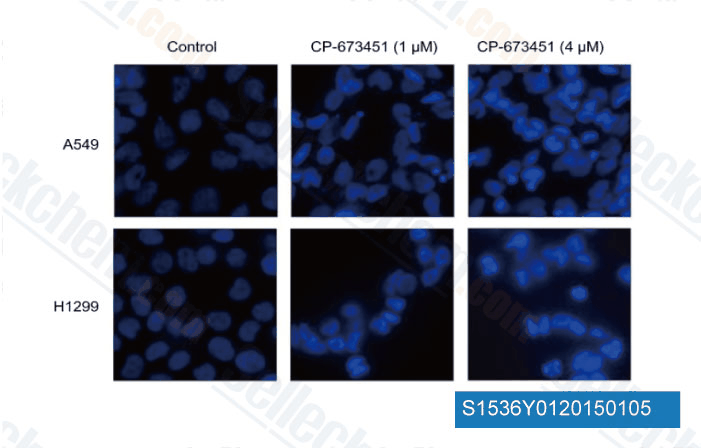
-
Daten von [ Onco Targets Ther , 2014 , 7, 1215-21 ]
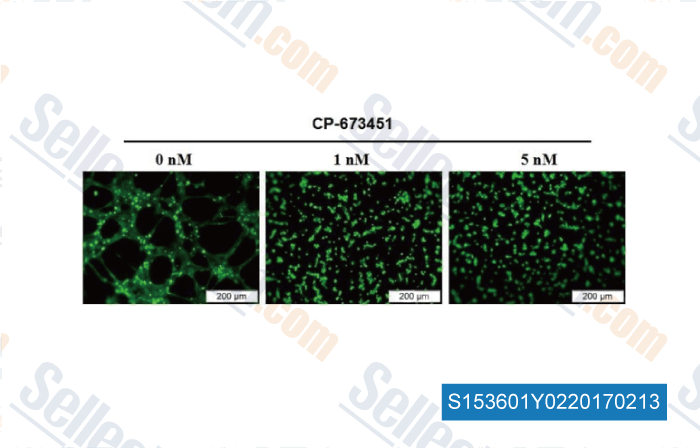
-
Daten von [ , , Environ Toxicol Pharmacol, 2016, 46:168-73. ]
Sellecks CP-673451 Wurde zitiert von 36 Publikationen
| Derivation of embryonic stem cells across avian species [ Nat Biotechnol, 2025, 10.1038/s41587-025-02833-3] | PubMed: 41028831 |
| Tumorigenesis Driven by BRAFV600E Requires Secondary Mutations that Overcome it's Feedback Inhibition of RAC1 and Migration [ Cancer Res, 2025, 10.1158/0008-5472.CAN-24-2220] | PubMed: 39992718 |
| Targeting PDGF signaling of cancer-associated fibroblasts blocks feedback activation of HIF-1α and tumor progression of clear cell ovarian cancer [ Cell Rep Med, 2024, S2666-3791(24)00201-5] | PubMed: 38670097 |
| Combined inhibition of CDK4/6 and AKT is highly effective against the luminal androgen receptor (LAR) subtype of triple negative breast cancer [ Cancer Lett, 2024, 604:217219] | PubMed: 39244005 |
| Exploring the effects of moxibustion on cognitive function in rats with multiple cerebral infarctions from the perspective of glial vascular unit repairing [ Front Pharmacol, 2024, 15:1428907] | PubMed: 39508044 |
| Tumorigenesis driven by the BRAFV600E oncoprotein requires secondary mutations that overcome its feedback inhibition of migration and invasion [ bioRxiv, 2024, 2023.11.21.568071] | PubMed: 38659913 |
| Pericytes protect rats and mice from sepsis-induced injuries by maintaining vascular reactivity and barrier function: implication of miRNAs and microvesicles [ Mil Med Res, 2023, 10(1):13] | PubMed: 36907884 |
| CP-673451, a Selective Platelet-Derived Growth Factor Receptor Tyrosine Kinase Inhibitor, Induces Apoptosis in Opisthorchis viverrini-Associated Cholangiocarcinoma via Nrf2 Suppression and Enhanced ROS [ Pharmaceuticals (Basel), 2023, 17(1)9] | PubMed: 38275995 |
| MiR-3529-3p from PDGF-BB-induced cancer-associated fibroblast-derived exosomes promotes the malignancy of oral squamous cell carcinoma [ Discov Oncol, 2023, 14(1):166] | PubMed: 37668846 |
| Microglia-derived PDGFB promotes neuronal potassium currents to suppress basal sympathetic tonicity and limit hypertension [ Immunity, 2022, S1074-7613(22)00291-6] | PubMed: 35863346 |
RÜCKGABERICHTLINIE
Die bedingungslose Rückgaberichtlinie von Selleck Chemical gewährleistet unseren Kunden ein reibungsloses Online-Einkaufserlebnis. Wenn Sie in irgendeiner Weise mit Ihrem Kauf unzufrieden sind, können Sie jeden Artikel innerhalb von 7 Tagen nach Erhalt zurückgeben. Im Falle von Produktqualitätsproblemen, sei es protokollbezogene oder produktbezogene Probleme, können Sie jeden Artikel innerhalb von 365 Tagen ab dem ursprünglichen Kaufdatum zurückgeben. Bitte befolgen Sie die nachstehenden Anweisungen, wenn Sie Produkte zurücksenden.
VERSAND UND LAGERUNG
Selleck-Produkte werden bei Raumtemperatur transportiert. Wenn Sie das Produkt bei Raumtemperatur erhalten, seien Sie versichert, dass die Qualitätskontrollabteilung von Selleck Experimente durchgeführt hat, um zu überprüfen, dass die normale Temperaturplatzierung von einem Monat die biologische Aktivität von Pulverprodukten nicht beeinträchtigt. Nach dem Sammeln lagern Sie das Produkt bitte gemäß den in der Datenblatt beschriebenen Anforderungen. Die meisten Selleck-Produkte sind unter den empfohlenen Bedingungen stabil.
NICHT FÜR DIE ANWENDUNG AM MENSCHEN, FÜR VETERINÄRMEDIZINISCHE DIAGNOSTIK ODER THERAPEUTISCHE ZWECKE.