
Technische Daten
| Formel | C21H22ClN3O3 |
||||||||||
| Molekulargewicht | 399.87 | CAS-Nr. | 186392-40-5 | ||||||||
| Löslichkeit (25°C)* | In vitro | DMSO | 80 mg/mL (200.06 mM) | ||||||||
| Water | Insoluble | ||||||||||
| Ethanol | Insoluble | ||||||||||
| In vivo (Lösungsmittel einzeln und der Reihe nach zum Produkt hinzufügen.) |
|
||||||||||
|
* <1 mg/ml bedeutet schwer löslich oder unlöslich. * Bitte beachten Sie, dass Selleck die Löslichkeit aller Verbindungen intern testet und die tatsächliche Löslichkeit geringfügig von veröffentlichten Werten abweichen kann. Dies ist normal und ist auf geringfügige Batch-zu-Batch-Variationen zurückzuführen. * Versand bei Raumtemperatur (Stabilitätstests zeigen, dass dieses Produkt ohne Kühlmaßnahmen versendet werden kann.) |
|||||||||||
Vorbereitung von Stammlösungen
Biologische Aktivität
| Beschreibung | CP-91149 ist ein selektiver Glykogenphosphorylase (GP)-Inhibitor mit einer IC50 von 0,13 μM in Anwesenheit von Glukose, 5- bis 10-fach weniger potent in Abwesenheit von Glukose. | ||
|---|---|---|---|
| Ziele |
|
||
| In vitro | CP-91149 displays 200-fold higher inhibitory activity against human liver glycogen phosphorylase a (HLGPa) than caffeine (IC50 = 26 μM). This compound (10-100 μM) inhibits -stimulated glycogenolysis in isolated rat hepatocytes in a dose-dependent manner, and in primary human hepatocytes with IC50 of ~2.1 μM. It also potently inhibits the activities of human muscle phosphorylase a and b with IC50 of 0.2 μM and ~0.3 μM, respectively. Treatment with this chemical at 2.5 μM induces inactivation of phosphorylase and sequential activation of glycogen synthase in hepatocytes, and increases glycogen synthesis by 7-fold at 5 mM glucose and by 2-fold at 20 mM glucose. It can partially counteract the effects of phosphorylase overexpression. This compound also potently inhibits brain GP with IC50 of 0.5 μM in A549 cells. Treatment at 10-30 μM causes significant glycogen accumulation in A549 and HSF55 cells. It treatment increases G1-phase cells with a significant reduction of the S-phase population in HSF55 cells, correlated with increased expression of p21 and p27. This chemical also promotes the dephosphorylation and activation of GS (glycogen synthase) in non-engineered or GP-overexpressing cultured human muscle cells, but exclusively in glucose-deprived cells. |
||
| In vivo | Oral administration of CP-91149 to diabetic ob/ob mice at 25-50 mg/kg causes rapid (3 hours) glucose lowering by 100-120 mg/dl without producing hypoglycemia, resulting from inhibition of glycogenolysis in vivo. This compound treatment does not lower glucose levels in normoglycemic, nondiabetic mice. In the non-fasted Goto-Kakizaki (GK) rats, administration of this chemical in combination with CS-917 suppresses hepatic glycogen reduction by CS-917 and decreases plasma glucose more than single administration of CS-917. |
Protokoll (aus Referenz)
| Kinase-Assay: |
|
|---|---|
| Zell-Assay: |
|
| Tierstudie: |
|
Referenzen
|
Kundenproduktvalidierung
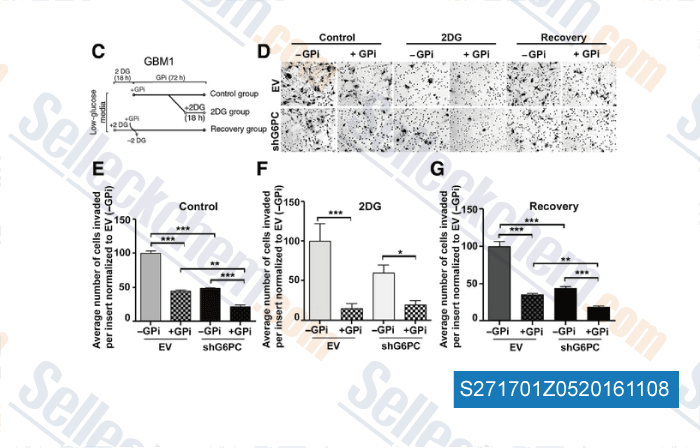
-
, , Mol Cancer Res, 2014, 12(11):1547-59.
Selleck's CP-91149 Wurde zitiert von 14 Publikationen
| Glycogen Metabolism Supports Early Glycolytic Reprogramming and Activation in Dendritic Cells in Response to Both TLR and Syk-Dependent CLR Agonists [ Cells, March 14, 2020, 715] | PubMed: 32183271 |
| Lactate production is a prioritized feature of adipocyte metabolism [ Journal of Biological Chemistry, January 3, 2020, 83-98] | PubMed: 31690627 |
| Regulation of stress granule formation in human oligodendrocytes [ Nat Commun, 2024, 15(1):1524] | PubMed: 38374028 |
| Glycogenesis and glyconeogenesis from glutamine, lactate and glycerol support human macrophage functions [ EMBO Rep, 2024, 10.1038/s44319-024-00278-4] | PubMed: 39424955 |
| Mutant IDH regulates glycogen metabolism from early cartilage development to malignant chondrosarcoma formation [ Cell Rep, 2023, 42(6):112578] | PubMed: 37267108 |
| Glycogen phosphorylase inhibition alongside taxol chemotherapy synergistically elicits ferroptotic cell death in clear cell ovarian and kidney cancers [ bioRxiv, 2023, 10.1101/2023.05.01.538916] | PubMed: None |
| Intracellular energy controls dynamics of stress-induced ribonucleoprotein granules [ Nat Commun, 2022, 13(1):5584] | PubMed: 36151083 |
| TCR activation directly stimulates PYGB-dependent glycogenolysis to fuel the early recall response in CD8+ memory T cells [ Mol Cell, 2022, S1097-2765(22)00538-X] | PubMed: 35738262 |
| A genome-wide CRISPR-Cas9 screen identifies CENPJ as a host regulator of altered microtubule organization during Plasmodium liver infection [ Cell Chem Biol, 2022, S2451-9456(22)00205-7] | PubMed: 35738280 |
| Analysis of the expression, function and signaling of glycogen phosphorylase isoforms in hepatocellular carcinoma [ Oncol Lett, 2022, 24(2):244] | PubMed: 35761940 |
RÜCKGABERICHTLINIE
Die bedingungslose Rückgaberichtlinie von Selleck Chemical gewährleistet unseren Kunden ein reibungsloses Online-Einkaufserlebnis. Wenn Sie in irgendeiner Weise mit Ihrem Kauf unzufrieden sind, können Sie jeden Artikel innerhalb von 7 Tagen nach Erhalt zurückgeben. Im Falle von Produktqualitätsproblemen, sei es protokollbezogene oder produktbezogene Probleme, können Sie jeden Artikel innerhalb von 365 Tagen ab dem ursprünglichen Kaufdatum zurückgeben. Bitte befolgen Sie die nachstehenden Anweisungen, wenn Sie Produkte zurücksenden.
VERSAND UND LAGERUNG
Selleck-Produkte werden bei Raumtemperatur transportiert. Wenn Sie das Produkt bei Raumtemperatur erhalten, seien Sie versichert, dass die Qualitätskontrollabteilung von Selleck Experimente durchgeführt hat, um zu überprüfen, dass die normale Temperaturplatzierung von einem Monat die biologische Aktivität von Pulverprodukten nicht beeinträchtigt. Nach dem Sammeln lagern Sie das Produkt bitte gemäß den in der Datenblatt beschriebenen Anforderungen. Die meisten Selleck-Produkte sind unter den empfohlenen Bedingungen stabil.
NICHT FÜR DIE ANWENDUNG AM MENSCHEN, FÜR VETERINÄRMEDIZINISCHE DIAGNOSTIK ODER THERAPEUTISCHE ZWECKE.