
Technische Daten
| Formel | C24H25N5O |
||||||
| Molekulargewicht | 399.49 | CAS-Nr. | 866405-64-3 | ||||
| Löslichkeit (25°C)* | In vitro | DMSO | 2 mg/mL (5.0 mM) | ||||
| Water | Insoluble | ||||||
| Ethanol | Insoluble | ||||||
| In vivo (Lösungsmittel einzeln und der Reihe nach zum Produkt hinzufügen.) |
|
||||||
|
* <1 mg/ml bedeutet schwer löslich oder unlöslich. * Bitte beachten Sie, dass Selleck die Löslichkeit aller Verbindungen intern testet und die tatsächliche Löslichkeit geringfügig von veröffentlichten Werten abweichen kann. Dies ist normal und ist auf geringfügige Batch-zu-Batch-Variationen zurückzuführen. * Versand bei Raumtemperatur (Stabilitätstests zeigen, dass dieses Produkt ohne Kühlmaßnahmen versendet werden kann.) |
|||||||
Vorbereitung von Stammlösungen
Biologische Aktivität
| Beschreibung | Dorsomorphin ist ein potenter, reversibler, selektiver AMPK-Inhibitor mit einem Ki von 109 nM in zellfreien Assays, der keine signifikante Hemmung mehrerer strukturell verwandter Kinasen wie ZAPK, SYK, PKCθ, PKA und JAK3 zeigt. Dorsomorphin hemmt selektiv die BMP-Typ-I-Rezeptoren ALK2, ALK3 und ALK6. Dorsomorphin wird zur Förderung spezifischer Zelldifferenzierung und zur Induktion der Autophagie von Krebszelllinien eingesetzt. Für Zelltests wird das wasserlösliche S7306 Dorsomorphin (Compound C) 2HCl empfohlen. | ||||||||
|---|---|---|---|---|---|---|---|---|---|
| Ziele |
|
||||||||
| In vitro | Dorsomorphin hemmt die ACC-Inaktivierung sowohl durch AICAR und attenuatiert auch die Wirkung von AICAR, die Fettsäureoxidation zu erhöhen oder lipogene Gene in Hepatozyten zu unterdrücken. Die Hemmung der AMPK-Aktivität durch diese Verbindung hemmt die autophagische Proteolyse in HT-29-Zellen fast vollständig. Darüber hinaus hemmt diese Chemikalie selektiv die BMP-Typ-I-Rezeptoren ALK2, ALK3 und ALK6 und blockiert somit die BMP-vermittelte SMAD1/5/8-Phosphorylierung, die Transkription von Zielgenen und die osteogene Differenzierung. |
||||||||
| In vivo | Dorsomorphin (10 mg/kg) reduziert die basalen Hepcidin-Expressionswerte und erhöht die Serumeisenkonzentrationen bei erwachsenen Mäusen. Diese Verbindung (0,2 mg/kg, i.v.) reduziert signifikant die VCAM-1- und ICAM-1-Expression in der thorakalen Aorta von LPS-behandelten Ratten. |
Protokoll (aus Referenz)
| Kinase-Assay: |
|
|---|---|
| Tierstudie: |
|
Referenzen
|
Kundenproduktvalidierung
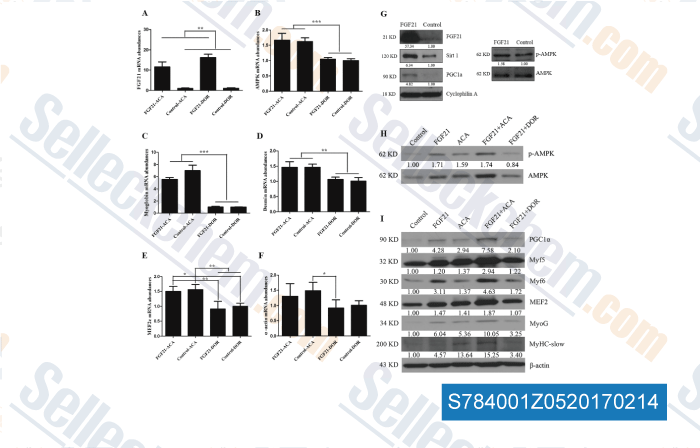
-
, , J Cell Physiol, 2017, 232(7):1893-1906
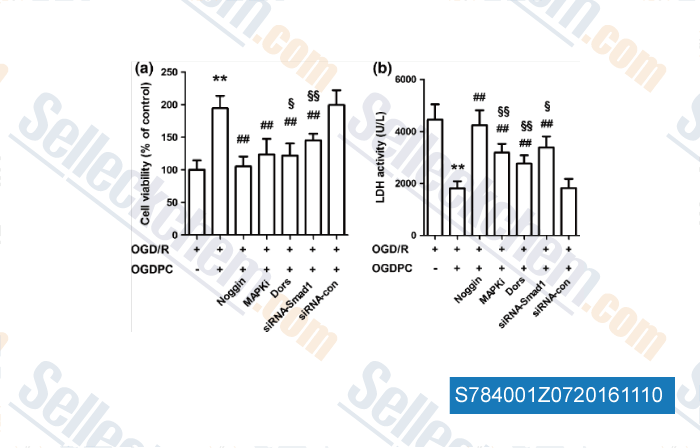
-
, , Clin Exp Pharmacol Physiol, 2016, 43(1):125-34.
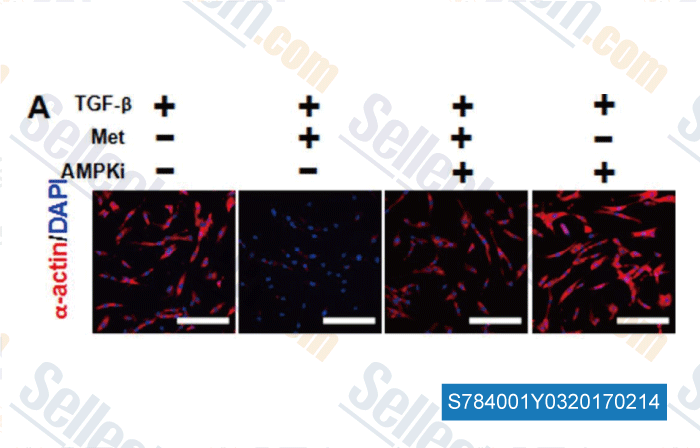
-
Daten von [ , , Oncotarget, 2016, 6(41):43605-19. ]
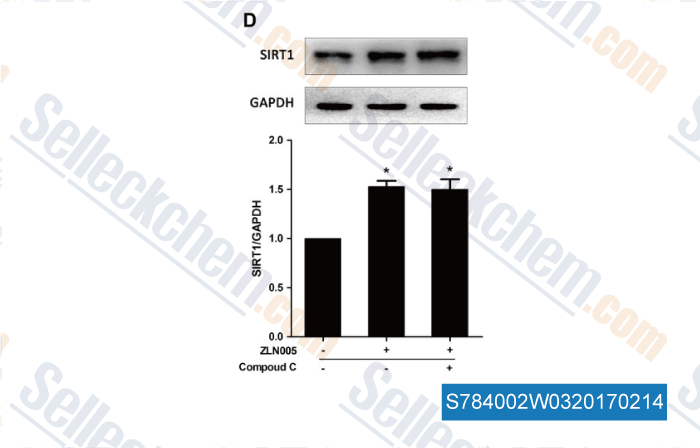
-
Daten von [ , , Exp Cell Res, 2016, 345(1):25-36. ]
Sellecks Dorsomorphin (Compound C) Wurde zitiert von 483 Publikationen
| METTL3 and METTL14 determine human neural fate specifications [ Nucleic Acids Res, 2025, 53(22)gkaf1397] | PubMed: 41385324 |
| Short-term starvation inhibits CD36 N-glycosylation and downregulates USP7 UFMylation to alleviate RBPJ-maintained T cell exhaustion in liver cancer [ Theranostics, 2025, 15(12):5931-5952] | PubMed: 40365281 |
| CETN3 deficiency induces microcephaly by disrupting neural stem/progenitor cell fate through impaired centrosome assembly and RNA splicing [ EMBO Mol Med, 2025, 17(10):2735-2761] | PubMed: 40926052 |
| The role of oxidative stress-mediated fibro-adipogenic progenitor senescence in skeletal muscle regeneration and repair [ Stem Cell Res Ther, 2025, 16(1):104] | PubMed: 40025535 |
| Induced pluripotent stem cells carrying novel APTX mutations presented defective neural differentiation with the accumulation of DNA single-strand breaks [ Cell Death Discov, 2025, 11(1):481] | PubMed: 41136416 |
| ERK1-mediated GLYCTK2 phosphorylation promotes fructolysis to sustain glioblastoma survival under glucose deprivation [ Cell Death Discov, 2025, 11(1):266] | PubMed: 40467571 |
| Unlocking Hopeaphenol: A Potent Ally Against Cardiac Hypertrophy via AMPK Activation [ Nutrients, 2025, 17(18)3025] | PubMed: 41010549 |
| D-mannose promotes diabetic wound healing through inhibiting advanced glycation end products formation in keratinocytes [ Mol Med, 2025, 31(1):15] | PubMed: 39827347 |
| Development of FGF21 Mutant with Potent Cardioprotective Effects in T2D Mice via FGFR1-AMPK-Mediated Inhibition of Oxidative Stress [ Int J Mol Sci, 2025, 26(14)6577] | PubMed: 40724827 |
| Vicenin-2 Hinders Pro-Inflammatory Response via Targeting the CaMKKβ-AMPK-SIRT1 Axis in Lipopolysaccharide-Stressed THP-1 Cells [ Int J Mol Sci, 2025, 26(5)2077] | PubMed: 40076701 |
RÜCKGABERICHTLINIE
Die bedingungslose Rückgaberichtlinie von Selleck Chemical gewährleistet unseren Kunden ein reibungsloses Online-Einkaufserlebnis. Wenn Sie in irgendeiner Weise mit Ihrem Kauf unzufrieden sind, können Sie jeden Artikel innerhalb von 7 Tagen nach Erhalt zurückgeben. Im Falle von Produktqualitätsproblemen, sei es protokollbezogene oder produktbezogene Probleme, können Sie jeden Artikel innerhalb von 365 Tagen ab dem ursprünglichen Kaufdatum zurückgeben. Bitte befolgen Sie die nachstehenden Anweisungen, wenn Sie Produkte zurücksenden.
VERSAND UND LAGERUNG
Selleck-Produkte werden bei Raumtemperatur transportiert. Wenn Sie das Produkt bei Raumtemperatur erhalten, seien Sie versichert, dass die Qualitätskontrollabteilung von Selleck Experimente durchgeführt hat, um zu überprüfen, dass die normale Temperaturplatzierung von einem Monat die biologische Aktivität von Pulverprodukten nicht beeinträchtigt. Nach dem Sammeln lagern Sie das Produkt bitte gemäß den in der Datenblatt beschriebenen Anforderungen. Die meisten Selleck-Produkte sind unter den empfohlenen Bedingungen stabil.
NICHT FÜR DIE ANWENDUNG AM MENSCHEN, FÜR VETERINÄRMEDIZINISCHE DIAGNOSTIK ODER THERAPEUTISCHE ZWECKE.