
Technische Daten
| Formel | C24H25N5O.2HCl |
|||
| Molekulargewicht | 472.41 | CAS-Nr. | 1219168-18-9 | |
| Löslichkeit (25°C)* | In vitro | Water | 94 mg/mL (198.97 mM) | |
| DMSO | Insoluble | |||
| Ethanol | Insoluble | |||
|
* <1 mg/ml bedeutet schwer löslich oder unlöslich. * Bitte beachten Sie, dass Selleck die Löslichkeit aller Verbindungen intern testet und die tatsächliche Löslichkeit geringfügig von veröffentlichten Werten abweichen kann. Dies ist normal und ist auf geringfügige Batch-zu-Batch-Variationen zurückzuführen. * Versand bei Raumtemperatur (Stabilitätstests zeigen, dass dieses Produkt ohne Kühlmaßnahmen versendet werden kann.) |
||||
Vorbereitung von Stammlösungen
Biologische Aktivität
| Beschreibung | Dorsomorphin 2HCl ist ein potenter, reversibler, selektiver AMPK-Inhibitor mit einem Ki von 109 nM in zellfreien Assays, der keine signifikante Hemmung mehrerer strukturell verwandter Kinasen wie ZAPK, SYK, PKCθ, PKA und JAK3 aufweist. Hemmt auch die Aktivität des Typ-I-BMP-Rezeptors. Dorsomorphin induziert Autophagy in Krebszelllinien. | ||||||||
|---|---|---|---|---|---|---|---|---|---|
| Ziele |
|
||||||||
| In vitro | Dorsomorphin hemmt die ACC-Inaktivierung durch AICAR und schwächt auch die Wirkung von AICAR ab, die Fettsäureoxidation zu erhöhen oder lipogene Gene in Hepatozyten zu unterdrücken. Die Hemmung der AMPK-Aktivität durch Dorsomorphin hemmt die autophagische Proteolyse in HT-29-Zellen fast vollständig. Darüber hinaus hemmt Dorsomorphin selektiv die BMP-Typ-I-Rezeptoren ALK2, ALK3 und ALK6 und blockiert somit die BMP-vermittelte SMAD1/5/8-Phosphorylierung, die Transkription von Zielgenen und die osteogene Differenzierung. |
||||||||
| In vivo | Dorsomorphin (10 mg/kg) reduziert die basalen Hepcidin-Expressionsspiegel und erhöht die Serumeisenkonzentrationen bei erwachsenen Mäusen. Dorsomorphin (0,2 mg/kg, i.v.) reduziert signifikant die VCAM-1- und ICAM-1-Expression in der thorakalen Aorta von LPS-behandelten Ratten. |
Protokoll (aus Referenz)
| Kinase-Assay: |
|
|---|---|
| Zell-Assay: |
|
| Tierstudie: |
|
Referenzen
|
Kundenproduktvalidierung
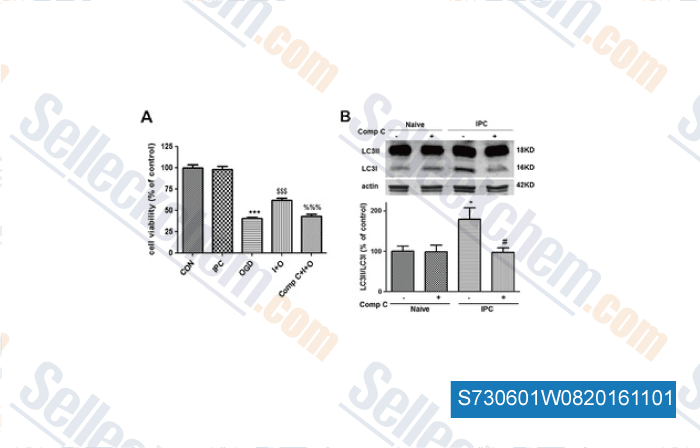
-
, , Mol Brain, 2015 ,8:20.
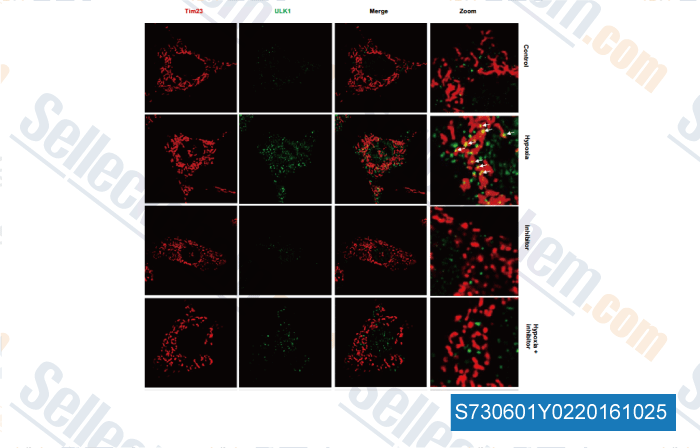
-
, , FEBS Lett, 2015, 589(15):1847-54.
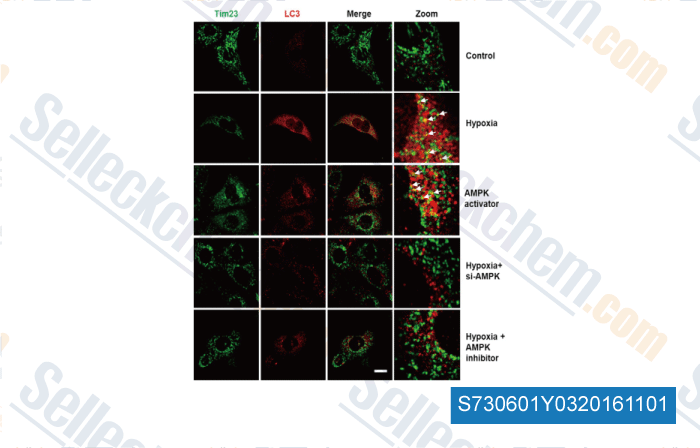
-
, , FEBS Letters, 2015, 1847-1854.
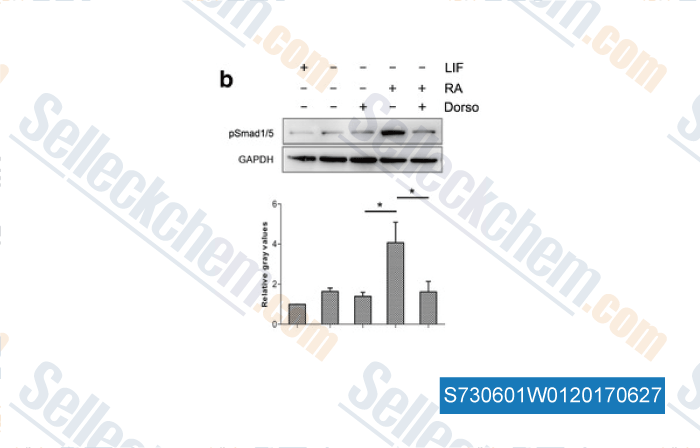
-
Daten von [ , , BMC Biotechnol, 2017, 17(1):17 ]
Sellecks Dorsomorphin Dihydrochloride Wurde zitiert von 522 Publikationen
| Coenzyme A protects against ferroptosis via CoAlation of mitochondrial thioredoxin reductase [ J Clin Invest, 2025, e190215] | PubMed: 40694424 |
| Inhibition of S100A8/A9 ameliorates neuroinflammation by blocking NET formation following traumatic brain injury [ Redox Biol, 2025, 81:103532] | PubMed: 39929053 |
| Oncogene-induced senescence mitochondrial metabolism and bioenergetics drive the secretory phenotype: further characterization and comparison with other senescence-inducing stimuli [ Redox Biol, 2025, 82:103606] | PubMed: 40158257 |
| Sulforaphane protects developing neural networks from VPA-induced synaptic alterations [ Mol Psychiatry, 2025, 10.1038/s41380-025-02967-5] | PubMed: 40175519 |
| AAV-mediated overexpression of CPT1B protects from cardiac hypertrophy and heart failure in a murine pressure overload model [ Basic Res Cardiol, 2025, 10.1007/s00395-025-01123-y] | PubMed: 40646338 |
| CHCHD2 rescues the mitochondrial dysfunction in iPSC-derived neurons from patient with Mohr-Tranebjaerg syndrome [ Cell Death Dis, 2025, 16(1):173] | PubMed: 40075073 |
| SIRT1 prevents noise-induced hearing loss by enhancing cochlear mitochondrial function [ Cell Commun Signal, 2025, 23(1):160] | PubMed: 40176044 |
| Methylstat sensitizes ovarian cancer cells to PARP-inhibition by targeting the histone demethylases JMJD1B/C [ Cancer Gene Ther, 2025, 10.1038/s41417-025-00874-z] | PubMed: 39915607 |
| Cordycepin alleviates metabolic dysfunction-associated liver disease by restoring mitochondrial homeostasis and reducing oxidative stress via Parkin-mediated mitophagy [ Biochem Pharmacol, 2025, 232:116750] | PubMed: 39793718 |
| Quantitative Live Imaging Reveals Phase Dependency of PDAC Patient-Derived Organoids on ERK and AMPK Activity [ Cancer Sci, 2025, 116(3):724-735] | PubMed: 39731327 |
RÜCKGABERICHTLINIE
Die bedingungslose Rückgaberichtlinie von Selleck Chemical gewährleistet unseren Kunden ein reibungsloses Online-Einkaufserlebnis. Wenn Sie in irgendeiner Weise mit Ihrem Kauf unzufrieden sind, können Sie jeden Artikel innerhalb von 7 Tagen nach Erhalt zurückgeben. Im Falle von Produktqualitätsproblemen, sei es protokollbezogene oder produktbezogene Probleme, können Sie jeden Artikel innerhalb von 365 Tagen ab dem ursprünglichen Kaufdatum zurückgeben. Bitte befolgen Sie die nachstehenden Anweisungen, wenn Sie Produkte zurücksenden.
VERSAND UND LAGERUNG
Selleck-Produkte werden bei Raumtemperatur transportiert. Wenn Sie das Produkt bei Raumtemperatur erhalten, seien Sie versichert, dass die Qualitätskontrollabteilung von Selleck Experimente durchgeführt hat, um zu überprüfen, dass die normale Temperaturplatzierung von einem Monat die biologische Aktivität von Pulverprodukten nicht beeinträchtigt. Nach dem Sammeln lagern Sie das Produkt bitte gemäß den in der Datenblatt beschriebenen Anforderungen. Die meisten Selleck-Produkte sind unter den empfohlenen Bedingungen stabil.
NICHT FÜR DIE ANWENDUNG AM MENSCHEN, FÜR VETERINÄRMEDIZINISCHE DIAGNOSTIK ODER THERAPEUTISCHE ZWECKE.