
Technische Daten
| Formel | C25H29Cl2F3N2O4S |
||||||
| Molekulargewicht | 581.47 | CAS-Nr. | 754240-09-0 | ||||
| Löslichkeit (25°C)* | In vitro | DMSO | 100 mg/mL (171.97 mM) | ||||
| Water | 100 mg/mL (171.97 mM) | ||||||
| Ethanol | Insoluble | ||||||
| In vivo (Lösungsmittel einzeln und der Reihe nach zum Produkt hinzufügen.) |
|
||||||
|
* <1 mg/ml bedeutet schwer löslich oder unlöslich. * Bitte beachten Sie, dass Selleck die Löslichkeit aller Verbindungen intern testet und die tatsächliche Löslichkeit geringfügig von veröffentlichten Werten abweichen kann. Dies ist normal und ist auf geringfügige Batch-zu-Batch-Variationen zurückzuführen. * Versand bei Raumtemperatur (Stabilitätstests zeigen, dass dieses Produkt ohne Kühlmaßnahmen versendet werden kann.) |
|||||||
Vorbereitung von Stammlösungen
Biologische Aktivität
| Beschreibung | EHT 1864 2HCl ist ein potenter Rac family GTPase-Inhibitor mit einer Kd von 40 nM, 50 nM, 60 nM und 250 nM für Rac1, Rac1b, Rac2 bzw. Rac3. | ||||||||
|---|---|---|---|---|---|---|---|---|---|
| Ziele |
|
||||||||
| In vitro | EHT 1864 hemmt selektiv die Rac-induzierte Lamellipodienbildung und kehrt spezifisch die Zelltransformation um, die durch konstitutiv aktivierte Mutanten von Rac1 und Tiam1 induziert wird. EHT 1864 beeinträchtigt stark die onkogene Ras-induzierte Zellproliferation in NIH 3T3-Zellen, die stabil H-Ras(61L)-Protein exprimieren. EHT 1864 reduziert auch die extrazellulären und intrazellulären Spiegel von Aβ-Peptiden durch Hemmung der γ-Sekretase-abhängigen Spaltung von APP. In kultivierten hippocampalen Pyramidenneuronen rettet EHT 1864 über die Hemmung von Rac1 den durch Rich2-Knockdown induzierten Phänotyp. | ||||||||
| In vivo | EHT 1864 (40 mg/kg i.p.) reduziert signifikant die Abeta 40- und Abeta 42-Spiegel in Meerschweinchengehirnen. |
Protokoll (aus Referenz)
| Kinase-Assay:[1] |
|
|---|---|
| Zell-Assay:[1] |
|
| Tierstudie:[2] |
|
Referenzen
|
Kundenproduktvalidierung
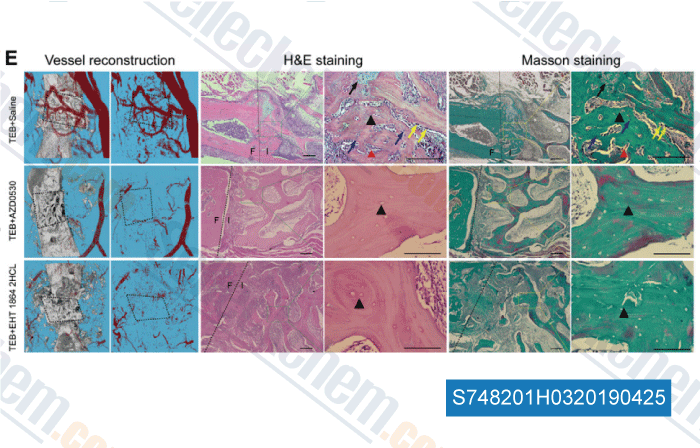
-
Daten von [ , , FASEB J, 2018, 32(4):2197-2211 ]

-
Daten von [ , , Am J Cancer Res, 2018, 8(1):70-80 ]
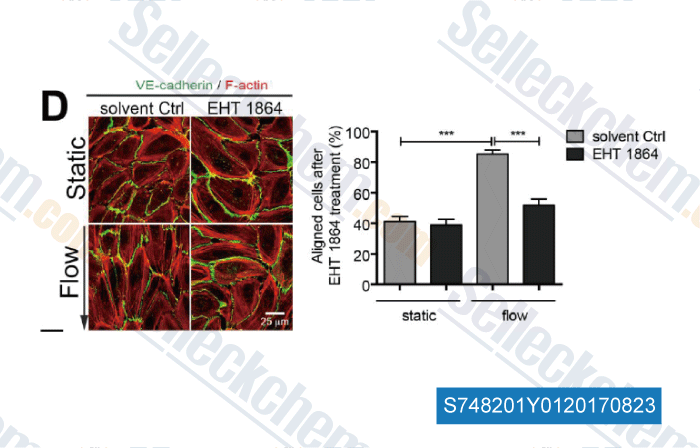
-
Daten von [ , , Mol Biol Cell, 2017, 28(13):1745-1753 ]
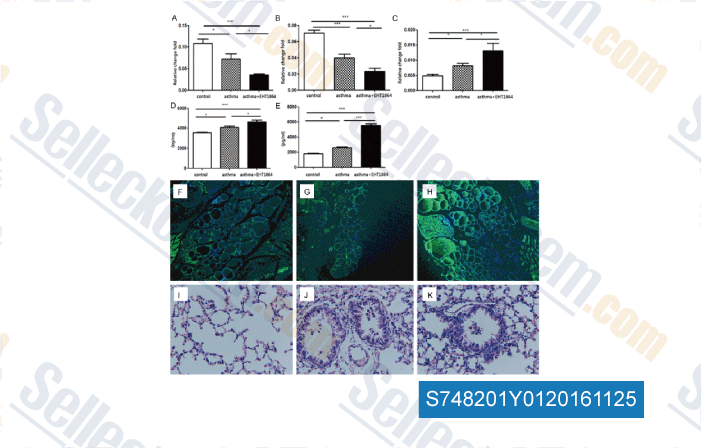
-
Daten von [ , , Int J Clin Exp Pathol, 2016, 9(6):5902-5911. ]
Sellecks EHT 1864 2HCl Wurde zitiert von 26 Publikationen
| PI(3,4,5)P3-mediated Cdc42 activation regulates macrophage podosome assembly [ Cell Mol Life Sci, 2025, 82(1):127] | PubMed: 40126693 |
| Hyperlipidemia drives tumor growth in a mouse model of obesity-accelerated breast cancer growth [ Cancer Metab, 2025, 13(1):39] | PubMed: 40877972 |
| Formation control between leader and migratory follower tissues allows coordinated growth [ Sci Adv, 2025, 11(31):eads2310] | PubMed: 40737421 |
| Gadd45g insufficiency drives the pathogenesis of myeloproliferative neoplasms [ Nat Commun, 2024, 15(1):2989] | PubMed: 38582902 |
| Oct4 controls basement membrane development during human embryogenesis [ Dev Cell, 2024, S1534-5807(24)00175-8] | PubMed: 38579716 |
| RAC1 inhibition ameliorates IBSP-induced bone metastasis in lung adenocarcinoma [ Cell Rep, 2024, 43(8):114528] | PubMed: 39052477 |
| Allometrically scaling tissue forces drive pathological foreign-body responses to implants via Rac2-activated myeloid cells [ Nat Biomed Eng, 2023, 10.1038/s41551-023-01091-5] | PubMed: 37749310 |
| The PMA phorbol ester tumor promoter increases canonical Wnt signaling via macropinocytosis [ Elife, 2023, 12RP89141] | PubMed: 37902809 |
| High-Content and High-Throughput Clonogenic Survival Assay Using Fluorescence Barcoding [ Cancers -Basel), 2023, 15(19)4772] | PubMed: 37835466 |
| Inhibition of exchange proteins directly activated by cAMP as a strategy for broad-spectrum antiviral development [ J Biol Chem, 2023, 299(6):104749] | PubMed: 37100284 |
RÜCKGABERICHTLINIE
Die bedingungslose Rückgaberichtlinie von Selleck Chemical gewährleistet unseren Kunden ein reibungsloses Online-Einkaufserlebnis. Wenn Sie in irgendeiner Weise mit Ihrem Kauf unzufrieden sind, können Sie jeden Artikel innerhalb von 7 Tagen nach Erhalt zurückgeben. Im Falle von Produktqualitätsproblemen, sei es protokollbezogene oder produktbezogene Probleme, können Sie jeden Artikel innerhalb von 365 Tagen ab dem ursprünglichen Kaufdatum zurückgeben. Bitte befolgen Sie die nachstehenden Anweisungen, wenn Sie Produkte zurücksenden.
VERSAND UND LAGERUNG
Selleck-Produkte werden bei Raumtemperatur transportiert. Wenn Sie das Produkt bei Raumtemperatur erhalten, seien Sie versichert, dass die Qualitätskontrollabteilung von Selleck Experimente durchgeführt hat, um zu überprüfen, dass die normale Temperaturplatzierung von einem Monat die biologische Aktivität von Pulverprodukten nicht beeinträchtigt. Nach dem Sammeln lagern Sie das Produkt bitte gemäß den in der Datenblatt beschriebenen Anforderungen. Die meisten Selleck-Produkte sind unter den empfohlenen Bedingungen stabil.
NICHT FÜR DIE ANWENDUNG AM MENSCHEN, FÜR VETERINÄRMEDIZINISCHE DIAGNOSTIK ODER THERAPEUTISCHE ZWECKE.