
Technische Daten
| Formel | C34H33N3O5 |
||||||||||
| Molekulargewicht | 563.64 | CAS-Nr. | 143664-11-3 | ||||||||
| Löslichkeit (25°C)* | In vitro | DMSO | 41 mg/mL (72.74 mM) | ||||||||
| Water | Insoluble | ||||||||||
| Ethanol | Insoluble | ||||||||||
| In vivo (Lösungsmittel einzeln und der Reihe nach zum Produkt hinzufügen.) |
|
||||||||||
|
* <1 mg/ml bedeutet schwer löslich oder unlöslich. * Bitte beachten Sie, dass Selleck die Löslichkeit aller Verbindungen intern testet und die tatsächliche Löslichkeit geringfügig von veröffentlichten Werten abweichen kann. Dies ist normal und ist auf geringfügige Batch-zu-Batch-Variationen zurückzuführen. * Versand bei Raumtemperatur (Stabilitätstests zeigen, dass dieses Produkt ohne Kühlmaßnahmen versendet werden kann.) |
|||||||||||
Vorbereitung von Stammlösungen
Biologische Aktivität
| Beschreibung | Elacridar (GF120918, GW120918, GG918, GW0918) ist ein potenter P-gp (MDR-1) und BCRP Inhibitor. | ||
|---|---|---|---|
| Ziele |
|
||
| In vitro | Elacridar (GF120918) hemmt die P-Glykoprotein (P-gp)-Markierung durch [3H]Azidopin mit einer IC50 von 0,16 μM. In Caki-1- und ACHN-Zellen hemmt es (2,5 μM) signifikant das Zellwachstum. Es wurde festgestellt, dass die P-Glykoprotein-Aktivität durch diese Verbindung gehemmt wird. Ihre Kombination führte zu einer signifikanten Reduktion der ABC-Subfamilie B Member 2 (ABCG2)-Expression in 786-O-Zellen. |
||
| In vivo | Elacridar (GF120918) erhöht die Plasma- und Hirnkonzentrationen sowie die Hirn-Plasma-Verhältnisse bei Wildtyp-Mäusen, wenn es oral (100 mg/kg, p.o.) ko-administriert wird, was den Spiegeln in Abcb1a/1b; Abcg2-/- Mäusen entspricht. Bei Friend-Leukämie-Virusstamm-B-Mäusen beträgt der Hirn-Plasma-Verteilungskoeffizient (Kp, Hirn) dieser Verbindung 0,82, 0,43 und 4,31 nach intravenöser (2,5 mg/kg), intraperitonealer (100 mg/kg) bzw. oraler (100 mg/kg) Behandlung. In Mrp4(-/-) Mäusen hemmt es den P-gp-vermittelten Transport vollständig, ohne signifikante Auswirkungen auf den Bcrp1-vermittelten Transport. |
Protokoll (aus Referenz)
| Kinase-Assay: |
|
|---|---|
| Zell-Assay: |
|
| Tierstudie: |
|
Referenzen
|
Kundenproduktvalidierung
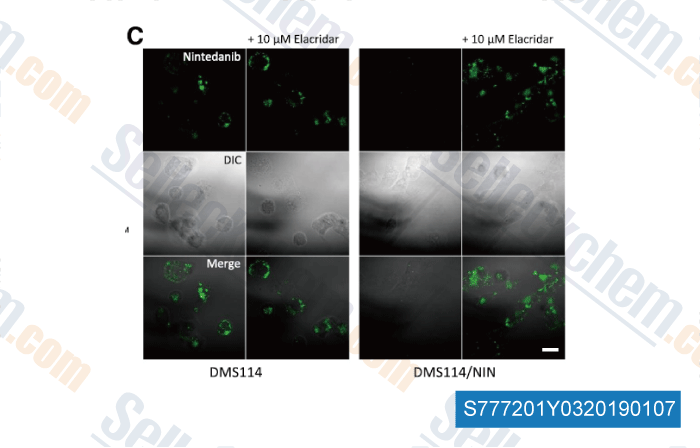
-
Daten von [ , , J Exp Clin Cancer Res, 2017, 36(1):122 ]
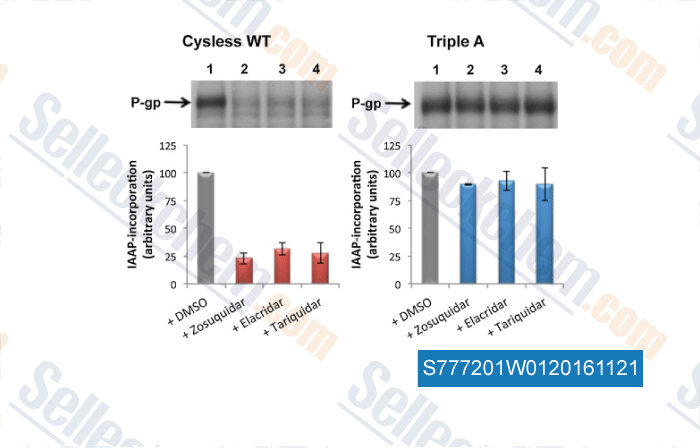
-
Daten von [ , , Biochem Pharmacol, 2016, 101:40-53. ]
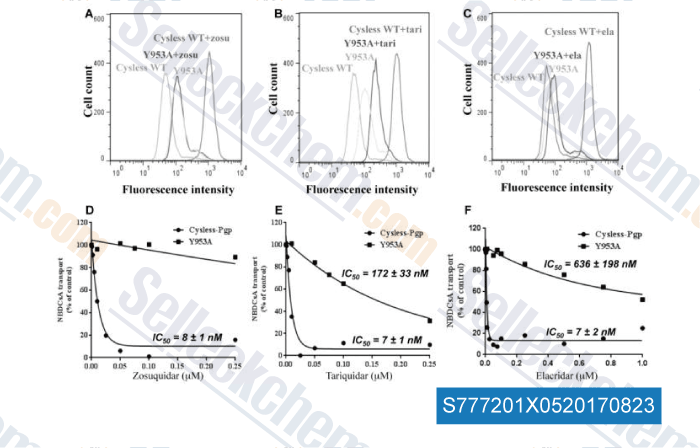
-
Daten von [ , , Biochem Pharmacol, 2016, 101:40-53 ]
Sellecks Elacridar (GF120918) Wurde zitiert von 30 Publikationen
| Identification of the Notch ligand DLK1 as an immunotherapeutic target and regulator of tumor cell plasticity and chemoresistance in adrenocortical carcinoma [ Nat Commun, 2025, 16(1):5511] | PubMed: 40595495 |
| Screening a living biobank identifies cabazitaxel as a strategy to combat acquired taxol resistance in high-grade serous ovarian cancer [ Cell Rep Med, 2025, 6(6):102160] | PubMed: 40466638 |
| Synthesis of carbon dots from spent coffee grounds: transforming waste into potential biomedical tools [ Nanoscale, 2025, 17(16):9947-9962] | PubMed: 40067158 |
| Nbeal2 Inactivation Triggers Abl1 Stabilisation and Dysregulated Subcellular Localisation of the Multi-Drug-Resistant Protein MDR1 (ABCB1) in Mast Cells [ Immunology, 2025, NONE] | PubMed: 41111259 |
| Targeting SUMOylation in ovarian cancer: Sensitivity, resistance, and the role of MYC [ iScience, 2025, 28(6):112555] | PubMed: 40487451 |
| Elacridar Inhibits BCRP Protein Activity in 2D and 3D Cell Culture Models of Ovarian Cancer and Re-Sensitizes Cells to Cytotoxic Drugs [ Int J Mol Sci, 2025, 26(12)5800] | PubMed: 40565261 |
| The Role of Elacridar, a P-gp Inhibitor, in the Re-Sensitization of PAC-Resistant Ovarian Cancer Cell Lines to Cytotoxic Drugs in 2D and 3D Cell Culture Models [ Int J Mol Sci, 2025, 26(3)1124] | PubMed: 39940891 |
| Overcoming ABCB1 mediated multidrug resistance in castration resistant prostate cancer [ Cell Death Dis, 2024, 15(8):558] | PubMed: 39090086 |
| Targeting the glutamine metabolism to suppress cell proliferation in mesenchymal docetaxel-resistant prostate cancer [ Oncogene, 2024, 43(26):2038-2050] | PubMed: 38750263 |
| Abcg2a is the functional homolog of human ABCG2 expressed at the zebrafish blood-brain barrier [ Fluids Barriers CNS, 2024, 21(1):27] | PubMed: 38491505 |
RÜCKGABERICHTLINIE
Die bedingungslose Rückgaberichtlinie von Selleck Chemical gewährleistet unseren Kunden ein reibungsloses Online-Einkaufserlebnis. Wenn Sie in irgendeiner Weise mit Ihrem Kauf unzufrieden sind, können Sie jeden Artikel innerhalb von 7 Tagen nach Erhalt zurückgeben. Im Falle von Produktqualitätsproblemen, sei es protokollbezogene oder produktbezogene Probleme, können Sie jeden Artikel innerhalb von 365 Tagen ab dem ursprünglichen Kaufdatum zurückgeben. Bitte befolgen Sie die nachstehenden Anweisungen, wenn Sie Produkte zurücksenden.
VERSAND UND LAGERUNG
Selleck-Produkte werden bei Raumtemperatur transportiert. Wenn Sie das Produkt bei Raumtemperatur erhalten, seien Sie versichert, dass die Qualitätskontrollabteilung von Selleck Experimente durchgeführt hat, um zu überprüfen, dass die normale Temperaturplatzierung von einem Monat die biologische Aktivität von Pulverprodukten nicht beeinträchtigt. Nach dem Sammeln lagern Sie das Produkt bitte gemäß den in der Datenblatt beschriebenen Anforderungen. Die meisten Selleck-Produkte sind unter den empfohlenen Bedingungen stabil.
NICHT FÜR DIE ANWENDUNG AM MENSCHEN, FÜR VETERINÄRMEDIZINISCHE DIAGNOSTIK ODER THERAPEUTISCHE ZWECKE.