
Technische Daten
| Formel | C21H25N7 |
||||||
| Molekulargewicht | 375.47 | CAS-Nr. | 934353-76-1 | ||||
| Löslichkeit (25°C)* | In vitro | DMSO | 105 mg/mL (279.64 mM) | ||||
| Water | 1 mg/mL (2.66 mM) | ||||||
| Ethanol | 1 mg/mL (2.66 mM) | ||||||
| In vivo (Lösungsmittel einzeln und der Reihe nach zum Produkt hinzufügen.) |
|
||||||
|
* <1 mg/ml bedeutet schwer löslich oder unlöslich. * Bitte beachten Sie, dass Selleck die Löslichkeit aller Verbindungen intern testet und die tatsächliche Löslichkeit geringfügig von veröffentlichten Werten abweichen kann. Dies ist normal und ist auf geringfügige Batch-zu-Batch-Variationen zurückzuführen. * Versand bei Raumtemperatur (Stabilitätstests zeigen, dass dieses Produkt ohne Kühlmaßnahmen versendet werden kann.) |
|||||||
Vorbereitung von Stammlösungen
Biologische Aktivität
| Beschreibung | ENMD-2076 zeigt selektive Aktivität gegen Aurora A und Flt3 mit IC50 von 14 nM und 1,86 nM, 25-fach selektiver für Aurora A als für Aurora B und weniger potent gegenüber RET, SRC, NTRK1/TRKA, CSF1R/FMS, VEGFR2/KDR, FGFR und PDGFR des Wachstums eines breiten Spektrums menschlicher solider Tumor- und hämatopoetischer Krebszelllinien mit IC50 von 0,025 bis 0,7 M, was Apoptose und G2/M-Phasenarrest induziert. Phase 2. | |||||||||||
|---|---|---|---|---|---|---|---|---|---|---|---|---|
| Ziele |
|
|||||||||||
| In vitro | ENMD-2076 zeigt Aktivität gegen mehrere Kinasen, die an der Angiogenese beteiligt sind, einschließlich FLT3, RET, FLT4/VEGFR3, SRC, NTRK1, CSF1R/FMS, LCK, VEGFR2/KDR, FGFR1/2 und PDGFR mit IC50 von 1,86-120 nM. Diese Verbindung hemmt das Wachstum einer Vielzahl menschlicher solider Tumor- und hämatopoetischer Krebszelllinien mit IC50 von 0,025 bis 0,7 M, was Apoptose und G2/M-Phasenarrest induziert. Es induziert die Regression oder vollständige Hemmung des Tumorwachstums in Tumorzell-Xenograftmodellen, die von Brust-, Darm-, Melanom-, Leukämie- und multiplem Myelom-Zelllinien abgeleitet sind. Diese Chemikalie ist das L (+) Tartrat-Salz von ENMD-981693. Es zeigt eine signifikante Zytotoxizität gegenüber Myelomzelllinien (IM9, ARH-77, U266, RPMI 8226, MM.1S, MM.1R, NCI-H929) und Primärzellen mit IC50 von 2,99 bis 7,06 M, was Apoptose induziert. Diese Verbindung zeigt eine geringe Zytotoxizität gegenüber hämatopoetischen Vorläufern. Es hemmt den Phosphoinositid-3-Kinase/Akt-Signalweg und reguliert Survivin und den X-chromosomalen Apoptose-Inhibitor herunter. Es hemmt auch Aurora A- und B-Kinasen und induziert einen G2/M-Zellzyklusarrest. | |||||||||||
| In vivo | ENMD-2076 hat nachhaltige hemmende Wirkungen auf die Aktivierung von Flt3 sowie VEGFR2/KDR und FGFR1/2 im HT29-Xenograftmodell. Diese Verbindung könnte die Bildung neuer Blutgefäße verhindern und gebildete Gefäße im MDA-MB-231-Xenograftmodell zurückbilden. Die orale Behandlung mit dieser Chemikalie (50, 100, 200 mg/kg pro Tag) hemmt das Tumorwachstum in H929-menschlichen Plasmozytom-Xenografts, mit signifikanter Reduktion von Phospho-Histon 3 (pH3), Ki-67 und Angiogenese sowie einem signifikanten Anstieg von gespaltenem Caspase-3. | |||||||||||
| Merkmale | Multitarget, antiproliferative, pro-apoptotische Aktivität, antiangiogen. |
Protokoll (aus Referenz)
| Kinase-Assay:[1] |
|
|---|---|
| Zell-Assay:[1] |
|
| Tierstudie:[1] |
|
Referenzen
|
Kundenproduktvalidierung
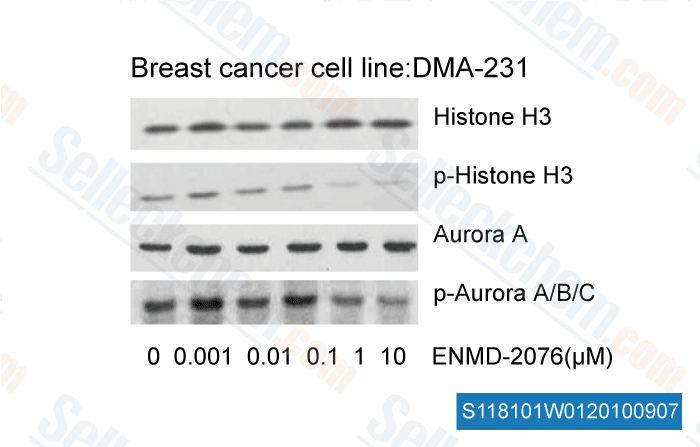
-
, , Dr. Zhang of Tianjin Medical University
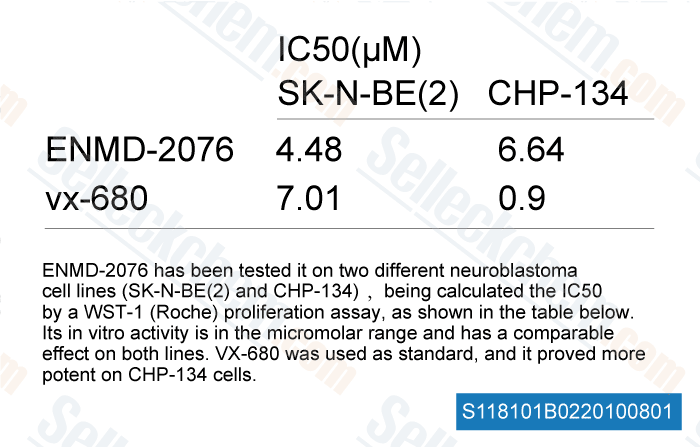
-
, , Dr. Antonino Maria Sparta ,University of Trento
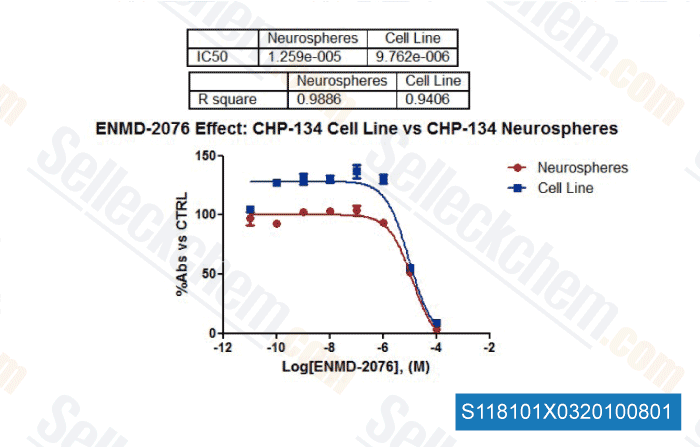
-
, , Dr. Antonino Maria Sparta ,University of Trento
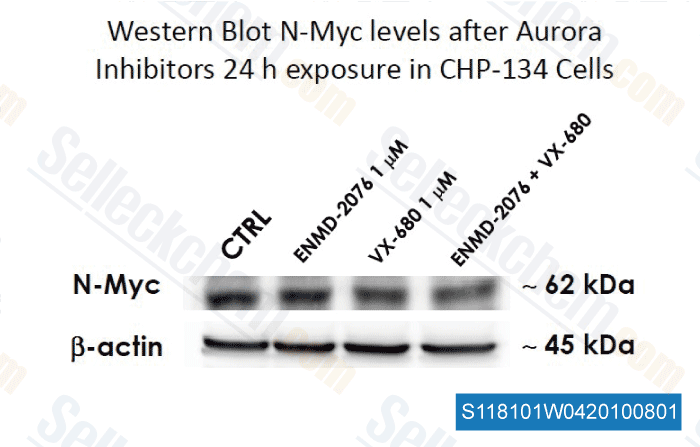
-
, , Dr. Antonino Maria Sparta, University of Trento
Sellecks ENMD-2076 Wurde zitiert von 10 Publikationen
| Identification of chemical inhibitors targeting long noncoding RNA through gene signature-based high throughput screening [ Int J Biol Macromol, 2025, 292:139119] | PubMed: 39722392 |
| A modular master regulator landscape controls cancer transcriptional identity [ Cell, 2021, 184(2):334-351.e20] | PubMed: 33434495 |
| Tumor immunological phenotype signature-based high-throughput screening for the discovery of combination immunotherapy compounds [ Sci Adv, 2021, 7(4)eabd7851] | PubMed: 33523948 |
| Targeted Polo-like Kinase Inhibition Combined With Aurora Kinase Inhibition in Pediatric Acute Leukemia Cells. [ J Pediatr Hematol Oncol, 2019, 41(6):e359-e370] | PubMed: 30702467 |
| The radiosensitizing effect of the aurora kinase inhibitors, ENMD-2076, on canine mast cell tumours in vitro. [Shiomitsu K, et al. Vet Comp Oncol, 2016, 14(1):13-27] | PubMed: 23763774 |
| Aurora Kinases as Druggable Targets in Pediatric Leukemia: Heterogeneity in Target Modulation Activities and Cytotoxicity by Diverse Novel Therapeutic Agents [Jayanthan A, et al. PLoS One, 2014, 9(7):e102741] | PubMed: 25048812 |
| Src-kinase inhibitors sensitize human cells of myeloid origin to Toll-like-receptor–induced interleukin 12 synthesis. [Wölfl M, et al. Blood, 2013, 122(7):1203-13] | PubMed: 23836556 |
| Targeting Sonic Hedgehog-Associated Medulloblastoma through Inhibition of Aurora and Polo-like Kinases. [Markant SL, et al. Cancer Res, 2013, 73(20):6310-22] | PubMed: 24067506 |
| The radiosensitizing effect of the aurora kinase inhibitors, ENMD-2076, on canine mast cell tumours in vitro. [Shiomitsu K, et al. Vet Comp Oncol, 2013, 10.1111/vco.12046] | PubMed: 23763774 |
| Systematic screen with kinases inhibitors reveals kinases play distinct roles in growth of osteoprogenitor cells [Bao NR, et al. Int J Clin Exp Pathol, 2013, 6(10):2082-91] | PubMed: 24133586 |
RÜCKGABERICHTLINIE
Die bedingungslose Rückgaberichtlinie von Selleck Chemical gewährleistet unseren Kunden ein reibungsloses Online-Einkaufserlebnis. Wenn Sie in irgendeiner Weise mit Ihrem Kauf unzufrieden sind, können Sie jeden Artikel innerhalb von 7 Tagen nach Erhalt zurückgeben. Im Falle von Produktqualitätsproblemen, sei es protokollbezogene oder produktbezogene Probleme, können Sie jeden Artikel innerhalb von 365 Tagen ab dem ursprünglichen Kaufdatum zurückgeben. Bitte befolgen Sie die nachstehenden Anweisungen, wenn Sie Produkte zurücksenden.
VERSAND UND LAGERUNG
Selleck-Produkte werden bei Raumtemperatur transportiert. Wenn Sie das Produkt bei Raumtemperatur erhalten, seien Sie versichert, dass die Qualitätskontrollabteilung von Selleck Experimente durchgeführt hat, um zu überprüfen, dass die normale Temperaturplatzierung von einem Monat die biologische Aktivität von Pulverprodukten nicht beeinträchtigt. Nach dem Sammeln lagern Sie das Produkt bitte gemäß den in der Datenblatt beschriebenen Anforderungen. Die meisten Selleck-Produkte sind unter den empfohlenen Bedingungen stabil.
NICHT FÜR DIE ANWENDUNG AM MENSCHEN, FÜR VETERINÄRMEDIZINISCHE DIAGNOSTIK ODER THERAPEUTISCHE ZWECKE.