
Technische Daten
| Formel | C21H20N4O3 |
||||||
| Molekulargewicht | 376.41 | CAS-Nr. | 209783-80-2 | ||||
| Löslichkeit (25°C)* | In vitro | DMSO | 75 mg/mL (199.25 mM) | ||||
| Water | Insoluble | ||||||
| Ethanol | Insoluble | ||||||
| In vivo (Lösungsmittel einzeln und der Reihe nach zum Produkt hinzufügen.) |
|
||||||
|
* <1 mg/ml bedeutet schwer löslich oder unlöslich. * Bitte beachten Sie, dass Selleck die Löslichkeit aller Verbindungen intern testet und die tatsächliche Löslichkeit geringfügig von veröffentlichten Werten abweichen kann. Dies ist normal und ist auf geringfügige Batch-zu-Batch-Variationen zurückzuführen. * Versand bei Raumtemperatur (Stabilitätstests zeigen, dass dieses Produkt ohne Kühlmaßnahmen versendet werden kann.) |
|||||||
Vorbereitung von Stammlösungen
Biologische Aktivität
| Beschreibung | Entinostat (MS-275, SNDX-275) hemmt stark HDAC1 und HDAC3 mit einer IC50 von 0,51 μM und 1,7 μM in zellfreien Assays, verglichen mit HDACs 4, 6, 8 und 10. Diese Verbindung induziert Autophagy und Apoptosis. Phase 3. | ||||
|---|---|---|---|---|---|
| Ziele |
|
||||
| In vitro | Entinostat (MS-275) zeigt eine hemmende Wirkung auf HDACs durch die 2'-Aminogruppe. Es induziert die Akkumulation von p21WAF1/CIP1 und Gelsolin in K562-Zellen und kann S-Phasen-Zellen reduzieren und G1-Phasen-Zellen in A2780-Zellen induzieren. Diese Verbindung hemmt die Proliferation menschlicher Tumorzelllinien, einschließlich A2780, Calu-3, HL-60, K562, St-4, HT-29, KB-3-1, Capan-1, 4-1St und HCT-15 mit IC50-Werten von 41,5 nM bis 4,71 μM, was auf die HAD-Hemmung zurückzuführen ist. Es ist nicht empfindlich gegenüber anderen HDACs (4, 6, 8 und 10) mit IC50-Werten von etwa/über 100 μM. Es zeigt eine große Hemmung menschlicher Leukämie- und Lymphomzellen, einschließlich U937, HL-60, K562 und Jurkat. MS-275 verringert auch die Expression von Cyclin D1 und den antiapoptotischen Proteinen Mcl-1 und XIAP. | ||||
| In vivo | Entinostat (MS-275) zeigt eine große Antitumoraktivität gegen menschliche Tumorxenotransplantate, außer HCT-15, bei 49 mg/kg. Es zeigt vielversprechendes therapeutisches Potenzial sowohl bei soliden als auch bei hämatologischen Malignomen sowie bei der Regulierung der physiologischen und aberranten Genexpression. In Kombination mit IL-2 hat diese Verbindung eine große Antitumoraktivität in einem Nierenzellkarzinom-Xenotransplantatmodell, was auf eine Verringerung der T-regulatorischen Zellen und eine Zunahme der Splenozyten zurückzuführen ist. |
Protokoll (aus Referenz)
| Kinase-Assay: |
|
|---|---|
| Zell-Assay: |
|
| Tierstudie: |
|
Referenzen
|
Kundenproduktvalidierung
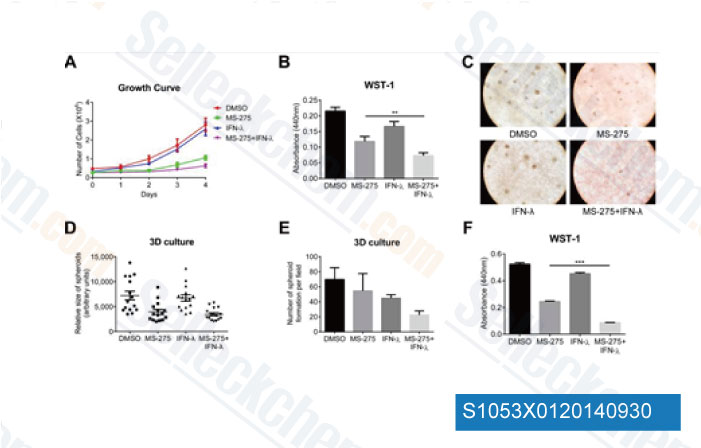
-
Daten von [ PLoS Biol , 2014 , 12, e1001758 ]
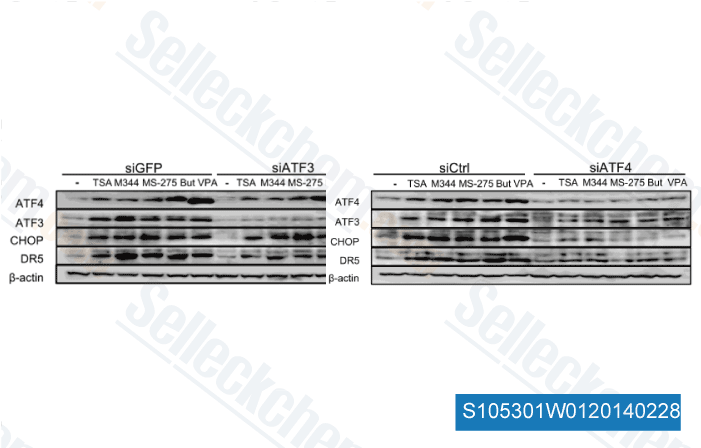
-
Daten von [ Biochem Biophys Res Commun , 2014 , 10.1016/j.bbrc.2014.01.184 ]
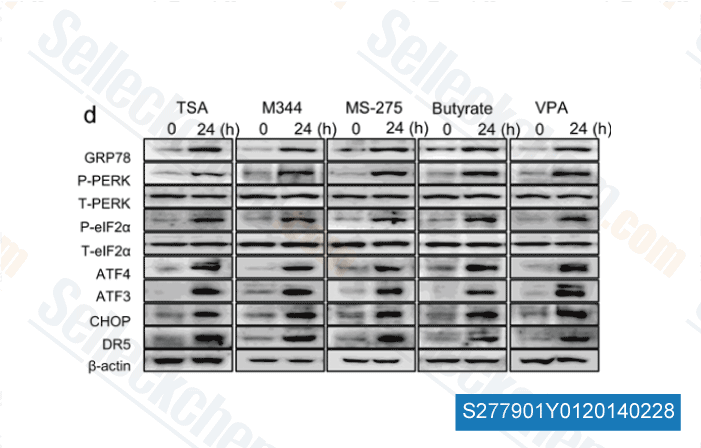
-
Daten von [ Biochem Biophys Res Commun , 2014 , 10.1016/j.bbrc.2014.01.184 ]
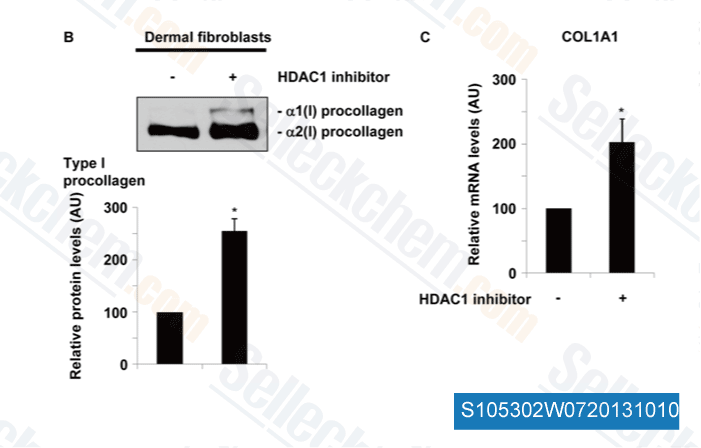
-
Daten von [ PLoS One , 2013 , 8, e74930 ]
Sellecks Entinostat (MS-275) Wurde zitiert von 437 Publikationen
| Reprogramming aerobic metabolism mitigates Streptococcus pyogenes tissue damage in a mouse necrotizing skin infection model [ Nat Commun, 2025, 16(1):2559] | PubMed: 40089471 |
| PROX1 is an early driver of lineage plasticity in prostate cancer [ J Clin Invest, 2025, 135(11)e187490] | PubMed: 40454483 |
| Early growth response 1 as a key regulator of PD-L1 expression and immune evasion in extranodal NK/T-cell lymphoma [ Blood Cancer J, 2025, 15(1):108] | PubMed: 40514360 |
| HDAC1 acts as a tumor suppressor in ALK-positive anaplastic large cell lymphoma: implications for HDAC inhibitor therapy [ Leukemia, 2025, 10.1038/s41375-025-02584-9] | PubMed: 40175628 |
| Stochastic demethylation and redundant epigenetic suppressive mechanisms generate highly heterogeneous responses to pharmacological DNA methyltransferase inhibition [ J Exp Clin Cancer Res, 2025, 44(1):21] | PubMed: 39844304 |
| Dual targeting of CDK6 and LSD1 is synergistic and overcomes differentiation blockade in AML [ EMBO Mol Med, 2025, 10.1038/s44321-025-00296-2] | PubMed: 40883610 |
| Engineering a multilayered 3D stromal barrier model for quantitative analysis of T cell infiltration and cytotoxicity [ Acta Biomater, 2025, S1742-7061(25)00677-4] | PubMed: 40939760 |
| Epigenomic regulation of stemness contributes to the low immunogenicity of the most mutated human cancer [ Cell Rep, 2025, S2211-1247(25)00332-8] | PubMed: 40250424 |
| Pharmacologically induced proteolysis of histone deacetylase-6 attenuates influenza virus replication despite limited anti-tumor effects [ Life Sci, 2025, 363:123401] | PubMed: 39814129 |
| HDAC1-3 inhibition triggers NEDD4-mediated CCR2 downregulation and attenuates immunosuppression in myeloid-derived suppressor cells [ Cancer Immunol Immunother, 2025, 74(3):81] | PubMed: 39891718 |
RÜCKGABERICHTLINIE
Die bedingungslose Rückgaberichtlinie von Selleck Chemical gewährleistet unseren Kunden ein reibungsloses Online-Einkaufserlebnis. Wenn Sie in irgendeiner Weise mit Ihrem Kauf unzufrieden sind, können Sie jeden Artikel innerhalb von 7 Tagen nach Erhalt zurückgeben. Im Falle von Produktqualitätsproblemen, sei es protokollbezogene oder produktbezogene Probleme, können Sie jeden Artikel innerhalb von 365 Tagen ab dem ursprünglichen Kaufdatum zurückgeben. Bitte befolgen Sie die nachstehenden Anweisungen, wenn Sie Produkte zurücksenden.
VERSAND UND LAGERUNG
Selleck-Produkte werden bei Raumtemperatur transportiert. Wenn Sie das Produkt bei Raumtemperatur erhalten, seien Sie versichert, dass die Qualitätskontrollabteilung von Selleck Experimente durchgeführt hat, um zu überprüfen, dass die normale Temperaturplatzierung von einem Monat die biologische Aktivität von Pulverprodukten nicht beeinträchtigt. Nach dem Sammeln lagern Sie das Produkt bitte gemäß den in der Datenblatt beschriebenen Anforderungen. Die meisten Selleck-Produkte sind unter den empfohlenen Bedingungen stabil.
NICHT FÜR DIE ANWENDUNG AM MENSCHEN, FÜR VETERINÄRMEDIZINISCHE DIAGNOSTIK ODER THERAPEUTISCHE ZWECKE.