
Technische Daten
| Formel | C31H34F2N6O2 |
||||||
| Molekulargewicht | 560.64 | CAS-Nr. | 1108743-60-7 | ||||
| Löslichkeit (25°C)* | In vitro | DMSO | 100 mg/mL (178.36 mM) | ||||
| Ethanol | 100 mg/mL (178.36 mM) | ||||||
| Water | Insoluble | ||||||
| In vivo (Lösungsmittel einzeln und der Reihe nach zum Produkt hinzufügen.) |
|
||||||
|
* <1 mg/ml bedeutet schwer löslich oder unlöslich. * Bitte beachten Sie, dass Selleck die Löslichkeit aller Verbindungen intern testet und die tatsächliche Löslichkeit geringfügig von veröffentlichten Werten abweichen kann. Dies ist normal und ist auf geringfügige Batch-zu-Batch-Variationen zurückzuführen. * Versand bei Raumtemperatur (Stabilitätstests zeigen, dass dieses Produkt ohne Kühlmaßnahmen versendet werden kann.) |
|||||||
Vorbereitung von Stammlösungen
Biologische Aktivität
| Beschreibung | Entrectinib ist ein oral bioverfügbarer Pan-TrkA/B/C-, ROS1- und ALK-Inhibitor mit einem IC50-Wert zwischen 0,1 und 1,7 nM. Entrectinib (RXDX-101) induziert autophagy. Phase 2. | |||||
|---|---|---|---|---|---|---|
| Ziele |
|
|||||
| In vitro | Entrectinib blockiert selektiv die Proliferation von ALK-abhängigen Zelllinien und hemmt potent die ALK-abhängige Signalübertragung. Diese Verbindung hemmt auch stark das Zellwachstum der NSCLC-Zelllinie NCI-H2228, die die EML4-ALK-Umlagerung aufweist. |
|||||
| In vivo | Bei Mäusen mit Karpas-299- und SR-786-Xenotransplantaten induziert Entrectinib (p.o.) eine vollständige Tumorregression. Bei NPM-ALK-transgenen Mäusen induziert diese Verbindung eine vollständige Regression der im Thymus und in den Lymphknoten beobachteten Tumormassen. Im NB-Xenotransplantatmodell verbesserte diese Verbindung die Wirksamkeit der konventionellen Chemotherapie bei gleichzeitiger Behandlung. |
Protokoll (aus Referenz)
Referenzen
|
Kundenproduktvalidierung
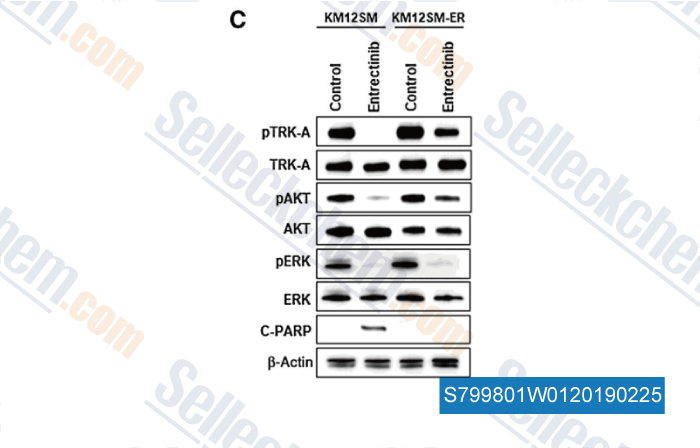
-
Daten von [ , , Clin Cancer Res, 2018, 24(10):2357-2369 ]
![(A) We transfected the EGFP/Eluc gene into KM12SM cells to establish KM12SM/Eluc cells. KM12SM/Eluc cells were inoculated into the brain of SCID mice. The mice were treated daily with or without entrectinib (15 mg/kg) for 37 days until the bioluminescence increased. Mean ± SE of total flux are shown in the lower panel. Then, the entrectinib-treated brain tumor was harvested at the point indicated by the orange triangle and cultured in vitro. The expanded tumor cells were named KM12SM-ER. (B) The sensitivity of KM12SM-ER and KM12SM cells to entrectinib was determined through cell viability assays, using a CCK-8 kit. The data (mean ± standard deviation [SD] of triplicate cultures) shown are representative of three independent experiments with similar results. (C) Tumor cells were treated with entrectinib (10 nmol/L) for 4 h or c-PARP for 48 h, and harvested lysates were assessed by western blotting. Data shown are representative of three independent experiments with similar results.](https://file.selleckchem.com/downloads/review/700px/Entrectinib-S799801W0120180502.gif)
-
Daten von [ , , Clin Cancer Res, 2018, doi: 10.1158/1078-0432.CCR-17-1623 ]
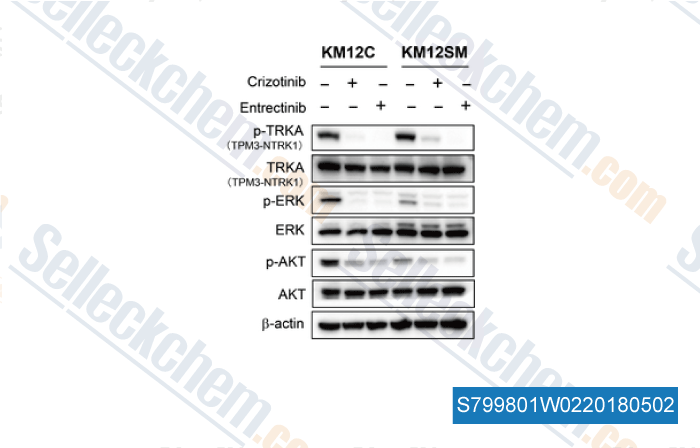
-
Daten von [ , , Cancer Med, 2017, 6(12):2972-2983 ]
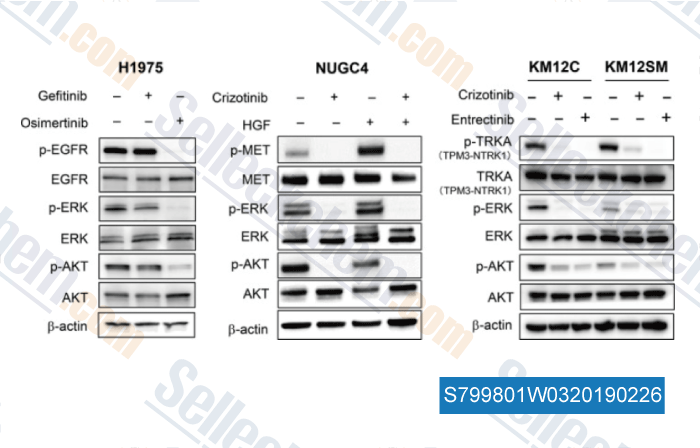
-
Daten von [ , , Cancer Med, 2017, 6(12):2972-2983 ]
Sellecks Entrectinib (Rxdx-101) Wurde zitiert von 61 Publikationen
| Targeting proteostasis in multiple myeloma through inhibition of LTK [ Leukemia, 2025, 10.1038/s41375-025-02682-8] | PubMed: 40634511 |
| Methylstat sensitizes ovarian cancer cells to PARP-inhibition by targeting the histone demethylases JMJD1B/C [ Cancer Gene Ther, 2025, 10.1038/s41417-025-00874-z] | PubMed: 39915607 |
| Zidesamtinib Selective Targeting of Diverse ROS1 Drug-Resistant Mutations [ Mol Cancer Ther, 2025, 10.1158/1535-7163.MCT-25-0025] | PubMed: 40299789 |
| Development of PROTACs for targeted degradation of oncogenic TRK fusions [ bioRxiv, 2025, 2025.06.18.660465] | PubMed: 40666929 |
| Clinical efficacy and identification of factors confer resistance to afatinib (tyrosine kinase inhibitor) in EGFR-overexpressing esophageal squamous cell carcinoma [ Signal Transduct Target Ther, 2024, 9(1):153] | PubMed: 38937446 |
| Pharmacological inhibition of PDGF-C/neuropilin-1 interaction: A novel strategy to reduce melanoma metastatic potential [ Biomed Pharmacother, 2024, 176:116766] | PubMed: 38788599 |
| Acquired NF2 mutation confers resistance to TRK inhibition in an ex vivo LMNA::NTRK1-rearranged soft-tissue sarcoma cell model [ J Pathol, 2024, 10.1002/path.6282] | PubMed: 38613194 |
| Acquired NF2 mutation confers resistance to TRK inhibition in an ex vivo LMNA::NTRK1-rearranged soft-tissue sarcoma cell model [ J Pathol, 2024, 263(2):257-269] | PubMed: 38613194 |
| LTK mutations responsible for resistance to lorlatinib in non-small cell lung cancer harboring CLIP1-LTK fusion [ Commun Biol, 2024, 7(1):412] | PubMed: 38575808 |
| Patient-derived rhabdomyosarcoma cells recapitulate the genetic and transcriptomic landscapes of primary tumors [ iScience, 2024, 27(10):110862] | PubMed: 39319271 |
RÜCKGABERICHTLINIE
Die bedingungslose Rückgaberichtlinie von Selleck Chemical gewährleistet unseren Kunden ein reibungsloses Online-Einkaufserlebnis. Wenn Sie in irgendeiner Weise mit Ihrem Kauf unzufrieden sind, können Sie jeden Artikel innerhalb von 7 Tagen nach Erhalt zurückgeben. Im Falle von Produktqualitätsproblemen, sei es protokollbezogene oder produktbezogene Probleme, können Sie jeden Artikel innerhalb von 365 Tagen ab dem ursprünglichen Kaufdatum zurückgeben. Bitte befolgen Sie die nachstehenden Anweisungen, wenn Sie Produkte zurücksenden.
VERSAND UND LAGERUNG
Selleck-Produkte werden bei Raumtemperatur transportiert. Wenn Sie das Produkt bei Raumtemperatur erhalten, seien Sie versichert, dass die Qualitätskontrollabteilung von Selleck Experimente durchgeführt hat, um zu überprüfen, dass die normale Temperaturplatzierung von einem Monat die biologische Aktivität von Pulverprodukten nicht beeinträchtigt. Nach dem Sammeln lagern Sie das Produkt bitte gemäß den in der Datenblatt beschriebenen Anforderungen. Die meisten Selleck-Produkte sind unter den empfohlenen Bedingungen stabil.
NICHT FÜR DIE ANWENDUNG AM MENSCHEN, FÜR VETERINÄRMEDIZINISCHE DIAGNOSTIK ODER THERAPEUTISCHE ZWECKE.