
Technische Daten
| Formel | C28H41N7O4 |
||||||||||
| Molekulargewicht | 539.67 | CAS-Nr. | 1338466-77-5 | ||||||||
| Löslichkeit (25°C)* | In vitro | DMSO | 50 mg/mL (92.64 mM) | ||||||||
| Ethanol | 7 mg/mL (12.97 mM) | ||||||||||
| Water | Insoluble | ||||||||||
| In vivo (Lösungsmittel einzeln und der Reihe nach zum Produkt hinzufügen.) |
|
||||||||||
|
* <1 mg/ml bedeutet schwer löslich oder unlöslich. * Bitte beachten Sie, dass Selleck die Löslichkeit aller Verbindungen intern testet und die tatsächliche Löslichkeit geringfügig von veröffentlichten Werten abweichen kann. Dies ist normal und ist auf geringfügige Batch-zu-Batch-Variationen zurückzuführen. * Versand bei Raumtemperatur (Stabilitätstests zeigen, dass dieses Produkt ohne Kühlmaßnahmen versendet werden kann.) |
|||||||||||
Vorbereitung von Stammlösungen
Biologische Aktivität
| Beschreibung | EPZ004777 ist ein potenter, selektiver DOT1L-Inhibitor mit einer IC50 von 0,4 nM in einem zellfreien Assay und zeigt eine >1.200-fache Selektivität für DOT1L gegenüber allen anderen getesteten PMTs. EPZ004777 induziert Apoptosis. | ||
|---|---|---|---|
| Ziele |
|
||
| In vitro | EPZ004777 hemmt selektiv die zelluläre H3K79-Methylierung und die Expression wichtiger MLL-Fusionszielgene. Nach der DOT1L-Hemmung hemmt diese Verbindung selektiv die Proliferation von MLL-Rearranged-Zelllinien und MLL-AF9-transformierten murinen hämatopoetischen Zellen. Darüber hinaus induziert sie Differenzierung und Apoptose in MLL-rearrangierten Zellen. Diese Chemikalie hemmt selektiv die Proliferation von MLL–AF10- und CALM–AF10-transformierten murinen Knochenmarkzellen. Die DOT1L-Hemmung durch dieses Mittel führt zu einer signifikant verringerten Proliferation, einer verringerten Expression von MLL-AF6-Zielgenen und einem Zellzyklusarrest von MLL-AF6-transformierten Zellen. | ||
| In vivo | EPZ004777 erzeugt eine potente Antitumorwirksamkeit und erhöht die mediane Überlebenszeit in einem Maus-Xenograft-Modell der MLL-Leukämie signifikant. |
Protokoll (aus Referenz)
| Kinase-Assay: |
|
|---|---|
| Zell-Assay: |
|
| Tierstudie: |
|
Referenzen
|
Kundenproduktvalidierung
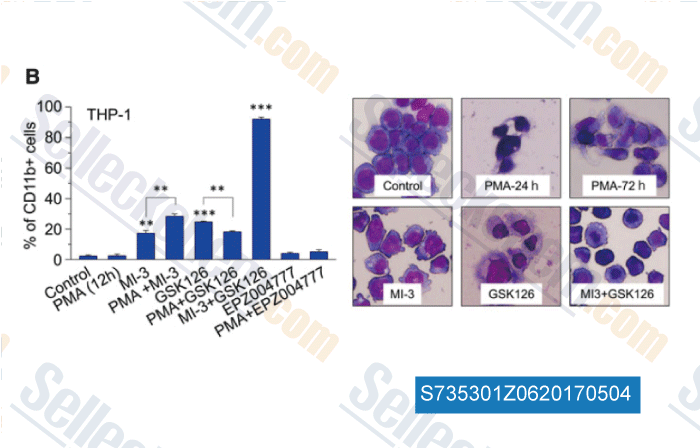
-
, , FEBS J, 2017, 284(9):1309-1323
Sellecks EPZ004777 Wurde zitiert von 32 Publikationen
| Transplantation of derivative retinal organoids from chemically induced pluripotent stem cells restored visual function [ NPJ Regen Med, 2024, 9(1):42] | PubMed: 39730340 |
| Histone H3K79 methylation by DOT1L promotes Aurora B localization at centromeres in mitosis [ Cell Rep, 2023, 42(8):112885] | PubMed: 37494186 |
| Transcriptome-based chemical screens identify CDK8 as a common barrier in multiple cell reprogramming systems [ Cell Rep, 2023, 42(6):112566] | PubMed: 37235474 |
| Nuclear Translocation of LDHA Promotes the Catabolism of BCAAs to Sustain GBM Cell Proliferation through the TxN Antioxidant Pathway [ Int J Mol Sci, 2023, 24(11)9365] | PubMed: 37298317 |
| Genome-wide DNA methylation changes upon DOT1L inhibition in hormone-responsive breast cancer cells [ Front Cell Dev Biol, 2023, 11:1308025.] | PubMed: 38099289 |
| Derivation of totipotent-like stem cells with blastocyst-like structure forming potential [ Cell Res, 2022, 10.1038/s41422-022-00668-0] | PubMed: 35508506 |
| Combinatorial targeting of a chromatin complex comprising Dot1L, menin and the tyrosine kinase BAZ1B reveals a new therapeutic vulnerability of endocrine therapy-resistant breast cancer [ Breast Cancer Res, 2022, 24(1):52] | PubMed: 35850772 |
| 3-deazaadenosine (3DA) alleviates senescence to promote cellular fitness and cell therapy efficiency in mice [ Nat Aging, 2022, 2:851-866] | PubMed: 36438588 |
| Role of Dot1L and H3K79 methylation in regulating somatic hypermutation of immunoglobulin genes [ Proc Natl Acad Sci U S A, 2021, 118(29)e2104013118] | PubMed: 34253616 |
| Permissive epigenomes endow reprogramming competence to transcriptional regulators [ Nat Chem Biol, 2020, 10.1038/s41589-020-0618-6] | PubMed: 32807969 |
RÜCKGABERICHTLINIE
Die bedingungslose Rückgaberichtlinie von Selleck Chemical gewährleistet unseren Kunden ein reibungsloses Online-Einkaufserlebnis. Wenn Sie in irgendeiner Weise mit Ihrem Kauf unzufrieden sind, können Sie jeden Artikel innerhalb von 7 Tagen nach Erhalt zurückgeben. Im Falle von Produktqualitätsproblemen, sei es protokollbezogene oder produktbezogene Probleme, können Sie jeden Artikel innerhalb von 365 Tagen ab dem ursprünglichen Kaufdatum zurückgeben. Bitte befolgen Sie die nachstehenden Anweisungen, wenn Sie Produkte zurücksenden.
VERSAND UND LAGERUNG
Selleck-Produkte werden bei Raumtemperatur transportiert. Wenn Sie das Produkt bei Raumtemperatur erhalten, seien Sie versichert, dass die Qualitätskontrollabteilung von Selleck Experimente durchgeführt hat, um zu überprüfen, dass die normale Temperaturplatzierung von einem Monat die biologische Aktivität von Pulverprodukten nicht beeinträchtigt. Nach dem Sammeln lagern Sie das Produkt bitte gemäß den in der Datenblatt beschriebenen Anforderungen. Die meisten Selleck-Produkte sind unter den empfohlenen Bedingungen stabil.
NICHT FÜR DIE ANWENDUNG AM MENSCHEN, FÜR VETERINÄRMEDIZINISCHE DIAGNOSTIK ODER THERAPEUTISCHE ZWECKE.