
Technische Daten
| Formel | C16H15ClN4O2 |
||||||
| Molekulargewicht | 330.77 | CAS-Nr. | 263707-16-0 | ||||
| Löslichkeit (25°C)* | In vitro | DMSO | 66 mg/mL (199.53 mM) | ||||
| Ethanol | 17 mg/mL (51.39 mM) | ||||||
| Water | Insoluble | ||||||
| In vivo (Lösungsmittel einzeln und der Reihe nach zum Produkt hinzufügen.) |
|
||||||
|
* <1 mg/ml bedeutet schwer löslich oder unlöslich. * Bitte beachten Sie, dass Selleck die Löslichkeit aller Verbindungen intern testet und die tatsächliche Löslichkeit geringfügig von veröffentlichten Werten abweichen kann. Dies ist normal und ist auf geringfügige Batch-zu-Batch-Variationen zurückzuführen. * Versand bei Raumtemperatur (Stabilitätstests zeigen, dass dieses Produkt ohne Kühlmaßnahmen versendet werden kann.) |
|||||||
Vorbereitung von Stammlösungen
Biologische Aktivität
| Beschreibung | ESI-09 ist ein spezifischer Austauschprotein, das direkt durch cAMP (EPAC) aktiviert wird Inhibitor mit einer IC50 von 3,2 μM und 1,4 μM für EPAC1 bzw. EPAC2, >100-fache Selektivität gegenüber PKA. | ||||
|---|---|---|---|---|---|
| Ziele |
|
||||
| In vitro | ESI-09, ein neuartiger nicht-zyklischer Nukleotid-EPAC-Antagonist, der in der Lage ist, die intrazelluläre EPAC-vermittelte Rap1-Aktivierung und Akt-Phosphorylierung sowie die EPAC-vermittelte Insulinsekretion in pankreatischen β-Zellen spezifisch zu blockieren. Andererseits unterdrückt diese Verbindung die durch epidermalen Wachstumsfaktor (EGF) induzierte Phosphorylierung von Akt in AsPC1-Zellen nicht. In Pankreaskrebszellen hemmt dieser Antagonist die Zellmigration und -invasion durch eine dosisabhängige Abnahme der 007-AM-induzierten Zelladhäsion. Diese Chemikalie reduziert signifikant die intrazelluläre und gesamte Bakterienzahl in menschlichen Nabelschnurvenen-Endothelzellen. Sie antagonisiert wirksam die durch CPT-cAMP induzierte Differenzierung von Schwann-Zellen (SC) sowie die Myelinbildung. In SC-Neuronen-Kulturen reduziert diese Verbindung die Anzahl der O1-positiven und MBP-positiven SCs dramatisch, ohne die Gesundheit der Neuronen oder der SCs selbst zu beeinträchtigen. | ||||
| In vivo | ESI-09 (10 mg/kg/d, i.p.) schützt über die pharmakologische Hemmung von EPAC1 WT C57BL/6-Mäuse vor tödlicher SFG-Rickettsiose. |
Protokoll (aus Referenz)
| Tierstudie:[2] |
|
|---|
Referenzen
|
Kundenproduktvalidierung
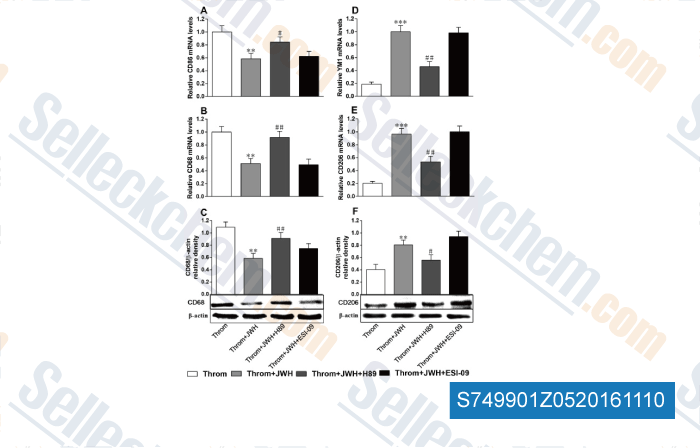
-
, , Brain Behav Immun, 2016, 58:118-129.
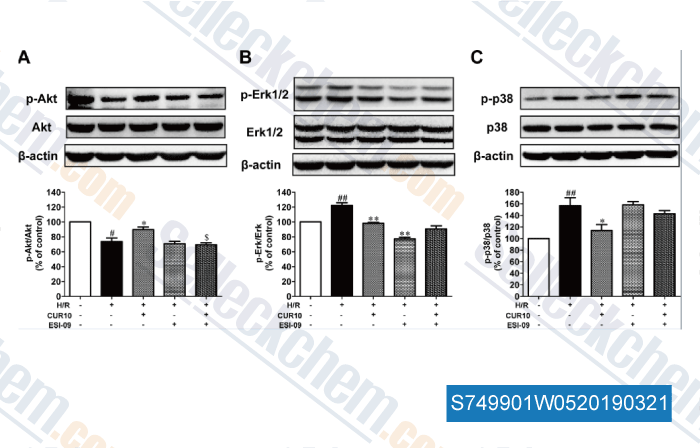
-
Daten von [ , , Biomed Pharmacother, 2019, 109:1268-1275 ]
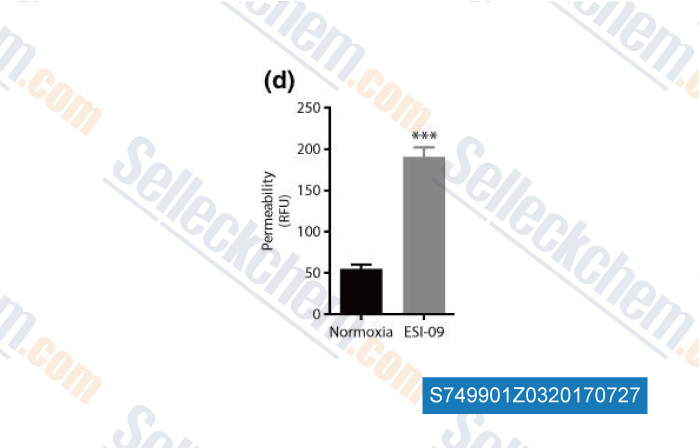
-
Daten von [ , , Acta Diabetol, 2017, 54(6):581-591 ]
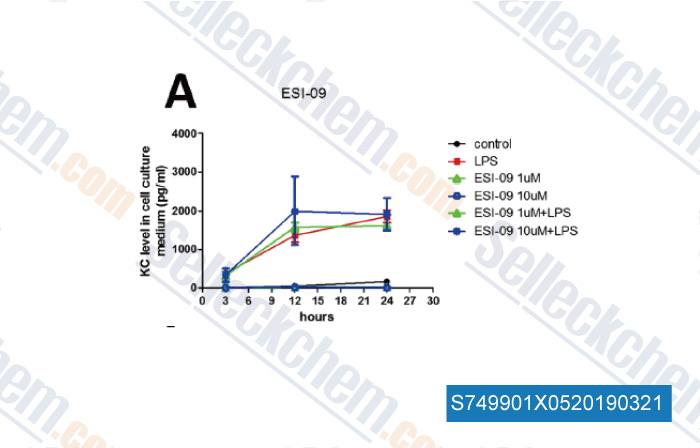
-
Daten von [ , , Inflammation, 2018, 41(3):1093-1103 ]
Sellecks ESI-09 Wurde zitiert von 14 Publikationen
| Ginsenoside Ro prevents endothelial injury via promoting Epac1/AMPK- mediated mitochondria protection in early diabetic retinopathy [ Pharmacol Res, 2025, 211:107562] | PubMed: 39732351 |
| Inhibition of exchange proteins directly activated by cAMP as a strategy for broad-spectrum antiviral development [ J Biol Chem, 2023, 299(6):104749] | PubMed: 37100284 |
| PNX14 but not PNX20 as a novel regulator of preadipocyte differentiation via activating Epac-ERK signaling pathway in Gallus gallus [ Gen Comp Endocrinol, 2023, 335:114232] | PubMed: 36774983 |
| Vitexin Mitigates Myocardial Ischemia/Reperfusion Injury in Rats by Regulating Mitochondrial Dysfunction via Epac1-Rap1 Signaling [ Oxid Med Cell Longev, 2021, 2021:9921982] | PubMed: 34257823 |
| Terbutaline attenuates LPS-induced injury of pulmonary microvascular endothelial cells by cAMP/Epac signaling [ Drug Dev Res, 2021, 10.1002/ddr.21901] | PubMed: 34846077 |
| Knockdown of GPSM1 Inhibits the Proliferation and Promotes the Apoptosis of B-Cell Acute Lymphoblastic Leukemia Cells by Suppressing the ADCY6-RAPGEF3-JNK Signaling Pathway [ Pathol Oncol Res, 2021, 27:643376] | PubMed: 34257610 |
| Exchange protein directly activated by cAMP (Epac) 1 plays an essential role in stress-induced exercise capacity by regulating PGC-1α and fatty acid metabolism in skeletal muscle. [ Pflugers Arch, 2020, 472(2):195-216] | PubMed: 31955265 |
| Curcumin pretreatment protects against hypoxia/reoxgenation injury via improvement of mitochondrial function, destabilization of HIF-1α and activation of Epac1-Akt pathway in rat bone marrow mesenchymal stem cells [Wang X, et al. Biomed Pharmacother, 2019, 109:1268-1275] | PubMed: 30551377 |
| Protective Effect of Quercetin in LPS-Induced Murine Acute Lung Injury Mediated by cAMP-Epac Pathway [Wang XF, et al. Inflammation, 2018, 41(3):1093-1103] | PubMed: 29569077 |
| Activation of Epac alleviates inflammation and vascular leakage in LPS-induced acute murine lung injury [Wang X, et al. Biomed Pharmacother, 2017, 96:1127-1136] | PubMed: 29174852 |
RÜCKGABERICHTLINIE
Die bedingungslose Rückgaberichtlinie von Selleck Chemical gewährleistet unseren Kunden ein reibungsloses Online-Einkaufserlebnis. Wenn Sie in irgendeiner Weise mit Ihrem Kauf unzufrieden sind, können Sie jeden Artikel innerhalb von 7 Tagen nach Erhalt zurückgeben. Im Falle von Produktqualitätsproblemen, sei es protokollbezogene oder produktbezogene Probleme, können Sie jeden Artikel innerhalb von 365 Tagen ab dem ursprünglichen Kaufdatum zurückgeben. Bitte befolgen Sie die nachstehenden Anweisungen, wenn Sie Produkte zurücksenden.
VERSAND UND LAGERUNG
Selleck-Produkte werden bei Raumtemperatur transportiert. Wenn Sie das Produkt bei Raumtemperatur erhalten, seien Sie versichert, dass die Qualitätskontrollabteilung von Selleck Experimente durchgeführt hat, um zu überprüfen, dass die normale Temperaturplatzierung von einem Monat die biologische Aktivität von Pulverprodukten nicht beeinträchtigt. Nach dem Sammeln lagern Sie das Produkt bitte gemäß den in der Datenblatt beschriebenen Anforderungen. Die meisten Selleck-Produkte sind unter den empfohlenen Bedingungen stabil.
NICHT FÜR DIE ANWENDUNG AM MENSCHEN, FÜR VETERINÄRMEDIZINISCHE DIAGNOSTIK ODER THERAPEUTISCHE ZWECKE.