
Technische Daten
| Formel | C53H83NO14 |
||||||
| Molekulargewicht | 958.22 | CAS-Nr. | 159351-69-6 | ||||
| Löslichkeit (25°C)* | In vitro | DMSO | 100 mg/mL (104.36 mM) | ||||
| Ethanol | 100 mg/mL (104.36 mM) | ||||||
| Water | Insoluble | ||||||
| In vivo (Lösungsmittel einzeln und der Reihe nach zum Produkt hinzufügen.) |
|
||||||
|
* <1 mg/ml bedeutet schwer löslich oder unlöslich. * Bitte beachten Sie, dass Selleck die Löslichkeit aller Verbindungen intern testet und die tatsächliche Löslichkeit geringfügig von veröffentlichten Werten abweichen kann. Dies ist normal und ist auf geringfügige Batch-zu-Batch-Variationen zurückzuführen. * Versand bei Raumtemperatur (Stabilitätstests zeigen, dass dieses Produkt ohne Kühlmaßnahmen versendet werden kann.) |
|||||||
Vorbereitung von Stammlösungen
Biologische Aktivität
| Beschreibung | Everolimus ist ein mTOR Inhibitor von FKBP12 mit einer IC50 von 1,6-2,4 nM in einem zellfreien Assay. Everolimus induziert Zell-Apoptose und Autophagy und hemmt die Proliferation von Tumorzellen. | ||||
|---|---|---|---|---|---|
| Ziele |
|
||||
| In vitro | Everolimus zeigt eine immunsuppressive Aktivität, die mit der von Rapamycin vergleichbar ist. Diese Verbindung konkurriert mit immobilisiertem FK 506 um die Bindung an biotinyliertes FKBP12 und zeigt eine hemmende Wirkung auf eine Zwei-Wege-MLR, die mit Milzzellen von BALB/c- und CBA-Mäusen mit einer IC50 von 0,12-1,8 nM durchgeführt wurde. Es zeigt auch antiangiogene/vaskuläre Effekte bei VEGF-induzierter HUVEC-Proliferation mit einer IC50 von 0,12 nM und bFGF-induzierter HUVEC-Proliferation mit einer IC50 von 0,8 nM. Eine aktuelle Studie zeigt, dass diese Chemikalie dosisabhängige hemmende Effekte auf die Gesamtzellen und die Stammzellen der BT474-Zelllinie und der primären Brustkrebszellen mit einer IC50 von 156 nM bei Gesamtzellen von primären Brustkrebszellen und 71 nM bei Gesamtzellen von BT474-Zellen zeigt. Darüber hinaus führt die Kombinationstherapie mit dieser Verbindung und Trastuzumab zu einer signifikant erhöhten Hemmung des Wachstums von Krebsstammzellen, wobei die Hemmrate um mehr als 50 % erhöht wird. | ||||
| In vivo | Everolimus (0,1 bis 10 mg/kg) hemmt dosisabhängig das Wachstum des primären (Ohr) und der Lymphknotenmetastasen von B16/BL6-Melanomen, mit einer verringerten Gesamtzahl von Gefäßen und reduzierten reifen Gefäßen. In einem Xenograft-Tiermodell von BT474-Stammzellen zeigt diese Verbindung signifikante Reduktionen der mittleren Tumorgrößen (590,6 mm3) im Vergleich zur Kontrollgruppe mit einer Tumorgröße von 698 mm3. Darüber hinaus verringert die Kombinationstherapie mit dieser Verbindung und Trastuzumab die Xenograft-Tumorgröße (410,8 mm3) signifikant stärker als die Behandlung mit dieser Verbindung allein. |
Protokoll (aus Referenz)
| Kinase-Assay:[1] |
|
|---|---|
| Zell-Assay:[3] |
|
| Tierstudie:[3] |
|
Referenzen
|
Kundenproduktvalidierung
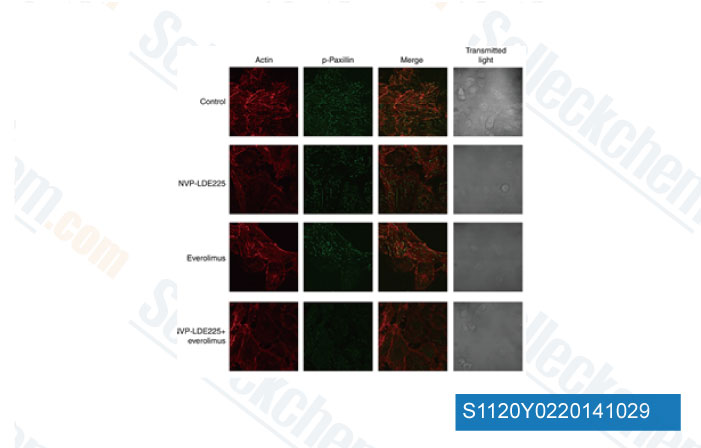
-
Daten von [ Br J Cancer , 2014 , 111(6), 1168-79 ]
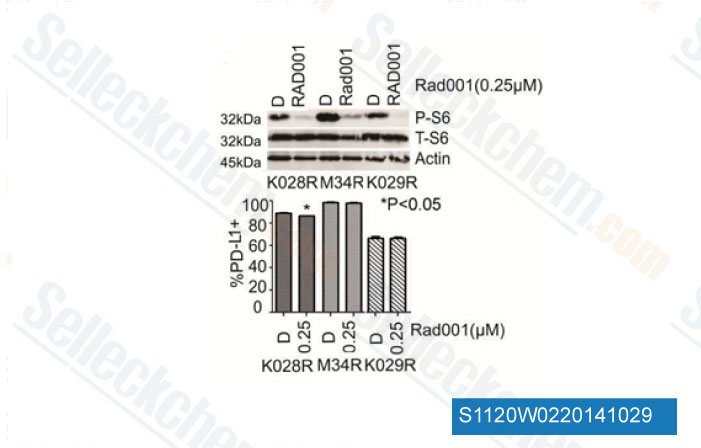
-
Daten von [ Clin Cancer Res , 2013 , 19(3),598-609 ]
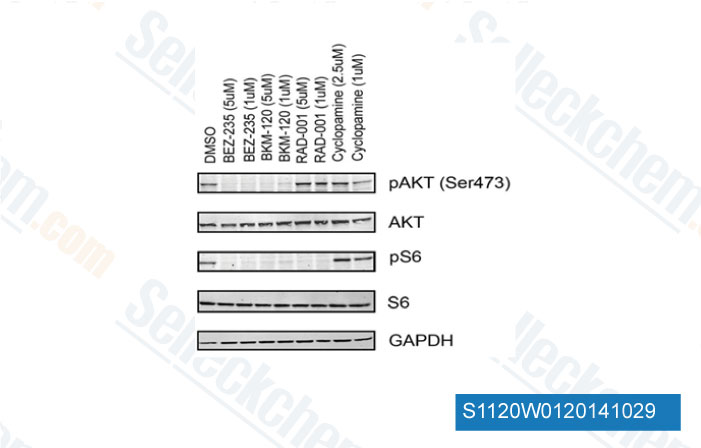
-
Daten von [ Cancer Cell , 2012 , 21(2), 155-67 ]
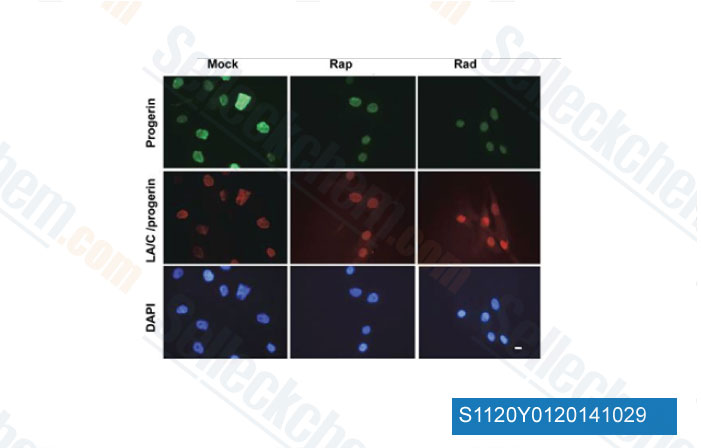
-
Daten von [ Aging (Albany NY) , 2012 , 4(2), 119-32 ]
Sellecks RAD001 (Everolimus) Wurde zitiert von 798 Publikationen
| Proteogenomic characterization of non-functional pancreatic neuroendocrine tumors unravels clinically relevant subgroups [ Cancer Cell, 2025, 43(4):776-796.e14] | PubMed: 40185092 |
| Ataluren improves hematopoietic and pancreatic disorders in Shwachman-Diamond syndrome patients: a compassionate program case-series [ Nat Commun, 2025, 16(1):8189] | PubMed: 40897730 |
| System analysis links SMARCD3 regulons to growth signaling and MEK inhibitor response in everolimus-resistant ER+ breast cancer cells [ Cell Rep Med, 2025, 6(11):102425] | PubMed: 41260207 |
| Haploinsufficiency of miR-143 and miR-145 reveal targetable dependencies in resistant del(5q) myelodysplastic neoplasm [ Leukemia, 2025, 39(4):917-928] | PubMed: 40000845 |
| Pancreatic Neuroendocrine Tumors Secrete Apolipoprotein E to Induce Tip Endothelial Cells That Remodel the Tumor-Stroma Ratio and Promote Cancer Progression [ Cancer Res, 2025, 85(15):2805-2819] | PubMed: 40623046 |
| Targeting the MYC oncogene with a selective bi-steric mTORC1 inhibitor elicits tumor regression in MYC-driven cancers [ Cell Chem Biol, 2025, 32(8):994-1012.e11] | PubMed: 40803322 |
| YAP1 promoter-associated noncoding RNA affects Ewing sarcoma cell tumorigenicity by regulating YAP1 expression [ Cell Mol Biol Lett, 2025, 30(1):63] | PubMed: 40414844 |
| Increased fatty acid delivery by tumor endothelium promotes metastatic outgrowth [ JCI Insight, 2025, 10(9)e187531] | PubMed: 40198126 |
| Molecular control of PDPNhi macrophage subset induction by ADAP as a host defense in sepsis [ JCI Insight, 2025, e186456] | PubMed: 39903516 |
| A phase II trial of mTORC1/2 inhibition in STK11 deficient non small cell lung cancer [ NPJ Precis Oncol, 2025, 9(1):67] | PubMed: 40069402 |
RÜCKGABERICHTLINIE
Die bedingungslose Rückgaberichtlinie von Selleck Chemical gewährleistet unseren Kunden ein reibungsloses Online-Einkaufserlebnis. Wenn Sie in irgendeiner Weise mit Ihrem Kauf unzufrieden sind, können Sie jeden Artikel innerhalb von 7 Tagen nach Erhalt zurückgeben. Im Falle von Produktqualitätsproblemen, sei es protokollbezogene oder produktbezogene Probleme, können Sie jeden Artikel innerhalb von 365 Tagen ab dem ursprünglichen Kaufdatum zurückgeben. Bitte befolgen Sie die nachstehenden Anweisungen, wenn Sie Produkte zurücksenden.
VERSAND UND LAGERUNG
Selleck-Produkte werden bei Raumtemperatur transportiert. Wenn Sie das Produkt bei Raumtemperatur erhalten, seien Sie versichert, dass die Qualitätskontrollabteilung von Selleck Experimente durchgeführt hat, um zu überprüfen, dass die normale Temperaturplatzierung von einem Monat die biologische Aktivität von Pulverprodukten nicht beeinträchtigt. Nach dem Sammeln lagern Sie das Produkt bitte gemäß den in der Datenblatt beschriebenen Anforderungen. Die meisten Selleck-Produkte sind unter den empfohlenen Bedingungen stabil.
NICHT FÜR DIE ANWENDUNG AM MENSCHEN, FÜR VETERINÄRMEDIZINISCHE DIAGNOSTIK ODER THERAPEUTISCHE ZWECKE.