
Technische Daten
| Formel | C9H11F2N3O4.HCI |
|||
| Molekulargewicht | 299.66 | CAS-Nr. | 122111-03-9 | |
| Löslichkeit (25°C)* | In vitro | Water | 59 mg/mL (196.88 mM) | |
| DMSO | Insoluble | |||
| Ethanol | Insoluble | |||
|
* <1 mg/ml bedeutet schwer löslich oder unlöslich. * Bitte beachten Sie, dass Selleck die Löslichkeit aller Verbindungen intern testet und die tatsächliche Löslichkeit geringfügig von veröffentlichten Werten abweichen kann. Dies ist normal und ist auf geringfügige Batch-zu-Batch-Variationen zurückzuführen. * Versand bei Raumtemperatur (Stabilitätstests zeigen, dass dieses Produkt ohne Kühlmaßnahmen versendet werden kann.) |
||||
Vorbereitung von Stammlösungen
Biologische Aktivität
| Beschreibung | Gemcitabine ist ein Pyrimidin-Nukleosid-Analog-Antitumor-Medikament, das die DNA-Synthese und -Reparatur hemmen kann, was zu zellulärer Autophagy und Apoptose führt. Es wird hauptsächlich zur Behandlung verschiedener solider Tumoren wie Bauchspeicheldrüsenkrebs und nicht-kleinzelligem Lungenkrebs eingesetzt und oft mit Chemotherapie kombiniert, um die Wirksamkeit zu erhöhen. | ||||||||
|---|---|---|---|---|---|---|---|---|---|
| Ziele |
|
||||||||
| In vitro | Gemcitabine induzierte die NF-κB-Aktivität in BxPC-3-, PANC-1- und MIA PaCa-2-Zellen und verringerte den Spiegel des NF-κB-Inhibitors IκBα in BxPC-3- und PANC-1-Zellen. Die Behandlung von BxPC-3-Zellen mit niedriger Dosis Gemcitabine für 48 Stunden führt zu einer dosisabhängigen Zunahme der NF-κB-Bindung. Im Gegensatz dazu ist die NF-κB-DNA-Bindung in BxPC-3-Zellen, die 48 Stunden lang mit höheren Gemcitabine-Dosen behandelt wurden, verringert; jedoch erhöht eine 24-stündige Behandlung mit diesen höheren Dosen die NF-κB-Bindung in BxPC-3-Zellen | ||||||||
| In vivo | Die intratumorale NF-κB-Aktivität ist bei den mit Gemcitabine behandelten Mäusen im Vergleich zu den PBS-behandelten Mäusen signifikant erhöht (1,3- bis 1,8-fach), was darauf hindeutet, dass Gemcitabine auch die NF-κB-Aktivierung induziert. | ||||||||
| Merkmale | Gemcitabine wurde zur Behandlung von Bauchspeicheldrüsenkrebs eingesetzt und zeigte eine effektive Antitumoraktivität. |
Protokoll (aus Referenz)
| Zell-Assay:[2] |
|
|---|---|
| Tierstudie:[2] |
|
Referenzen
|
Kundenproduktvalidierung
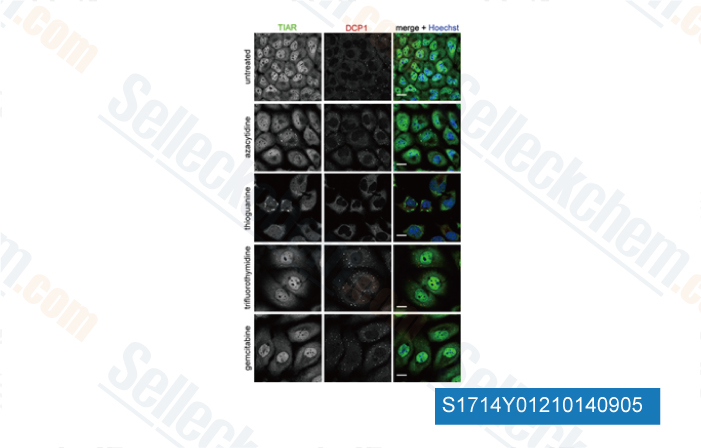
-
Daten von [ Nucleic Acids Res , 2014 , 42(10), 6436-47 ]
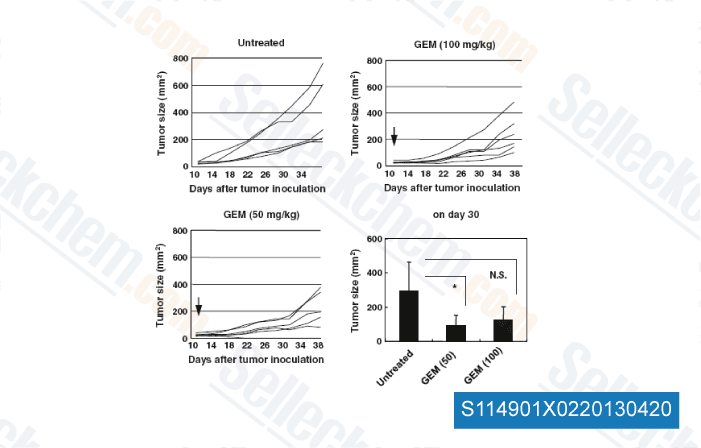
-
Daten von [ Cancer Immunol Immunother , 2013 , 62, 383–391 ]
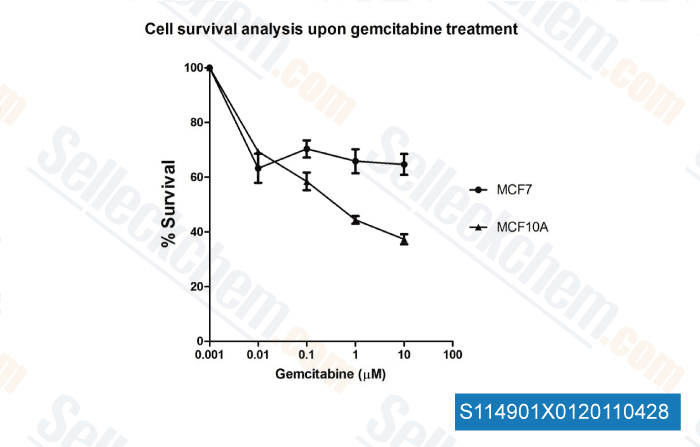
-
, , Dr. Helen Sadik of Johns Hopkins University
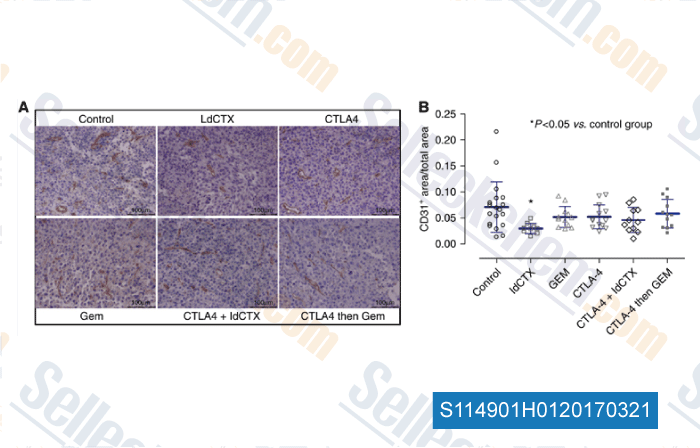
-
Daten von [ , , Br J Cancer, 2017, 116(3):324-334 ]
Sellecks Gemcitabine Hydrochloride Wurde zitiert von 193 Publikationen
| Macropinocytosis maintains CAF subtype identity under metabolic stress in pancreatic cancer [ Cancer Cell, 2025, S1535-6108(25)00271-5] | PubMed: 40712568 |
| Dynamic regulation of integrin β1 phosphorylation supports invasion of breast cancer cells [ Nat Cell Biol, 2025, 27(6):1021-1034] | PubMed: 40419795 |
| Cryobioprinted human tumor models with shelf-stable programmability [ Trends Biotechnol, 2025, S0167-7799(25)00406-8] | PubMed: 41168031 |
| Senescence-associated lysosomal dysfunction impairs cystine deprivation-induced lipid peroxidation and ferroptosis [ Nat Commun, 2025, 16(1):6617] | PubMed: 40731111 |
| Elesclomol-copper combination synergistically targets mitochondrial metabolism in cancer stem cells to overcome chemoresistance in PDAC [ Mol Ther, 2025, 33(12):6160-6177] | PubMed: 40931516 |
| Pancreatic cancer-derived extracellular vesicles remodel the tumor microenvironment and enhance chemoresistance by delivering KRASG12D protein to cancer-associated fibroblasts [ Mol Ther, 2025, S1525-0016(25)00027-9] | PubMed: 39810420 |
| Ex vivo 3D micro-tumour testing platform for predicting clinical response to platinum-based therapy in patients with high-grade serous ovarian cancer [ NPJ Precis Oncol, 2025, 9(1):306] | PubMed: 40885787 |
| ME3BP-7 is a targeted cytotoxic agent that rapidly kills pancreatic cancer cells expressing high levels of monocarboxylate transporter MCT1 [ Elife, 2025, 13RP94488] | PubMed: 40391649 |
| NIR pH-Responsive PEGylated PLGA Nanoparticles as Effective Phototoxic Agents in Resistant PDAC Cells [ Polymers (Basel), 2025, 17(8)1101] | PubMed: 40284366 |
| UPP1 enhances bladder cancer progression and gemcitabine resistance through AKT [ Int J Biol Sci, 2024, 20(4):1389-1409] | PubMed: 38385072 |
RÜCKGABERICHTLINIE
Die bedingungslose Rückgaberichtlinie von Selleck Chemical gewährleistet unseren Kunden ein reibungsloses Online-Einkaufserlebnis. Wenn Sie in irgendeiner Weise mit Ihrem Kauf unzufrieden sind, können Sie jeden Artikel innerhalb von 7 Tagen nach Erhalt zurückgeben. Im Falle von Produktqualitätsproblemen, sei es protokollbezogene oder produktbezogene Probleme, können Sie jeden Artikel innerhalb von 365 Tagen ab dem ursprünglichen Kaufdatum zurückgeben. Bitte befolgen Sie die nachstehenden Anweisungen, wenn Sie Produkte zurücksenden.
VERSAND UND LAGERUNG
Selleck-Produkte werden bei Raumtemperatur transportiert. Wenn Sie das Produkt bei Raumtemperatur erhalten, seien Sie versichert, dass die Qualitätskontrollabteilung von Selleck Experimente durchgeführt hat, um zu überprüfen, dass die normale Temperaturplatzierung von einem Monat die biologische Aktivität von Pulverprodukten nicht beeinträchtigt. Nach dem Sammeln lagern Sie das Produkt bitte gemäß den in der Datenblatt beschriebenen Anforderungen. Die meisten Selleck-Produkte sind unter den empfohlenen Bedingungen stabil.
NICHT FÜR DIE ANWENDUNG AM MENSCHEN, FÜR VETERINÄRMEDIZINISCHE DIAGNOSTIK ODER THERAPEUTISCHE ZWECKE.