
Technische Daten
| Formel | C25H24N4O2 |
||||||||||||||
| Molekulargewicht | 412.48 | CAS-Nr. | 133052-90-1 | ||||||||||||
| Löslichkeit (25°C)* | In vitro | DMSO | 82 mg/mL (198.79 mM) | ||||||||||||
| Ethanol | 1 mg/mL (2.42 mM) | ||||||||||||||
| Water | Insoluble | ||||||||||||||
| In vivo (Lösungsmittel einzeln und der Reihe nach zum Produkt hinzufügen.) |
|
||||||||||||||
|
* <1 mg/ml bedeutet schwer löslich oder unlöslich. * Bitte beachten Sie, dass Selleck die Löslichkeit aller Verbindungen intern testet und die tatsächliche Löslichkeit geringfügig von veröffentlichten Werten abweichen kann. Dies ist normal und ist auf geringfügige Batch-zu-Batch-Variationen zurückzuführen. * Versand bei Raumtemperatur (Stabilitätstests zeigen, dass dieses Produkt ohne Kühlmaßnahmen versendet werden kann.) |
|||||||||||||||
Vorbereitung von Stammlösungen
Biologische Aktivität
| Beschreibung | Bisindolylmaleimide I (GF109203X, GO 6850) ist ein potenter PKC-Inhibitor mit IC50-Werten von 20 nM, 17 nM, 16 nM und 20 nM für PKC , PKC I, PKC II und PKC in zellfreien Assays. Diese Verbindung zeigt eine mehr als 3000-fache Selektivität für PKC im Vergleich zu EGFR, PDGFR und Insulinrezeptor. | ||||||||
|---|---|---|---|---|---|---|---|---|---|
| Ziele |
|
||||||||
| In vitro | Bisindolylmaleimide I (GF109203X) ist ein ATP-kompetitiver PKC-Inhibitor, der die durch PKC-aktivierende Stimuli induzierte Thrombozytenaggregation verhindert und Potenzial als Werkzeug zur Untersuchung der PKC-Beteiligung an Signaltransduktionswegen hat. Es bewirkt auch eine Umkehrung der P-Glykoprotein- und MRP-vermittelten Multidrug-Resistenz. Die PKC-Hemmung durch diese Verbindung reduziert signifikant die Carbachol-stimulierte ERK1/2-Aktivierung und die anschließende Proliferation von SNU-407-Darmkrebszellen. | ||||||||
| In vivo | Bisindolylmaleimide I (GF109203X) hemmt dosisabhängig die BK-induzierte mechanische Allodynie bei Wistar-Ratten in einer Dosis von 10 μg/Maus (i.pl.). | ||||||||
| Merkmale | Größere Selektivität als der PKC-Inhibitor Staurosporin. GF109203X ist eine chemische Sonde zur Untersuchung von PKC-Signaltransduktionswegen. Potenzial für den Einsatz bei einer Vielzahl von Krebsarten. |
Protokoll (aus Referenz)
| Kinase-Assay: |
|
|---|---|
| Zell-Assay: |
|
| Tierstudie: |
|
Referenzen
|
Kundenproduktvalidierung
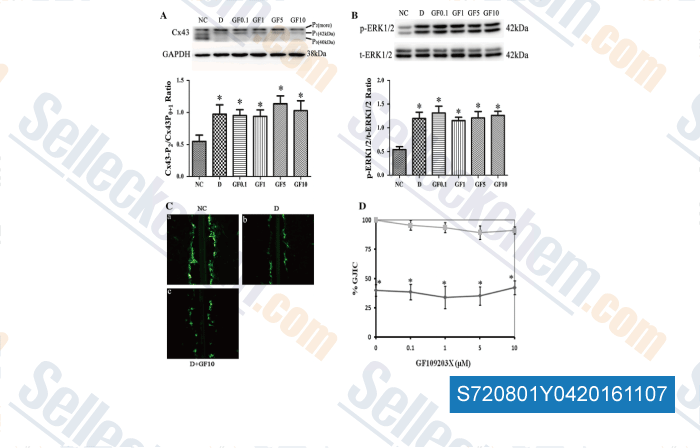
-
, , Mol Cell Biochem, 2015, 400(1-2):213-22.
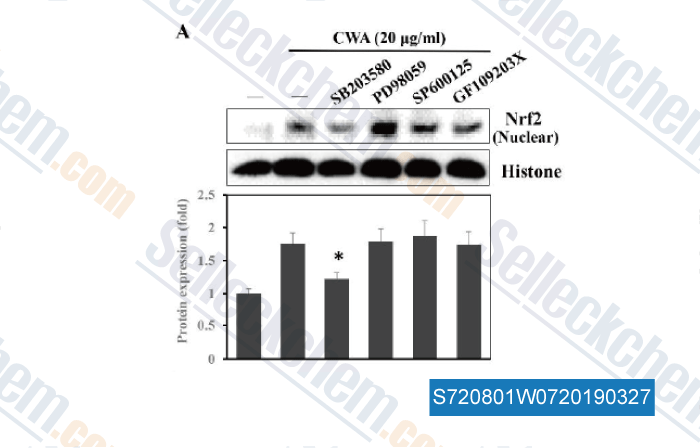
-
Daten von [ , , Free Radic Biol Med, 2018, 129:338-353 ]
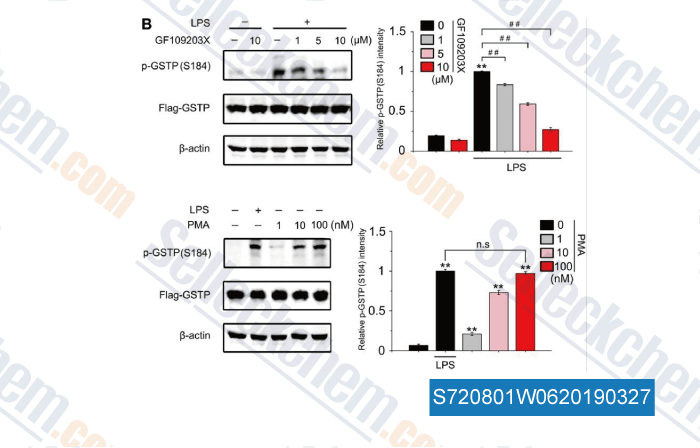
-
Daten von [ , , Front Immunol, 2018, 9:268 ]
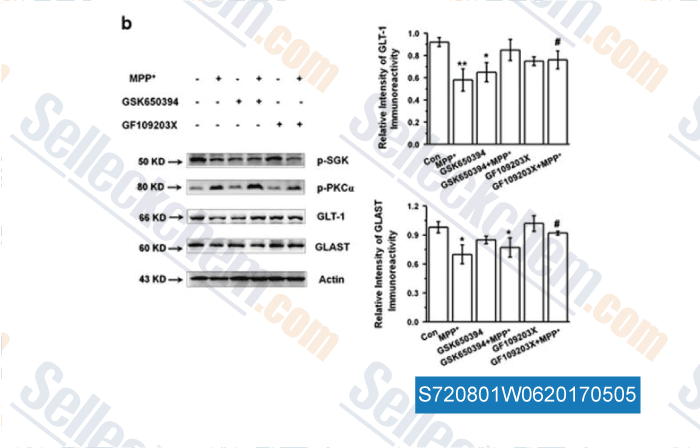
-
Daten von [ , , Cell Death Dis, 2017, 8(2):e2574 ]
Sellecks Bisindolylmaleimide I (GF109203X) Wurde zitiert von 64 Publikationen
| Dynamic phosphorylation of Fascin-1 orchestrates microglial phagocytosis and neurological recovery after spinal cord injury [ J Neuroinflammation, 2025, 22(1):121] | PubMed: 40281563 |
| HEP14-activated PKC-ERK1/2 pathway boosts HEP14-empowered hADSCs for ovarian regeneration and functional restoration [ Commun Biol, 2025, 8(1):1267] | PubMed: 40849553 |
| ELK3 destabilization by speckle-type POZ protein suppresses prostate cancer progression and docetaxel resistance [ Cell Death Dis, 2024, 15(4):274] | PubMed: 38632244 |
| Transcription of microRNAs is regulated by developmental signaling pathways and transcription factors [ Front Cell Dev Biol, 2024, 12:1356589] | PubMed: 38721525 |
| Downregulation of PIK3IP1/TrIP on T cells is controlled by TCR signal strength, PKC, and metalloprotease-mediated cleavage [ J Biol Chem, 2024, 300(12):107930] | PubMed: 39454954 |
| Epithelial TNF controls cell differentiation and CFTR activity to maintain intestinal mucin homeostasis [ J Clin Invest, 2023, 10.1172/JCI163591] | PubMed: 37643009 |
| Lysine methylation promotes NFAT5 activation and determines temozolomide efficacy in glioblastoma [ Nat Commun, 2023, 14(1):4062] | PubMed: 37429858 |
| Neurokinin-1 receptor drives PKCɑ-AURKA/N-Myc signaling to facilitate the neuroendocrine progression of prostate cancer [ Cell Death Dis, 2023, 14(6):384] | PubMed: 37385990 |
| HDAC Inhibition Restores Response to HER2-Targeted Therapy in Breast Cancer via PHLDA1 Induction [ Int J Mol Sci, 2023, 24(7)6228] | PubMed: 37047202 |
| Epicardial Adipose Tissue-Derived Leptin Promotes Myocardial Injury in Metabolic Syndrome Rats Through PKC/NADPH Oxidase/ROS Pathway [ J Am Heart Assoc, 2023, 12(15):e029415] | PubMed: 37489731 |
RÜCKGABERICHTLINIE
Die bedingungslose Rückgaberichtlinie von Selleck Chemical gewährleistet unseren Kunden ein reibungsloses Online-Einkaufserlebnis. Wenn Sie in irgendeiner Weise mit Ihrem Kauf unzufrieden sind, können Sie jeden Artikel innerhalb von 7 Tagen nach Erhalt zurückgeben. Im Falle von Produktqualitätsproblemen, sei es protokollbezogene oder produktbezogene Probleme, können Sie jeden Artikel innerhalb von 365 Tagen ab dem ursprünglichen Kaufdatum zurückgeben. Bitte befolgen Sie die nachstehenden Anweisungen, wenn Sie Produkte zurücksenden.
VERSAND UND LAGERUNG
Selleck-Produkte werden bei Raumtemperatur transportiert. Wenn Sie das Produkt bei Raumtemperatur erhalten, seien Sie versichert, dass die Qualitätskontrollabteilung von Selleck Experimente durchgeführt hat, um zu überprüfen, dass die normale Temperaturplatzierung von einem Monat die biologische Aktivität von Pulverprodukten nicht beeinträchtigt. Nach dem Sammeln lagern Sie das Produkt bitte gemäß den in der Datenblatt beschriebenen Anforderungen. Die meisten Selleck-Produkte sind unter den empfohlenen Bedingungen stabil.
NICHT FÜR DIE ANWENDUNG AM MENSCHEN, FÜR VETERINÄRMEDIZINISCHE DIAGNOSTIK ODER THERAPEUTISCHE ZWECKE.