Omipalisib (GSK2126458)

Katalog-Nr.S2658 Charge:S265808

Drucken

Technische Daten

Formel

C25H17F2N5O3S

Molekulargewicht 505.5 CAS-Nr. 1086062-66-9
Löslichkeit (25°C)* In vitro DMSO 30 mg/mL (59.34 mM)
Water Insoluble
Ethanol Insoluble
In vivo (Lösungsmittel einzeln und der Reihe nach zum Produkt hinzufügen.)
Homogeneous suspension
CMC-NA
≥5mg/ml Taking the 1 mL working solution as an example, add 5 mg of this product to 1 ml of CMC-Na solution, mix evenly to obtain a homogeneous suspension with a final concentration of 5 mg/ml.
Clear solution
2%DMSO 40%PEG300 2%Tween80 56%ddH2O

Validiert von Selleck Labs. Sollten Sie Anpassungen an dieser Formulierung benötigen, wenden Sie sich an unser Vertriebsteam für kundenspezifische Tests.

4.000mg/ml (7.91mM) Taking the 1 mL working solution as an example, add 20 μL of 200 mg/ml clarified DMSO stock solution to 400 μL of PEG300, mix evenly to clarify it; add 20 μL of Tween80 to the above system, mix evenly to clarify; then continue to add 560 μL of ddH2O to adjust the volume to 1 mL. The mixed solution should be used immediately for optimal results. 
* <1 mg/ml bedeutet schwer löslich oder unlöslich.
* Bitte beachten Sie, dass Selleck die Löslichkeit aller Verbindungen intern testet und die tatsächliche Löslichkeit geringfügig von veröffentlichten Werten abweichen kann. Dies ist normal und ist auf geringfügige Batch-zu-Batch-Variationen zurückzuführen.
* Versand bei Raumtemperatur (Stabilitätstests zeigen, dass dieses Produkt ohne Kühlmaßnahmen versendet werden kann.)

Vorbereitung von Stammlösungen

Biologische Aktivität

Beschreibung Omipalisib (GSK2126458, GSK458) ist ein hochselektiver und potenter Inhibitor von p110α/β/δ/γ, mTORC1/2 mit Ki von 0,019 nM/0,13 nM/0,024 nM/0,06 nM bzw. 0,18 nM/0,3 nM in zellfreien Assays. Diese Verbindung induziert Autophagy. Phase 1.
Ziele
p110α
(Cell-free assay)
p110δ
(Cell-free assay)
p110γ
(Cell-free assay)
p110β
(Cell-free assay)
mTORC1
(Cell-free assay)
Mehr anzeigen
0.019 nM(Ki) 0.024 nM(Ki) 0.06 nM(Ki) 0.13 nM(Ki) 0.18 nM(Ki)
In vitro Omipalisib (GSK2126458) hemmt potent die Aktivität der in menschlichen Krebszellen vorkommenden häufig aktivierenden Mutanten von p110α (E542K, E545K und H1047R) mit Ki-Werten von 8 pM, 8 pM bzw. 9 pM. Diese Verbindung bewirkt eine signifikante Reduktion der pAkt-S473-Spiegel mit bemerkenswerter Potenz in T47D- und BT474-Zellen mit IC50-Werten von 0,41 nM bzw. 0,18 nM. Darüber hinaus führt es zu einem G1-Zellzyklusarrest und erzeugt einen hemmenden Effekt auf die Zellproliferation in einer großen Panel von Zelllinien, einschließlich der Brustkrebslinien T47D und BT474 mit IC50-Werten von 3 nM bzw. 2,4 nM.
In vivo In einem BT474-Xenograft-Modell für menschliche Tumoren führt die Behandlung mit Omipalisib (GSK2126458) zu einer dosisabhängigen Reduktion der pAkt-S473-Spiegel und zeigte eine dosisabhängige Tumorwachstumshemmung bei einer niedrigen Dosis von 300 μg/kg. Außerdem weist es eine geringe Blutclearance und eine gute orale Bioverfügbarkeit bei vier präklinischen Spezies (Maus, Ratte, Hund und Affe) auf.

Protokoll (aus Referenz)

Kinase-Assay:[1]
  • HTRF In-vitro-Profilierungsassays zur PI3K-Hemmung

    Verbindungen werden seriell (3-fach in 100 % DMSO) über eine 384-Well-Polypropylen-Mutterplatte von Spalte 1 bis Spalte 12 und Spalte 13 bis Spalte 24 verdünnt, um 11 Konzentrationen für Omipalisib (GSK2126458) zu erhalten. Die Spalten 6 und 18 enthalten nur DMSO. Sobald die Titrationen vorgenommen wurden, werden 0,05 μL auf eine 384-Well-Assay-Platte mit geringem Volumen übertragen. Diese Assay-Platte enthält drei pharmakologische Kontrollen (bekannte PI3K-Inhibitoren) und 3 Assay-Kontrollen: (1) Enzym ohne Inhibitor; (2) Puffer ohne Enzym und (3) Puffer ohne Enzym plus natives PIP3. DMSO wird in alle Vertiefungen der Spalten 6 und 18 gestempelt. PIP3 wird mit 40 μM in 1X Reaktionspuffer (1 μL 200 μM PIP3) zu alternierenden Reihen der Spalte 18 (Vertiefungen 18 B, D, F, H, J, L, N, P) gegeben. Die Kontrollreaktionen ohne Enzym werden in den Vertiefungen 18 A, C, E, G, I, K, M, O (0,1 μL 100 % DMSO) durchgeführt. Der PI3-Kinase-Profilierungsassay wird mit dem HTRF-Kit optimiert. Das Assay-Kit enthält sieben Reagenzien: 1) 4X Reaktionspuffer; 2) natives PIP2 (Substrat); 3) Stop A (EDTA); 4) Stop B (Biotin-PIP3); 5) Detektionsmix A (Streptavidin-APC); 6) Detektionsmix B (Eu-markiertes Anti-GST plus GST-markierte PH-Domäne); 7) Detektionsmix C (KF). Der PI3Kinase-Reaktionspuffer wird durch 1:4-Verdünnung des Stamms mit deionisiertem Wasser hergestellt. Frisch zubereitetes DTT wird am Verwendungstag in einer Endkonzentration von 5 mM hinzugefügt. Die Enzymzugabe und die Vorinkubation der Verbindung werden durch Zugabe von 2,5 μL PI3K (in doppelter Endkonzentration) in 1X Reaktionspuffer zu allen Vertiefungen mit einem Multidrop Combi initiiert. Die Platten werden 15 Minuten lang bei Raumtemperatur inkubiert. Die Reaktionen werden durch Zugabe von 2,5 μL 2X Substratlösung (PIP2 und ATP in 1X Reaktionspuffer) mit einem Multidrop Combi initiiert. Die Platten werden eine Stunde lang bei Raumtemperatur inkubiert. Die Reaktionen werden durch Zugabe von 2,5 μL Stopplösung (Stop A und Stop B im Verhältnis 5:1 vorgemischt) zu allen Vertiefungen mit dem Multidrop Combi gequencht. Die gequenchten Reaktionen werden dann verarbeitet, um die Produktbildung nachzuweisen, indem 2,5 μL Detektionslösung zu allen Vertiefungen mit dem Multidrop Combi gegeben werden (Detektionsmix C, Detektionsmix A und Detektionsmix B im Verhältnis 18:1:1 kombiniert, d. h.: für ein Gesamtvolumen von 6000 μL mischen Sie 5400 μL Detektionsmix C, 300 μL Detektionsmix A und 300 μL Detektionsmix B. Hinweis: Diese Lösung sollte 2 Stunden vor Gebrauch hergestellt werden). Nach einer einstündigen Inkubation im Dunkeln wird das HTRF-Signal auf dem Envision-Plattenleser bei 330 nm Anregung und dualer Emissionsdetektion bei 620 nm (Eu) und 665 nm (APC) gemessen.

Zell-Assay:[1]
  • Zelllinien

    BT474, HCC1954 and T-47D cells

  • Konzentrationen

    0-1 μM

  • Inkubationszeit

    72 hours

  • Methode

    BT474, HCC1954 and T-47D (human breast) are cultured in RPMI-1640 containing 10% fetal bovine serum at 37 °C in 5% CO2 incubator. Cells are split into T75 flask two to three days prior to assay set up at density which yields approximately 70-80% confluence at time of harvest for assay. Cells are harvested using 0.25% trypsin-EDTA. Cell counts are performed on cell suspension using Trypan Blue exclusion staining. Cells are then plated in 384 well black flat bottom polystyrene in 48 μL of culture media per well at 1,000 cells/well. All plates are placed at 5% CO2, 37 °C overnight and Omipalisib (GSK2126458) is added the following day. One plate is treated with CellTiter-Glo for a day 0 (t=0) measurement and read as described below. This compound is prepared in clear bottom polypropylene 384 well plates with consecutive two fold dilutions. 4 μL of these dilutions are added to 105 μL culture media, after mixing the solution, 2 μL of these dilutions are added into each well of the cell plates. The final concentration of DMSO in all wells is 0.15%. Cells are incubated at 37 °C, 5% CO2 for 72 hours. Following 72 hours of incubation with it each plate is developed and read. CellTiter-Glo reagent is added to assay plates using a volume equivalent to the cell culture volume in the wells. Plates are shaken for approximately two minutes and incubated at room temperature for approximately 30 minutes and chemiluminescent signal is read on the Analyst GT reader. Results are expressed as a percent of the t=0 and plotted against the compound concentration. Cell growth inhibition is determined for this compound by fitting the dose response with a 4 or 6 parameter curve fit using XLfit software and determining the concentration that inhibits 50% of the cell growth (gIC50) with the Y min as the t=0 and Y max as the DMSO control. Value from wells with no cells is subtracted from all samples for background correction.

Tierstudie:[1]
  • Tiermodelle

    Human BT474 tumors implanted in mice.

  • Dosierungen

    ≤300 μg /kg

  • Verabreichung

    Administered via p.o.

Referenzen

  • http://pubs.acs.org/doi/abs/10.1021/ml900028r
  • https://pubmed.ncbi.nlm.nih.gov/22389471/

Kundenproduktvalidierung

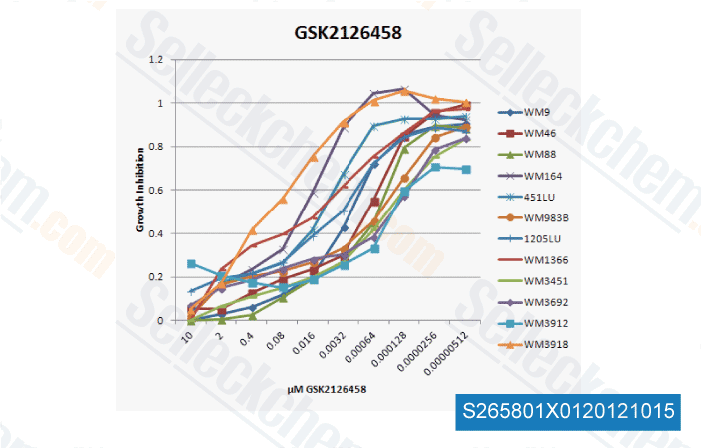
Dr.Wang Wei from NanFang Hospital,

<p>Dose response curve of compound on melanoma cell lines.  Compound was dissolved in DMSO, added in a 5-fold dilution series, starting with 10 μM, and incubated for 72 hours.  Fluorescence was measured after 8 hours incubation in resazurin.  Data was normalized to DMSO (maximal viability) and Doxorubicin (minimum viability).</p>

, , One customer

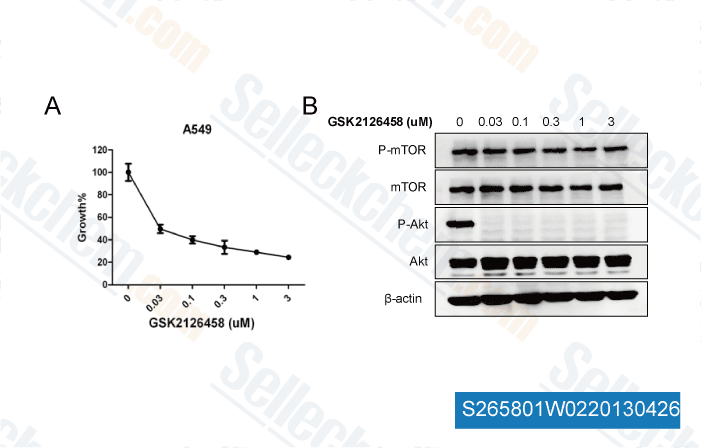
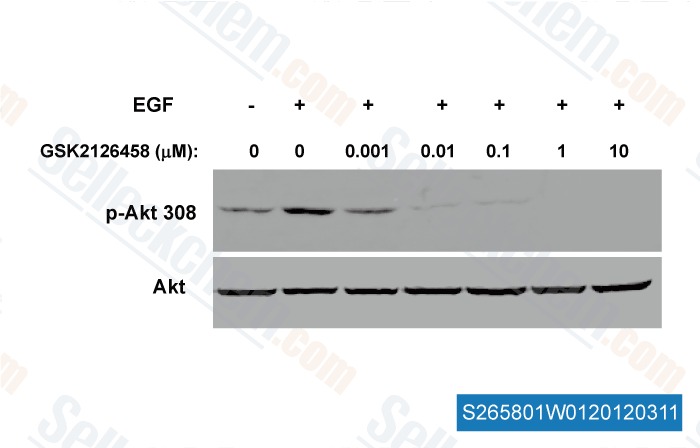
<p>After starved in serum-free medium for 24 h, A549 cells incubated with the indicated concentrations of GSK2126458 for 3 h,followed by 20-minute stimolation of 100ng/ml EGF.</p>

, , Dr. Zhang of Tianjin Medical University
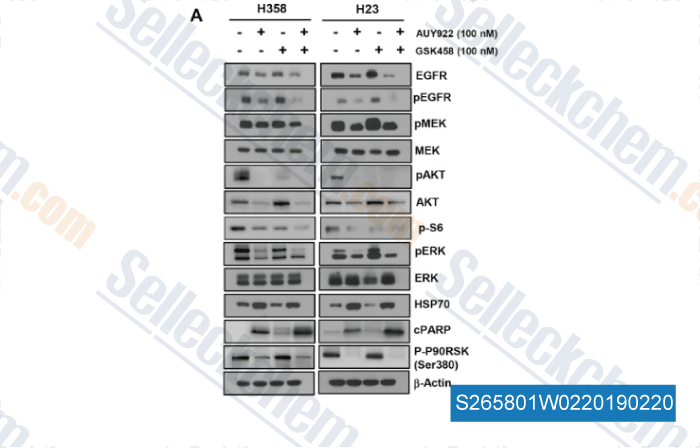
A, Effects of AUY922 and GSK458 alone on pathways downstream of KRAS. Western blotting of EGFR, pEGFR, pMEK, MEK, pAKT, AKT, pERK, ERK, HSP70, cleaved (c)PARP, and pRSK levels in two PI3K inhibitor-resistant NSCLC cell lines following treatment with each drug. β-Actin was included as a loading control.

Daten von [ , , Cancer Lett, 2017, 406:47-53 ]

Sellecks Omipalisib (GSK2126458) Wurde zitiert von 61 Publikationen

Depleting the action of EZH2 through PI3K-mTOR inhibition to overcome metastasis and immunotherapy resistance in triple-negative breast cancer [ Mol Cancer Ther, 2025, 10.1158/1535-7163.MCT-24-0693] PubMed: 40497697
Changes in Melanoma Cell Morphology Following Inhibition of Cell Invasion by Third-Generation mTOR Kinase Inhibitors [ Int J Mol Sci, 2025, 26(16)7770] PubMed: 40869090
Combined Omipalisib and MAPK Inhibition Suppress PDAC Growth [ Cancers (Basel), 2025, 17(7)1152] PubMed: 40227649
Trametinib sensitizes KRAS-mutant lung adenocarcinoma tumors to PD-1/PD-L1 axis blockade via Id1 downregulation [ Mol Cancer, 2024, 23(1):78] PubMed: 38643157
NKX2-5 regulates vessel remodeling in scleroderma-associated pulmonary arterial hypertension [ JCI Insight, 2024, 9(10)e164191] PubMed: 38652537
Characterizing heterogeneous single-cell dose responses computationally and experimentally using threshold inhibition surfaces and dose-titration assays [ NPJ Syst Biol Appl, 2024, 10(1):42] PubMed: 38637530
Analysis of hsa_circ_0136256 as a biomarker for fibrosis in systemic sclerosis [ BMC Biotechnol, 2024, 24(1):91] PubMed: 39538329
"Proteotranscriptomic analysis of advanced colorectal cancer patient derived organoids for drug sensitivity prediction" [ J Exp Clin Cancer Res, 2023, 42(1):8] PubMed: 36604765
PI3K/mTOR inhibitors promote G6PD autophagic degradation and exacerbate oxidative stress damage to radiosensitize small cell lung cancer [ Cell Death Dis, 2023, 14(10):652] PubMed: 37802999
Integrin-mediated electric axon guidance underlying optic nerve formation in the embryonic chick retina [ Commun Biol, 2023, 6(1):680] PubMed: 37391492

RÜCKGABERICHTLINIE
Die bedingungslose Rückgaberichtlinie von Selleck Chemical gewährleistet unseren Kunden ein reibungsloses Online-Einkaufserlebnis. Wenn Sie in irgendeiner Weise mit Ihrem Kauf unzufrieden sind, können Sie jeden Artikel innerhalb von 7 Tagen nach Erhalt zurückgeben. Im Falle von Produktqualitätsproblemen, sei es protokollbezogene oder produktbezogene Probleme, können Sie jeden Artikel innerhalb von 365 Tagen ab dem ursprünglichen Kaufdatum zurückgeben. Bitte befolgen Sie die nachstehenden Anweisungen, wenn Sie Produkte zurücksenden.

VERSAND UND LAGERUNG
Selleck-Produkte werden bei Raumtemperatur transportiert. Wenn Sie das Produkt bei Raumtemperatur erhalten, seien Sie versichert, dass die Qualitätskontrollabteilung von Selleck Experimente durchgeführt hat, um zu überprüfen, dass die normale Temperaturplatzierung von einem Monat die biologische Aktivität von Pulverprodukten nicht beeinträchtigt. Nach dem Sammeln lagern Sie das Produkt bitte gemäß den in der Datenblatt beschriebenen Anforderungen. Die meisten Selleck-Produkte sind unter den empfohlenen Bedingungen stabil.

NICHT FÜR DIE ANWENDUNG AM MENSCHEN, FÜR VETERINÄRMEDIZINISCHE DIAGNOSTIK ODER THERAPEUTISCHE ZWECKE.