
Technische Daten
| Formel | C23H28N2O2.2HCl |
||||||||||
| Molekulargewicht | 437.4 | CAS-Nr. | 1902123-72-1 | ||||||||
| Löslichkeit (25°C)* | In vitro | DMSO | 87 mg/mL (198.9 mM) | ||||||||
| Water | 42 mg/mL (96.02 mM) | ||||||||||
| Ethanol | Insoluble | ||||||||||
| In vivo (Lösungsmittel einzeln und der Reihe nach zum Produkt hinzufügen.) |
|
||||||||||
|
* <1 mg/ml bedeutet schwer löslich oder unlöslich. * Bitte beachten Sie, dass Selleck die Löslichkeit aller Verbindungen intern testet und die tatsächliche Löslichkeit geringfügig von veröffentlichten Werten abweichen kann. Dies ist normal und ist auf geringfügige Batch-zu-Batch-Variationen zurückzuführen. * Versand bei Raumtemperatur (Stabilitätstests zeigen, dass dieses Produkt ohne Kühlmaßnahmen versendet werden kann.) |
|||||||||||
Vorbereitung von Stammlösungen
Biologische Aktivität
| Beschreibung | GSK2879552 2HCl ist ein potenter, selektiver, oral bioverfügbarer, irreversibler LSD1 Inhibitor mit Kiapp von 1,7 μM. Phase 1. | ||
|---|---|---|---|
| Ziele |
|
||
| In vitro | In 165 Zelllinien hemmt GSK2879552 das Wachstum von 9/28 kleinzelligen Lungenkarzinom (SCLC)-Linien und 20/29 AML-Linien im Bereich von 40 % bis 100 %. Die Untergruppe der SCLC-Linien und Primärproben, die eine Wachstumshemmung als Reaktion auf GSK2879552 erfahren, zeigen eine DNA-Hypomethylierung einer charakteristischen Sonde. | ||
| In vivo | In SCLC-Xenograft-tragenden Mäusen zeigt GSK2879552 (1,5 mg/kg, p.o.) eine Tumorwachstumshemmung von 17 %–83 %. |
Protokoll (aus Referenz)
| Kinase-Assay:[1] |
|
|---|---|
| Zell-Assay:[1] |
|
Referenzen
|
Kundenproduktvalidierung
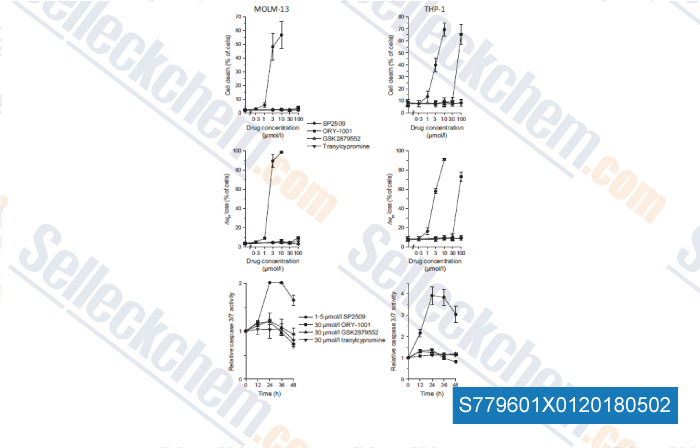
-
Daten von [ , , Br J Haematol, 2017, doi: 10.1111/bjh.14983 ]
Sellecks GSK2879552 Dihydrochloride Wurde zitiert von 29 Publikationen
| Dual targeting of CDK6 and LSD1 is synergistic and overcomes differentiation blockade in AML [ EMBO Mol Med, 2025, 10.1038/s44321-025-00296-2] | PubMed: 40883610 |
| A CRISPR-Cas9 screen reveals genetic determinants of the cellular response to decitabine [ EMBO Rep, 2025, 10.1038/s44319-025-00385-w] | PubMed: 39930152 |
| The lncRNA ELDR suppresses tumorigenicity of AML by interfering with DNA replication and chromatin accessibility [ Blood Adv, 2025, bloodadvances.2024015427] | PubMed: 40921006 |
| A Model of Traumatic Brain Injury Oligomerizes Tau in Cortical Organoids and Induces Clinically Relevant Pathologies that Synergize with MAPT Mutation [ J Neurotrauma, 2025, 10.1177/08977151251374286] | PubMed: 40900146 |
| Epigenetic modifiers to treat retinal degenerative diseases [ bioRxiv, 2025, 2025.05.22.655558] | PubMed: 40501782 |
| LSD1 inhibition improves efficacy of adoptive T cell therapy by enhancing CD8+ T cell responsiveness [ Nat Commun, 2024, 15(1):7366] | PubMed: 39191730 |
| Transposable elements-mediated recruitment of KDM1A epigenetically silences HNF4A expression to promote hepatocellular carcinoma [ Nat Commun, 2024, 15(1):5631] | PubMed: 38965210 |
| Pharmacological inhibition of LSD1 suppresses growth of hepatocellular carcinoma by inducing GADD45B [ MedComm (2020), 2023, 4(3):e269] | PubMed: 37250145 |
| E3 ligase Trim35 inhibits LSD1 demethylase activity through K63-linked ubiquitination and enhances anti-tumor immunity in NSCLC [ Cell Rep, 2023, 10.1016/j.celrep.2023.113477] | PubMed: 37979167 |
| Crucial Role of Lysine-Specific Histone Demethylase 1 in RANKL-Mediated Osteoclast Differentiation [ Int J Mol Sci, 2023, 24(4)3605] | PubMed: 36835016 |
RÜCKGABERICHTLINIE
Die bedingungslose Rückgaberichtlinie von Selleck Chemical gewährleistet unseren Kunden ein reibungsloses Online-Einkaufserlebnis. Wenn Sie in irgendeiner Weise mit Ihrem Kauf unzufrieden sind, können Sie jeden Artikel innerhalb von 7 Tagen nach Erhalt zurückgeben. Im Falle von Produktqualitätsproblemen, sei es protokollbezogene oder produktbezogene Probleme, können Sie jeden Artikel innerhalb von 365 Tagen ab dem ursprünglichen Kaufdatum zurückgeben. Bitte befolgen Sie die nachstehenden Anweisungen, wenn Sie Produkte zurücksenden.
VERSAND UND LAGERUNG
Selleck-Produkte werden bei Raumtemperatur transportiert. Wenn Sie das Produkt bei Raumtemperatur erhalten, seien Sie versichert, dass die Qualitätskontrollabteilung von Selleck Experimente durchgeführt hat, um zu überprüfen, dass die normale Temperaturplatzierung von einem Monat die biologische Aktivität von Pulverprodukten nicht beeinträchtigt. Nach dem Sammeln lagern Sie das Produkt bitte gemäß den in der Datenblatt beschriebenen Anforderungen. Die meisten Selleck-Produkte sind unter den empfohlenen Bedingungen stabil.
NICHT FÜR DIE ANWENDUNG AM MENSCHEN, FÜR VETERINÄRMEDIZINISCHE DIAGNOSTIK ODER THERAPEUTISCHE ZWECKE.