
Technische Daten
| Formel | C26H20ClN3O5 |
||||||
| Molekulargewicht | 489.91 | CAS-Nr. | 1346607-05-3 | ||||
| Löslichkeit (25°C)* | In vitro | DMSO | 100 mg/mL (204.11 mM) | ||||
| Water | Insoluble | ||||||
| Ethanol | Insoluble | ||||||
| In vivo (Lösungsmittel einzeln und der Reihe nach zum Produkt hinzufügen.) |
|
||||||
|
* <1 mg/ml bedeutet schwer löslich oder unlöslich. * Bitte beachten Sie, dass Selleck die Löslichkeit aller Verbindungen intern testet und die tatsächliche Löslichkeit geringfügig von veröffentlichten Werten abweichen kann. Dies ist normal und ist auf geringfügige Batch-zu-Batch-Variationen zurückzuführen. * Versand bei Raumtemperatur (Stabilitätstests zeigen, dass dieses Produkt ohne Kühlmaßnahmen versendet werden kann.) |
|||||||
Vorbereitung von Stammlösungen
Biologische Aktivität
| Beschreibung | GSK621 ist ein spezifischer und potenter AMPK-Aktivator. | |
|---|---|---|
| Ziele |
|
|
| In vitro | In AML-Zelllinien und primären AML-Proben erhöht GSK621 die Phosphorylierung an AMPKα T172, einem Marker der AMPK-Aktivierung, deutlich. In einem Satz von 20 Zelllinien reduziert diese Verbindung die Proliferation aller 20 Linien mit IC50-Werten von 13-30 μM und erhöht die Apoptose in 17 (85%) Linien. Zusätzlich löst es auch Autophagie aus, die teilweise zum Zelltod von AML-Zellen beiträgt. | |
| In vivo | Bei Nacktmäusen mit MOLM-14-Xenografts reduziert GSK621 (30 mg/kg, i.p.) das Leukämiewachstum und verlängert das Überleben signifikant durch die Verbesserung der AMPK-Aktivität und die Induktion der Apoptose. |
Protokoll (aus Referenz)
| Kinase-Assay: |
|
|---|---|
| Zell-Assay: |
|
| Tierstudie: |
|
Referenzen
|
Kundenproduktvalidierung
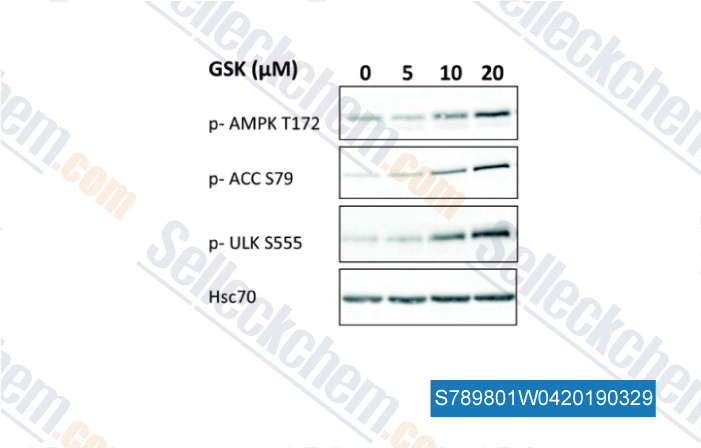
-
Daten von [ , , Haematologica, 2018, doi:10.3324/haematol.2018.191403 ]
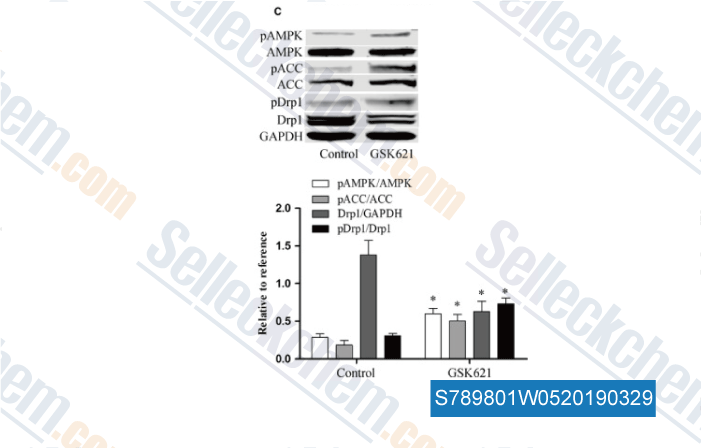
-
Daten von [ , , J Cell Mol Med, 2018, doi:10.1111/jcmm.13975 ]
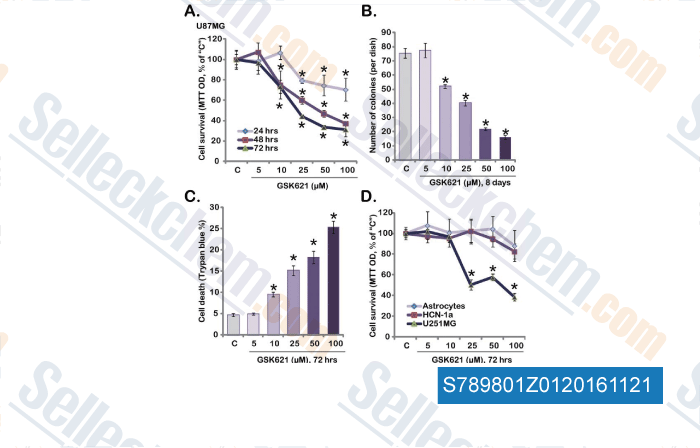
-
Daten von [ , , PLoS One, 2016, 11(8):e0161017. ]
Sellecks GSK621 Wurde zitiert von 16 Publikationen
| (Pro)renin receptor aggravates myocardial pyroptosis in diabetic cardiomyopathy through AMPK-NLRP3 pathway [ Front Pharmacol, 2024, 15:1453647] | PubMed: 39545058 |
| AMPK stimulation inhibits YAP/TAZ signaling to ameliorate hepatic fibrosis [ Sci Rep, 2024, 14(1):5205] | PubMed: 38433278 |
| Redefining the role of AMPK in autophagy and the energy stress response [ Nat Commun, 2023, 14(1):2994] | PubMed: 37225695 |
| AMPK Stimulation Inhibits YAP/TAZ Signaling to Ameliorate Hepatic Fibrosis [ Research Square, 2023, 10.21203/rs.3.rs-3727864/v1] | PubMed: none |
| AMPK-PERK axis represses oxidative metabolism and enhances apoptotic priming of mitochondria in acute myeloid leukemia [ Cell Rep, 2022, 38(1):110197] | PubMed: 34986346 |
| GPR120 induces regulatory dendritic cells by inhibiting HK2-dependent glycolysis to alleviate fulminant hepatic failure [ Cell Death Dis, 2021, 13(1):1] | PubMed: 34911928 |
| Effects of (Pro)renin Receptor on Diabetic Cardiomyopathy Pathological Processes in Rats via the PRR-AMPK-YAP Pathway [ Front Physiol, 2021, 12:657378] | PubMed: 34122131 |
| GPA peptide inhibits NLRP3 inflammasome activation to ameliorate colitis through AMPK pathway [ Aging (Albany NY), 2020, 12(18):18522-18544] | PubMed: 32950971 |
| Metformin induces lipogenic differentiation in myofibroblasts to reverse lung fibrosis [ Nat Commun, 2019, 10(1-:2987] | PubMed: 31278260 |
| Ubiquinol-cytochrome C reductase core protein II promotes tumorigenesis by facilitating p53 degradation. [ EBioMedicine, 2019, 40:92-105] | PubMed: 30674441 |
RÜCKGABERICHTLINIE
Die bedingungslose Rückgaberichtlinie von Selleck Chemical gewährleistet unseren Kunden ein reibungsloses Online-Einkaufserlebnis. Wenn Sie in irgendeiner Weise mit Ihrem Kauf unzufrieden sind, können Sie jeden Artikel innerhalb von 7 Tagen nach Erhalt zurückgeben. Im Falle von Produktqualitätsproblemen, sei es protokollbezogene oder produktbezogene Probleme, können Sie jeden Artikel innerhalb von 365 Tagen ab dem ursprünglichen Kaufdatum zurückgeben. Bitte befolgen Sie die nachstehenden Anweisungen, wenn Sie Produkte zurücksenden.
VERSAND UND LAGERUNG
Selleck-Produkte werden bei Raumtemperatur transportiert. Wenn Sie das Produkt bei Raumtemperatur erhalten, seien Sie versichert, dass die Qualitätskontrollabteilung von Selleck Experimente durchgeführt hat, um zu überprüfen, dass die normale Temperaturplatzierung von einem Monat die biologische Aktivität von Pulverprodukten nicht beeinträchtigt. Nach dem Sammeln lagern Sie das Produkt bitte gemäß den in der Datenblatt beschriebenen Anforderungen. Die meisten Selleck-Produkte sind unter den empfohlenen Bedingungen stabil.
NICHT FÜR DIE ANWENDUNG AM MENSCHEN, FÜR VETERINÄRMEDIZINISCHE DIAGNOSTIK ODER THERAPEUTISCHE ZWECKE.