
|
Wie zu zitieren 1. Für Zitate im Text (Materialien & Methoden): 2. Für die Tabelle der Schlüsselressourcen: |
||
|
Gebührenfrei: (877) 796-6397 -- Nur USA und Kanada -- |
Fax: +1-832-582-8590 Bestellungen: +1-832-582-8158 |
Technischer Support: +1-832-582-8158 Ext:3 Bitte geben Sie Ihre Bestellnummer in der E-Mail an. Wir bemühen uns, alle E-Mail-Anfragen innerhalb eines Werktages zu beantworten. |
Biologische Beschreibung
| Spezifität | Histone H3 (mono Methyl Lys9) Antibody [E5H2] detektiert endogene Histon-H3-Proteinspiegel nur, wenn diese an Lys9 monomethyliert sind. Dieser Antikörper kreuzreagiert nicht mit nicht-methyliertem, di-methyliertem oder tri-methyliertem Lys9. Darüber hinaus kreuzreagiert dieser Antikörper nicht mit anderen bekannten monomethylierten, dimethylierten oder trimethylierten Lysinen an den Histonen H3, H4, H2A oder H2B. |
|---|---|
| Hintergrund | Das Nukleosom, bestehend aus den vier Kernhistonen H2A, H2B, H3 und H4, dient als grundlegende strukturelle und regulatorische Einheit des Chromatins. Über seine klassische Rolle bei der DNA-Kompaktierung hinaus fungiert das Nukleosom als dynamische Plattform für die epigenetische Regulation, wobei Histone eine breite Palette von posttranslationalen Modifikationen (PTMs) wie Acetylierung, Phosphorylierung, Methylierung und Ubiquitinierung erfahren. Diese chemischen Modifikationen steuern auf komplexe Weise die Chromatinarchitektur und die Genexpression und beeinflussen Prozesse, die für Entwicklung, Differenzierung und Genomstabilität unerlässlich sind. Unter den Histon-PTMs stellt die Methylierung einen entscheidenden Regulationsmechanismus dar, der aktive oder repressive Chromatinzustände definiert. Arginin-Methylierung, katalysiert durch Protein-Arginin-Methyltransferasen (PRMTs) wie PRMT1 und CARM1 (PRMT4), tritt typischerweise an H3-Resten Arg2, Arg17 und Arg26 sowie am H4-Rest Arg3 auf und ist im Allgemeinen mit der transkriptionellen Aktivierung verbunden. Im Gegensatz dazu kann die Lysin-Methylierung an Histonen H3 (Lys4, Lys9, Lys27, Lys36, Lys79) und H4 (Lys20) je nach spezifischem Rest und Chromatin-Kontext entweder als aktivierende oder repressive Markierung fungieren. Diese Methylierungsignaturen dienen als molekulare Andockstellen für Effektorproteine und Chromatin-assoziierte Komplexe, die Methyl-Lysin-Reste durch spezialisierte Reader-Domänen erkennen, darunter Chromodomänen (z. B. HP1, PRC1), PHD-Finger (z. B. BPTF, ING2), Tudor-Domänen (z. B. 53BP1) und WD40-Repeats (z. B. WDR5). Insbesondere spielt die H3K9-Methylierung eine zentrale Rolle bei der transkriptionellen Repression und der Bildung von Heterochromatin, wobei sie in konstitutiv kondensierten chromosomalen Regionen und entwicklungsbedingt stillgelegten Loci angereichert ist. Genomweite Analysen zeigen, dass Veränderungen in der H3K9-Methylierung eng mit der Rekrutierung und Dissoziation der RNA-Polymerase II korrelieren, wobei Remethylierungsereignisse eine stärkere Assoziation mit der Freisetzung der RNA-Polymerase II als die Histon-Deacetylierung zeigen, was ihre entscheidende Rolle bei der transkriptionellen Kontrolle und Chromatinzustandsübergängen unterstreicht. |
Nutzungsinformationen
| Anwendung | WB, IP, IF, ChIP | Verdünnung |
|
||||||||
|---|---|---|---|---|---|---|---|---|---|---|---|
| Reaktivität | Human, Mouse, Rat, Monkey | ||||||||||
| Quelle | Rabbit Monoclonal Antibody | MW | 17 kDa | ||||||||
| Lagerpuffer | PBS, pH 7.2+50% Glycerol+0.05% BSA+0.01% NaN3 | Lagerung (Ab dem Datum des Erhalts) |
-20°C (avoid freeze-thaw cycles), 2 years | ||||||||
| WB |
Experimental Protocol:
Sample preparation
1. Tissue: Lyse the tissue sample by adding an appropriate volume of ice-cold RIPA/NP-40 Lysis Buffer (containing Protease Inhibitor Cocktail),and homogenize the tissue at a low temperature. 2. Adherent cell: Aspirate the culture medium and wash the cells with ice-cold PBS twice. Lyse the cells by adding an appropriate volume of RIPA/NP-40 Lysis Buffer (containing Protease Inhibitor Cocktail) and put the sample on ice for 5 min. 3. Suspension cell: Transfer the culture medium to a pre-cooled centrifuge tube. Centrifuge and aspirate the supernatant. Wash the cells with ice-cold PBS twice. Lyse the cells by adding an appropriate volume of RIPA/NP-40 Lysis Buffer (containing Protease Inhibitor Cocktail) and put the sample on ice for 5 min. 4. Place the lysate into a pre-cooled microcentrifuge tube. Centrifuge at 4°C for 15 min. Collect the supernatant;
5. Remove a small volume of lysate to determine the protein concentration;
6. Combine the lysate with protein loading buffer. Boil 20 µL sample under 95-100°C for 5 min. Centrifuge for 5 min after cool down on ice.
Electrophoretic separation
1. According to the concentration of extracted protein, load appropriate amount of protein sample and marker onto SDS-PAGE gels for electrophoresis. Recommended separating gel (lower gel) concentration: 10%. Reference Table for Selecting SDS-PAGE Separation Gel Concentrations 2. Power up 80V for 30 minutes. Then the power supply is adjusted (110 V~150 V), the Marker is observed, and the electrophoresis can be stopped when the indicator band of the predyed protein Marker where the protein is located is properly separated. (Note that the current should not be too large when electrophoresis, too large current (more than 150 mA) will cause the temperature to rise, affecting the result of running glue. If high currents cannot be avoided, an ice bath can be used to cool the bath.)
Transfer membrane
1. Take out the converter, soak the clip and consumables in the pre-cooled converter;
2. Activate PVDF membrane with methanol for 1 min and rinse with transfer buffer;
3. Install it in the order of "black edge of clip - sponge - filter paper - filter paper - glue -PVDF membrane - filter paper - filter paper - sponge - white edge of clip"; 4. The protein was electrotransferred to PVDF membrane. ( 0.22 µm PVDF membrane is recommended )) Reference Table for Selecting PVDF Membrane Pore Size Specifications Recommended conditions for wet transfer: 200 mA, 60 min. ( Note that the transfer conditions can be adjusted according to the protein size. For high-molecular-weight proteins, a higher current and longer transfer time are recommended. However, ensure that the transfer tank remains at a low temperature to prevent gel melting.)
Block
1. After electrotransfer, wash the film with TBST at room temperature for 5 minutes;
2. Incubate the film in the blocking solution for 1 hour at room temperature;
3. Wash the film with TBST for 3 times, 5 minutes each time.
Antibody incubation
1. Use 5% skim milk powder to prepare the primary antibody working liquid (recommended dilution ratio for primary antibody 1:1000), gently shake and incubate with the film at 4°C overnight; 2. Wash the film with TBST 3 times, 5 minutes each time;
3. Add the secondary antibody to the blocking solution and incubate with the film gently at room temperature for 1 hour;
4. After incubation, wash the film with TBST 3 times for 5 minutes each time.
Antibody staining
1. Add the prepared ECL luminescent substrate (or select other color developing substrate according to the second antibody) and mix evenly;
2. Incubate with the film for 1 minute, remove excess substrate (keep the film moist), wrap with plastic film, and expose in the imaging system.
|
| IF |
Experimental Protocol:
Specimen Preparation
1. Aspirate liquid, then cover cells to a depth of 2–3 mm with 4% Paraformaldehyde diluted in 1X PBS.
NOTE: Paraformaldehyde is toxic, use only in a fume hood.
2. Fix cells for 15 min at room temperature.
3. Aspirate fixative, rinse three times in 1X PBS for 5 min each.
4. Proceed with Immunostaining.
Immunostaining
1. Add theblocking buffer and incubate for 60 min at RT.
2. Prepare primary antibody diluent in antibody dilution buffer as recommended .
3. Aspirate blocking solution, apply diluted primary antibody.
4. Incubate overnight at 4°C.
5. Rinse three times in 1X PBS for 5 min each.
6. Incubate specimens in fluorochrome-conjugated secondary antibody diluted in antibody dilution buffer for 1–2 hr at room temperature in the dark.
7. Rinse three times in 1X PBS for 5 min each.
8. Mount slides usingmounting medium with DAPI and cover with coverslips.
9. For best results, allow mountant to cure overnight at room temperature. For long-term storage, store slides flat at 23°C protected from light.
|
| IF |
Experimental Protocol:
Sample Preparation
1. Adherent Cells: Place a clean, sterile coverslip in a culture dish. Once the cells grow to near confluence as a monolayer, remove the coverslip for further use.
2. Suspension Cells: Seed the cells onto a clean, sterile slide coated with poly-L-lysine.
3. Frozen Sections: Allow the slide to thaw at room temperature. Wash it with pure water or PBS for 2 times, 3 minutes each time.
4. Paraffin Sections: Deparaffinization and rehydration. Wash the slide with pure water or PBS for 3 times, 3 minutes each time. Then perform antigen retrieval.
Fixation
1. Fix the cell coverslips/spots or tissue sections at room temperature using a fixative such as 4% paraformaldehyde (4% PFA) for 10-15 minutes.
2. Wash the sample with PBS for 3 times, 3 minutes each time.
Permeabilization
1.Add a detergent such as 0.1–0.3% Triton X-100 to the sample and incubate at room temperature for 10–20 minutes.
(Note: This step is only required for intracellular antigens. For antigens expressed on the cell membrane, this step is unnecessary.)
Wash the sample with PBS for 3 times, 3 minutes each time.
Blocking
Add blocking solution and incubate at room temperature for at least 1 hour. (Common blocking solutions include: serum from the same source as the secondary antibody, BSA, or goat serum.)
Note: Ensure the sample remains moist during and after the blocking step to prevent drying, which can lead to high background.
Immunofluorescence Staining (Day 1)
1. Remove the blocking solution and add the diluted primary antibody.
2. Incubate the sample in a humidified chamber at 4°C overnight.
Immunofluorescence Staining (Day 2)
1. Remove the primary antibody and wash with PBST for 3 times, 5 minutes each time.
2. Add the diluted fluorescent secondary antibody and incubate in the dark at 4°C for 1–2 hours.
3. Remove the secondary antibody and wash with PBST for 3 times, 5 minutes each time.
4. Add diluted DAPI and incubate at room temperature in the dark for 5–10 minutes.
5. Wash with PBST for 3 times, 5 minutes each time.
Mounting
1. Mount the sample with an anti-fade mounting medium.
2. Allow the slide to dry at room temperature overnight in the dark.
3. Store the slide in a slide storage box at 4°C, protected from light.
|
Referenzen
|
Anwendungsdaten
IF
Validiert von Selleck
-
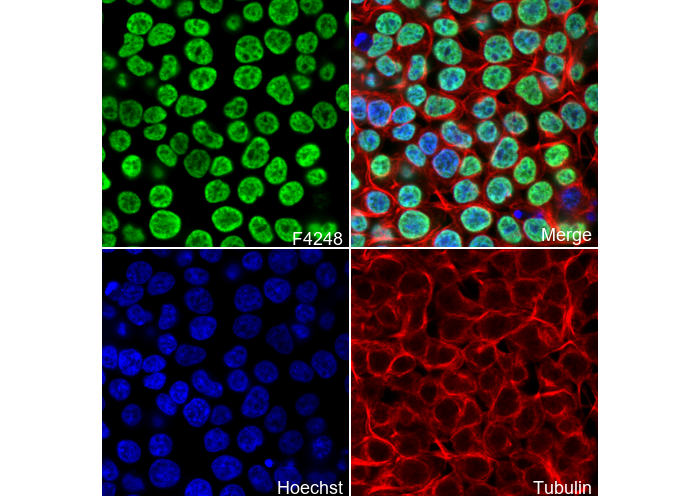 Immunofluorescent analysis of U2OS cells using F4248 (green, 1:3200), Hoechst (blue) and tubulin (Red).
WB
Validiert von Selleck
-
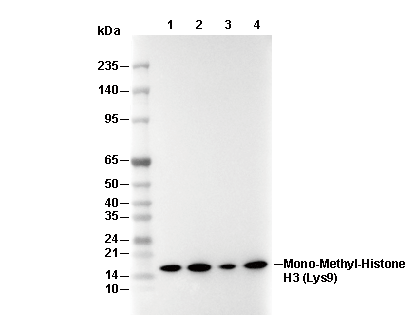 Lane 1: Hela, Lane 2: 3T3, Lane 3: C6, Lane 4: COS-7