
Technische Daten
| Formel | C18H28ClN3O5S |
|||
| Molekulargewicht | 433.95 | CAS-Nr. | 747-36-4 | |
| Löslichkeit (25°C)* | In vitro | Water | 87 mg/mL (200.48 mM) | |
| DMSO | Insoluble | |||
| Ethanol | Insoluble | |||
|
* <1 mg/ml bedeutet schwer löslich oder unlöslich. * Bitte beachten Sie, dass Selleck die Löslichkeit aller Verbindungen intern testet und die tatsächliche Löslichkeit geringfügig von veröffentlichten Werten abweichen kann. Dies ist normal und ist auf geringfügige Batch-zu-Batch-Variationen zurückzuführen. * Versand bei Raumtemperatur (Stabilitätstests zeigen, dass dieses Produkt ohne Kühlmaßnahmen versendet werden kann.) |
||||
Vorbereitung von Stammlösungen
Biologische Aktivität
| Beschreibung | Hydroxychloroquine (HCQ) Sulfate ist ein Antimalariamittel, das zur Behandlung von systemischem Lupus erythematodes, rheumatoider Arthritis und anderen Autoimmun-, entzündlichen und dermatologischen Erkrankungen eingesetzt wird. Es fungiert auch als Inhibitor von Autophagy und toll-like receptor (TLR) 7/9. | ||
|---|---|---|---|
| Ziele |
|
||
| In vitro | Hydroxychloroquine Sulfate ist ein potenter Inhibitor von Autophagy. Es verhindert die lysosomale Ansäuerung und stört dadurch einen entscheidenden Schritt im autophagen Prozess. Eine HCQ-Behandlung hemmt das Wachstum von RCC- (Nierenzellkrebs-) Zellen, fördert die Apoptose, hemmt den mitochondrialen Sauerstoffverbrauch und erhöht die Glykolyserate. |
||
| In vivo | Die Behandlung mit Hydroxychloroquine Sulfate reduziert die Infarktgröße in einem In-vivo-Rattenmodell der I/R-Verletzung und die kardioprotektive Wirkung von Hydroxychloroquine ist ERK1/2-abhängig. Darüber hinaus zeigt Hydroxychloroquine Sulfate eine frühe vaskuläre Schutzwirkung. HCQ scheint das Auftreten von endothelialer Dysfunktion (ED) bei behandelten Tieren zu verhindern. |
Protokoll (aus Referenz)
| Kinase-Assay: |
|
|---|---|
| Zell-Assay: |
|
Referenzen
|
Kundenproduktvalidierung
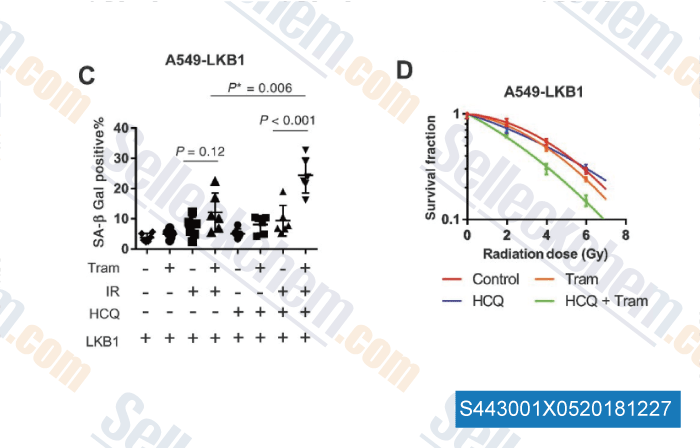
-
Daten von [ , , Clin Cancer Res, 2018, doi:10.1158/1078-0432.CCR-18-1489 ]
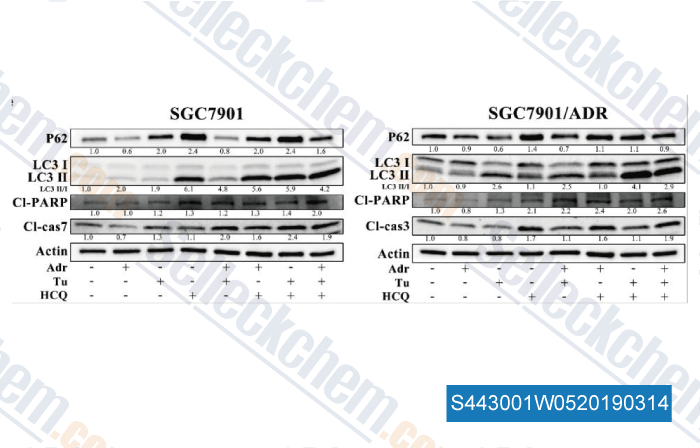
-
Daten von [ , , J Exp Clin Cancer Res, 2018, 37(1):272 ]
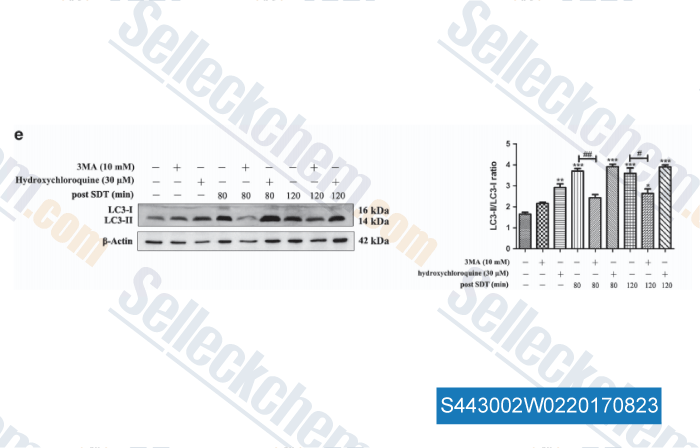
-
Daten von [ , , Cell Death Dis, 2017, 8(1):e2558 ]
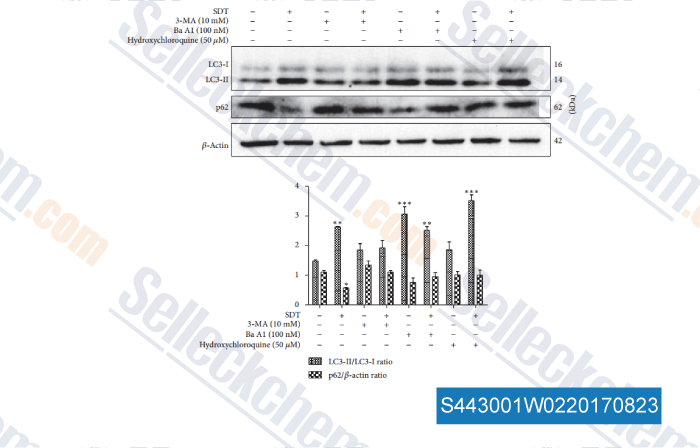
-
Daten von [ , , Oxid Med Cell Longev, 2017, 8519169 ]
Sellecks HCQ (Hydroxychloroquine) Sulfate Wurde zitiert von 124 Publikationen
| Reticulophagy receptor FAM134C restrains BMP receptor signaling [ EMBO J, 2025, 10.1038/s44318-025-00581-3] | PubMed: 41116059 |
| BMAL1-depletion remodels ceramide metabolism to regulate ferroptosis and sorafenib chemosensitivity in acute myeloid leukemia [ iScience, 2025, 28(4):112054] | PubMed: 40241743 |
| MYC Overexpression Enhances Sensitivity to MEK Inhibition in Head and Neck Squamous Cell Carcinoma [ Int J Mol Sci, 2025, 26(2)588] | PubMed: 39859304 |
| Gossypin induces apoptosis and autophagy via the MAPK/JNK pathway in HT‑29 human colorectal cancer cells [ Int J Mol Med, 2025, 56(1)107] | PubMed: 40376978 |
| HCQ reverses the immune imbalance related to severe infections following chemotherapy of acute myeloid leukemia and exhibits inhibitory effects on inflammatory cytokine storms [ Clin Exp Med, 2025, 25(1):294] | PubMed: 40815351 |
| Glycopolymer nanomicelles: pH-responsive drug delivery, endocytosis pathway, autophagy behavior, and the effect of autophagy inhibitors [ J Mater Sci-Mater M, 2025, 36(1):47] | PubMed: 40478478 |
| TRIM22 inhibits the metastasis of colorectal cancer through facilitating β-Catenin degradation [ Exp Cell Res, 2025, 446(2):114473] | PubMed: 39978715 |
| Pyrimethamine Inhibits Human Ovarian Cancer by Triggering Lethal Mitophagy via Activating the p38/JNK/ERK Pathway [ Oncol Res, 2025, 33(9):2421-2434] | PubMed: 40918465 |
| Itaconate drives pro-inflammatory responses through proteasomal degradation of GLO1 [ Biochem Biophys Res Commun, 2025, 747:151292] | PubMed: 39787788 |
| Platelet factor 4 modulates endothelial cell antimicrobial activity to enhance bacterial clearance and improve sepsis outcomes [ bioRxiv, 2025, 2025.09.02.673783] | PubMed: 40950105 |
RÜCKGABERICHTLINIE
Die bedingungslose Rückgaberichtlinie von Selleck Chemical gewährleistet unseren Kunden ein reibungsloses Online-Einkaufserlebnis. Wenn Sie in irgendeiner Weise mit Ihrem Kauf unzufrieden sind, können Sie jeden Artikel innerhalb von 7 Tagen nach Erhalt zurückgeben. Im Falle von Produktqualitätsproblemen, sei es protokollbezogene oder produktbezogene Probleme, können Sie jeden Artikel innerhalb von 365 Tagen ab dem ursprünglichen Kaufdatum zurückgeben. Bitte befolgen Sie die nachstehenden Anweisungen, wenn Sie Produkte zurücksenden.
VERSAND UND LAGERUNG
Selleck-Produkte werden bei Raumtemperatur transportiert. Wenn Sie das Produkt bei Raumtemperatur erhalten, seien Sie versichert, dass die Qualitätskontrollabteilung von Selleck Experimente durchgeführt hat, um zu überprüfen, dass die normale Temperaturplatzierung von einem Monat die biologische Aktivität von Pulverprodukten nicht beeinträchtigt. Nach dem Sammeln lagern Sie das Produkt bitte gemäß den in der Datenblatt beschriebenen Anforderungen. Die meisten Selleck-Produkte sind unter den empfohlenen Bedingungen stabil.
NICHT FÜR DIE ANWENDUNG AM MENSCHEN, FÜR VETERINÄRMEDIZINISCHE DIAGNOSTIK ODER THERAPEUTISCHE ZWECKE.