
Technische Daten
| Formel |
C22H21N3O4
|
||||||
| Molekulargewicht | 391.42 | CAS-Nr. | 610798-31-7 | ||||
| Löslichkeit (25°C)* | In vitro | DMSO | 78 mg/mL (199.27 mM) | ||||
| Ethanol | 6 mg/mL (15.32 mM) | ||||||
| Water | Insoluble | ||||||
| In vivo (Lösungsmittel einzeln und der Reihe nach zum Produkt hinzufügen.) |
|
||||||
|
* <1 mg/ml bedeutet schwer löslich oder unlöslich. * Bitte beachten Sie, dass Selleck die Löslichkeit aller Verbindungen intern testet und die tatsächliche Löslichkeit geringfügig von veröffentlichten Werten abweichen kann. Dies ist normal und ist auf geringfügige Batch-zu-Batch-Variationen zurückzuführen. * Versand bei Raumtemperatur (Stabilitätstests zeigen, dass dieses Produkt ohne Kühlmaßnahmen versendet werden kann.) |
|||||||
Vorbereitung von Stammlösungen
Biologische Aktivität
| Beschreibung | Icotinib (BPI-2009H) ist ein potenter und spezifischer EGFR-Inhibitor mit einer IC50 von 5 nM und zielt auf EGFR, EGFR(L858R), EGFR(L861Q), EGFR(T790M) und EGFR(T790M, L858R) ab. | ||
|---|---|---|---|
| Ziele |
|
||
| In vitro | Icotinib (BPI-2009H) hemmt die EGFR-Aktivität dosisabhängig mit einem IC50-Wert von 5 nM und vollständiger Hemmung bei 62,5 nM. Es hemmt selektiv nur die EGFR-Mitglieder, einschließlich des Wildtyps und der Mutanten, mit Hemmwirksamkeiten von 61-99 %. Diese Verbindung blockiert die EGFR-vermittelte intrazelluläre Tyrosinphosphorylierung in menschlichen epidermoiden Karzinom-A431-Zellen dosisabhängig. In unserem Proliferationstest, der an den Zelllinien A431, BGC-823, A549, H460, HCT8, KB und Bel-7402 durchgeführt wurde, stellten wir fest, dass die relative Empfindlichkeit der Zelllinien gegenüber Icotinib A431 > BGC-823 > A549 > H460 > KB > HCT8 und Bel-7402 ist. Es zeigt ein breites Spektrum an Antitumoraktivität und ist besonders wirksam gegen Tumoren, die höhere EGFR-Spiegel exprimieren. | ||
| In vivo | Icotinib (BPI-2009H) zeigt eine Antitumorwirkung bei verschiedenen Arten von Xenografts. Bei einer Dosis von 120 mg/kg hemmt es das Tumorwachstum mit einer Rate von 51,5 %, 31,0 % bzw. 67,4 % in den A431-, A549- und H460-Xenografts. |
Protokoll (aus Referenz)
| Kinase-Assay:[1] |
|
|---|---|
| Zell-Assay:[1] |
|
| Tierstudie:[1] |
|
Referenzen
|
Kundenproduktvalidierung
![<p>B. Effect of Icotinib treatment on the subcellular localization of ABCG2 in NCI-H460/MX20 cell. ABCG2 staining is shown in green. DAPI (blue) counterstains the nuclei. C. Effect of Icotinib on the ATPase activity of ABCG2: The BeFx-sensitive specific ATPase activity of ABCG2 was determined in the presence of 0-5 μM of Icotinib as described in supplemental methods. The activity in the absence of Icotinib (basal activity) was considered to be 100%, and % -fold stimulation ± S.D. (Y-axis) was plotted as a function of indicated concentrations of Icotinib (X-axis). D. Effect of Icotinib on the photolabeling of ABCG2 with [125I]-IAAP: Crude membranes from ABCG2 expressing MCF7-FLV1000 cells were photo-crosslinked with [125I]-IAAP in the presence and absence of 0-50 μM of Icotinib as described in supplemental methods. [125I]-IAAP incorporated in ABCG2 band was quantified using ImageQuant software and plotted as % [125I]-IAAP incorporated ± S.D. (Y-axis) as a function of varying concentration of Icotinib (X-axis). The upper panel shows a representative autoradiogram from three independent experiments and the arrow represents the ABCG2 band photo-crosslinked with [125I]-IAAP.</p>](https://file.selleckchem.com/downloads/review/700px/Icotinib-S292201Y0120161107.gif)
-
, , Oncotarget, 2015, 5(12):4529-42.
-
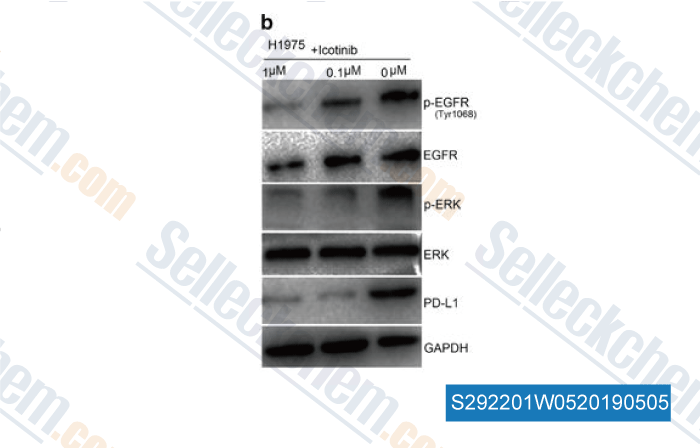
Daten von [ , , Oncogene, 2017, 36(45):6235-6243 ]
Sellecks Icotinib (BPI-2009H) Wurde zitiert von 10 Publikationen
| Patient-derived rhabdomyosarcoma cells recapitulate the genetic and transcriptomic landscapes of primary tumors [ iScience, 2024, 27(10):110862] | PubMed: 39319271 |
| Genetic alterations predict poor efficacy, outcomes and resistance to second-line osimertinib treatment in non-small cell lung cancer [ Am J Cancer Res, 2024, 14(1):33-51] | PubMed: 38323283 |
| A community challenge for a pancancer drug mechanism of action inference from perturbational profile data [ Cell Rep Med, 2022, 3(1):100492] | PubMed: 35106508 |
| Defining the sensitivity landscape of EGFR variants to tyrosine kinase inhibitors [ Transl Res, 2022, S1931-5244(22)00244-4] | PubMed: 36347492 |
| Sensitivity analysis of EGFR L861Q mutation to six tyrosine kinase inhibitors [ Clin Transl Oncol, 2022, 10.1007/s12094-022-02854-3] | PubMed: 35666454 |
| A positive feedback loop formed by NGFR and FOXP3 contributes to the resistance of non-small cell lung cancer to icotinib [ Transl Cancer Res, 2020, 9(2):1044-1052] | PubMed: 35117449 |
| HER2 recruits AKT1 to disrupt STING signalling and suppress antiviral defence and antitumour immunity. [ Nat Cell Biol, 2019, 21(8):1027-1040] | PubMed: 31332347 |
| BIN1 reverses PD-L1-mediated immune escape by inactivating the c-MYC and EGFR/MAPK signaling pathways in non-small cell lung cancer [Wang J Oncogene, 2017, 36(45):6235-6243] | PubMed: 28714960 |
| CD166-mediated epidermal growth factor receptor phosphorylation promotes the growth of oral squamous cell carcinoma [Guodong Jia, et al. Oral Oncology, 2016, 10.1016/j.oraloncology.2016.05.010] | |
| Icotinib antagonizes ABCG2-mediated multidrug resistance, but not the pemetrexed resistance mediated by thymidylate synthase and ABCG2. [Wang DS, et al. Oncotarget, 2015, 5(12):4529-42] | PubMed: 24980828 |
RÜCKGABERICHTLINIE
Die bedingungslose Rückgaberichtlinie von Selleck Chemical gewährleistet unseren Kunden ein reibungsloses Online-Einkaufserlebnis. Wenn Sie in irgendeiner Weise mit Ihrem Kauf unzufrieden sind, können Sie jeden Artikel innerhalb von 7 Tagen nach Erhalt zurückgeben. Im Falle von Produktqualitätsproblemen, sei es protokollbezogene oder produktbezogene Probleme, können Sie jeden Artikel innerhalb von 365 Tagen ab dem ursprünglichen Kaufdatum zurückgeben. Bitte befolgen Sie die nachstehenden Anweisungen, wenn Sie Produkte zurücksenden.
VERSAND UND LAGERUNG
Selleck-Produkte werden bei Raumtemperatur transportiert. Wenn Sie das Produkt bei Raumtemperatur erhalten, seien Sie versichert, dass die Qualitätskontrollabteilung von Selleck Experimente durchgeführt hat, um zu überprüfen, dass die normale Temperaturplatzierung von einem Monat die biologische Aktivität von Pulverprodukten nicht beeinträchtigt. Nach dem Sammeln lagern Sie das Produkt bitte gemäß den in der Datenblatt beschriebenen Anforderungen. Die meisten Selleck-Produkte sind unter den empfohlenen Bedingungen stabil.
NICHT FÜR DIE ANWENDUNG AM MENSCHEN, FÜR VETERINÄRMEDIZINISCHE DIAGNOSTIK ODER THERAPEUTISCHE ZWECKE.