
Technische Daten
| Formel | C22H18FN7O |
||||||
| Molekulargewicht | 415.42 | CAS-Nr. | 870281-82-6 | ||||
| Löslichkeit (25°C)* | In vitro | DMSO | 100 mg/mL (240.72 mM) | ||||
| Ethanol | 34 mg/mL (81.84 mM) | ||||||
| Water | Insoluble | ||||||
| In vivo (Lösungsmittel einzeln und der Reihe nach zum Produkt hinzufügen.) |
|
||||||
|
* <1 mg/ml bedeutet schwer löslich oder unlöslich. * Bitte beachten Sie, dass Selleck die Löslichkeit aller Verbindungen intern testet und die tatsächliche Löslichkeit geringfügig von veröffentlichten Werten abweichen kann. Dies ist normal und ist auf geringfügige Batch-zu-Batch-Variationen zurückzuführen. * Versand bei Raumtemperatur (Stabilitätstests zeigen, dass dieses Produkt ohne Kühlmaßnahmen versendet werden kann.) |
|||||||
Vorbereitung von Stammlösungen
Biologische Aktivität
| Beschreibung | Idelalisib (CAL-101) ist ein selektiver p110δ-Inhibitor mit einer IC50 von 2,5 nM in zellfreien Assays; es zeigte eine 40- bis 300-fach höhere Selektivität für p110δ als für p110α/β/γ und eine 400- bis 4000-fach höhere Selektivität für p110δ als für C2β, hVPS34, DNA-PK und mTOR. Idelalisib stimuliert auch die Autophagy. | ||||
|---|---|---|---|---|---|
| Ziele |
|
||||
| In vitro | Idelalisib (CAL-101) ist nicht empfindlich gegenüber anderen PI3K-Klasse-I-Untereinheiten, einschließlich p110α, p110β und p110γ. Es blockiert spezifisch die FcϵR1 p110δ-vermittelte CD63-Expression mit einer EC50 von 8 nM in primären Basophilen. Diese Verbindung zeigt eine größere Aktivität in Zellen der B-Zell-akuten lymphoblastischen Leukämie (B-ALL) und der chronischen lymphatischen Leukämie (CLL) im Vergleich zu Zellen der akuten myeloischen Leukämie (AML) und der myeloproliferativen Neoplasie (MPN). Es führt zu einer Reduktion von pAktS473, pAktT308 und dem nachgeschalteten Zielprotein S6 in SU-DHL-5-, KARPAS-422- und CCRF-SB-Zellen mit einer EC50 von 0,1 bis 1,0 μM. Es induziert eine selektive Zytotoxizität in CLL-Zellen, unabhängig vom IgVH-Mutationsstatus oder der Interphasenzytogenetik, hauptsächlich über einen Caspase-abhängigen Mechanismus. Die Verbindung induziert die Zytotoxizität bevorzugt in CLL-Zellen im Vergleich zu normalen B-Zellen, ohne Zytotoxizität in anderen hämatopoetischen Zellen zu erzeugen, im Vergleich zu LY294002. Es fehlt das direkte zytotoxische Potenzial gegenüber T-Zellen und natürlichen Killerzellen (NK-Zellen). Es kann die Produktion entzündlicher Zytokine, wie IL-6, IL-10, TNF-α und IFN-γ, und aktivierungsinduzierter Zytokine, wie CD40L, hemmen. Es antagonisiert auch das CD40L-vermittelte Überleben von CLL-Zellen. Es induziert eine Akkumulation von Zellen in G1 und eine Abnahme der S-Phasen-Population in L1236- und L591-Zellen, was diese Verbindung als neue Strategie zur Behandlung des Hodgkin-Lymphoms (HL) kennzeichnet. |
Protokoll (aus Referenz)
| Kinase-Assay: |
|
|---|---|
| Zell-Assay: |
|
Referenzen
|
Kundenproduktvalidierung
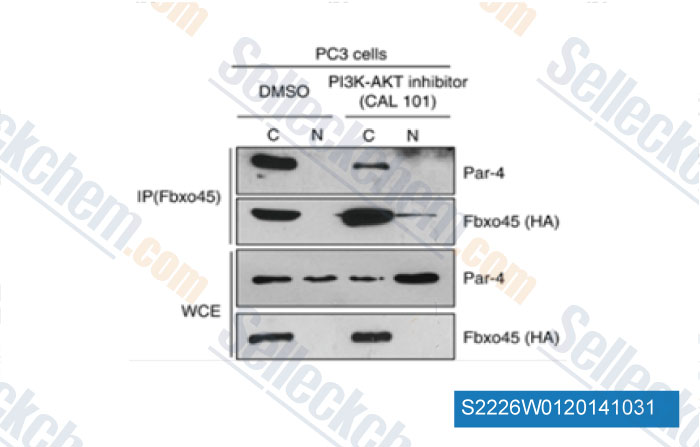
-
Daten von [ Cell Death Differ , 2014 , 21(10), 1535-45 ]
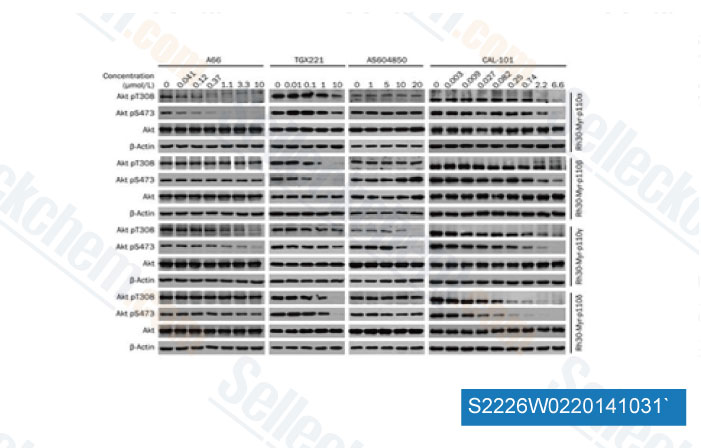
-
Daten von [ Acta Pharmacol Sin , 2013 , 34(9),1201-7 ]
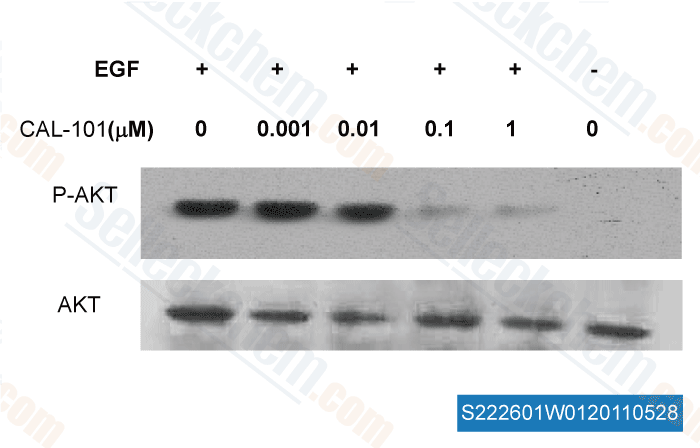
-
, , Dr. Zhang of Tianjin Medical University
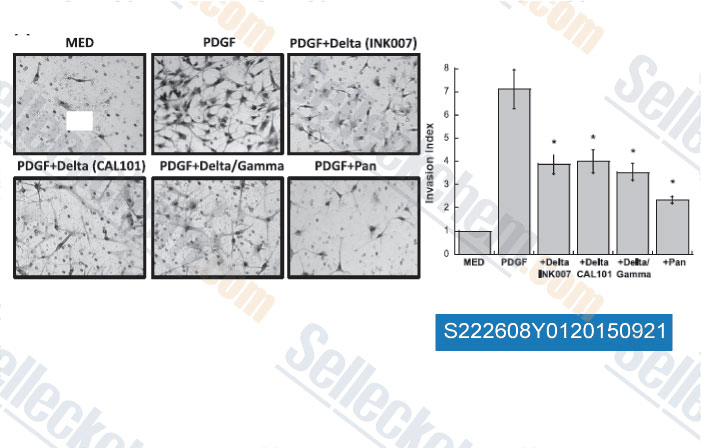
-
Daten von [ , , J Immunol, 2014, 192(5): 2063-70 ]
Sellecks CAL-101 (Idelalisib) Wurde zitiert von 297 Publikationen
| A patient-derived T cell lymphoma biorepository uncovers pathogenetic mechanisms and host-related therapeutic vulnerabilities [ Cell Rep Med, 2025, S2666-3791(25)00102-8] | PubMed: 40147445 |
| Single-cell RNA sequencing of human double-negative T cells reveals a favorable cellular signature for cancer therapy [ J Immunother Cancer, 2025, 13(4)e010684] | PubMed: 40246580 |
| TLR4 endocytosis and endosomal TLR4 signaling are distinct and independent outcomes of TLR4 activation [ EMBO Rep, 2025, 10.1038/s44319-025-00444-2] | PubMed: 40204912 |
| Mitigating T-Cell Mitochondrial Dysfunction in CLL to Augment CAR T-Cell Therapy: Evaluation in an Immunocompetent Model [ Blood Adv, 2025, bloodadvances.2024014822] | PubMed: 39938006 |
| Depleting the action of EZH2 through PI3K-mTOR inhibition to overcome metastasis and immunotherapy resistance in triple-negative breast cancer [ Mol Cancer Ther, 2025, 10.1158/1535-7163.MCT-24-0693] | PubMed: 40497697 |
| A subset of neutrophil phagosomes is characterised by pulses of Class I PI3K activity [ Dis Model Mech, 2025, 18(9)dmm052042] | PubMed: 40692416 |
| Evaluation of co‑inhibition of ErbB family kinases and PI3K for HPV‑negative head and neck squamous cell carcinoma [ Oncol Rep, 2025, 53(3)38] | PubMed: 39886949 |
| FoxO1/Rictor axis induces a nongenetic adaptation to ibrutinib via Akt activation in chronic lymphocytic leukemia [ J Clin Invest, 2024, 134(23)e173770] | PubMed: 39436708 |
| Complement factor H is an ICOS ligand modulating Tregs in the glioma microenvironment [ Cancer Immunol Res, 2024, 10.1158/2326-6066.CIR-23-1092] | PubMed: 39378431 |
| Longitudinal phosphoproteomics reveals the PI3K-PAK1 axis as a potential target for recurrent colorectal liver metastases [ Cell Rep, 2024, 43(12):115061] | PubMed: 39689713 |
RÜCKGABERICHTLINIE
Die bedingungslose Rückgaberichtlinie von Selleck Chemical gewährleistet unseren Kunden ein reibungsloses Online-Einkaufserlebnis. Wenn Sie in irgendeiner Weise mit Ihrem Kauf unzufrieden sind, können Sie jeden Artikel innerhalb von 7 Tagen nach Erhalt zurückgeben. Im Falle von Produktqualitätsproblemen, sei es protokollbezogene oder produktbezogene Probleme, können Sie jeden Artikel innerhalb von 365 Tagen ab dem ursprünglichen Kaufdatum zurückgeben. Bitte befolgen Sie die nachstehenden Anweisungen, wenn Sie Produkte zurücksenden.
VERSAND UND LAGERUNG
Selleck-Produkte werden bei Raumtemperatur transportiert. Wenn Sie das Produkt bei Raumtemperatur erhalten, seien Sie versichert, dass die Qualitätskontrollabteilung von Selleck Experimente durchgeführt hat, um zu überprüfen, dass die normale Temperaturplatzierung von einem Monat die biologische Aktivität von Pulverprodukten nicht beeinträchtigt. Nach dem Sammeln lagern Sie das Produkt bitte gemäß den in der Datenblatt beschriebenen Anforderungen. Die meisten Selleck-Produkte sind unter den empfohlenen Bedingungen stabil.
NICHT FÜR DIE ANWENDUNG AM MENSCHEN, FÜR VETERINÄRMEDIZINISCHE DIAGNOSTIK ODER THERAPEUTISCHE ZWECKE.