
Technische Daten
| Formel | C29H31N7O |
||||||
| Molekulargewicht | 493.6 | CAS-Nr. | 152459-95-5 | ||||
| Löslichkeit (25°C)* | In vitro | DMSO | 98 mg/mL (198.54 mM) | ||||
| Water | Insoluble | ||||||
| Ethanol | Insoluble | ||||||
| In vivo (Lösungsmittel einzeln und der Reihe nach zum Produkt hinzufügen.) |
|
||||||
|
* <1 mg/ml bedeutet schwer löslich oder unlöslich. * Bitte beachten Sie, dass Selleck die Löslichkeit aller Verbindungen intern testet und die tatsächliche Löslichkeit geringfügig von veröffentlichten Werten abweichen kann. Dies ist normal und ist auf geringfügige Batch-zu-Batch-Variationen zurückzuführen. * Versand bei Raumtemperatur (Stabilitätstests zeigen, dass dieses Produkt ohne Kühlmaßnahmen versendet werden kann.) |
|||||||
Vorbereitung von Stammlösungen
Biologische Aktivität
| Beschreibung | Imatinib ist ein Multi-Target-Inhibitor der Tyrosinkinase mit Hemmung für v-Abl, c-Kit und PDGFR, die IC50-Werte betragen 0,6 μM, 0,1 μM bzw. 0,1 μM in zellfreien oder zellbasierten Assays. Imatinib (STI571) induziert Autophagie. | ||||||
|---|---|---|---|---|---|---|---|
| Ziele |
|
||||||
| In vitro | In-vitro-Assays zur Hemmung einer Reihe von Tyrosin- und Serin/Threonin-Proteinkinasen zeigen, dass Imatinib die v-Abl-Tyrosinkinase und PDGFR potent mit einer IC50 von 0,6 bzw. 0,1 μM hemmt. Diese Verbindung hemmt die SLF-abhängige Aktivierung der Wildtyp-c-Kit-Kinaseaktivität mit einer IC50 für diese Effekte von ca. 0,1 μM, was der Konzentration entspricht, die zur Hemmung von PDGFR erforderlich ist. Es zeigt wachstumshemmende Aktivität auf die menschliche Bronchialkarzinoid-Zelllinie NCI-H727 und die menschliche Pankreaskarzinoid-Zelllinie BON-1 mit einer IC50 von 32,4 bzw. 32,8 μM. Eine aktuelle Studie zeigt, dass diese Chemikalie das Potenzial hat, ihre antileukämischen Wirkungen bei chronischer myeloischer Leukämie durch die Herunterregulierung von hERG1 K(+)-Kanälen zu entfalten, die in Leukämiezellen stark exprimiert werden und von außergewöhnlicher Bedeutung für die Begünstigung der Leukämogenese zu sein scheinen. |
||||||
| In vivo | Imatinib erzeugt einen unterschiedlichen Antitumor-Effekt bei drei xenograftierten Tumoren, die aus chirurgischen Proben von frischen menschlichen kleinzelligen Lungenkrebsen stammen, mit 80 %, 40 % und 78 % Wachstumshemmung von SCLC6-, SCLC61- und SCLC108-Tumoren bzw. keiner signifikanten Hemmung des SCLC74-Wachstums. Bei mit fettreicher Diät gefütterten ApoE(-/-)-Mäusen reduziert diese Verbindung die durch fettreiche Diät induzierte Lipidfärbefläche signifikant um 30 %, 27 % und 35 % im Vergleich zu unbehandelten Kontrollen mit fettreicher Diät, wenn sie per Gavage mit 10, 20 und 40 mg/kg dosiert wird, und unterdrückt die Lipidakkumulation in der Halsschlagader. |
Protokoll (aus Referenz)
| Kinase-Assay: |
|
|---|---|
| Zell-Assay: |
|
Referenzen
|
Kundenproduktvalidierung
![<p> </p><p>Inhibition of thymidine (a and b) and cytarabine (c and d) uptake with imatinib. K562 cells (a and c) and MEG-01 cells (b and d) were incubated at 37 ◦C for 15 min with imatinib transport buffer, and then incubated with 0.5 Ci of [3H] thymidine or [3H] cytarabine for an additional 5 min in presence of imatinib. Cells were then washed 3 times, lysed and radioactivity associated to cell pellets was quantified. DMSO, dimethylsulfoxide; DPD, dipyridamole.</p>](https://file.selleckchem.com/downloads/review/700px/Imatinib-S247501Z0120130501.gif)
-
Daten von [ Leukemia Res , 2012 , 36, 1311-1314 ]
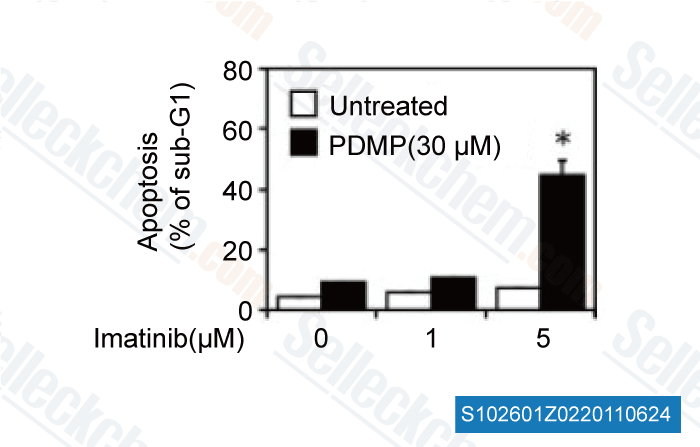
-
Daten von [ FASEB J , 2011 , 25, 3661-3673 ]
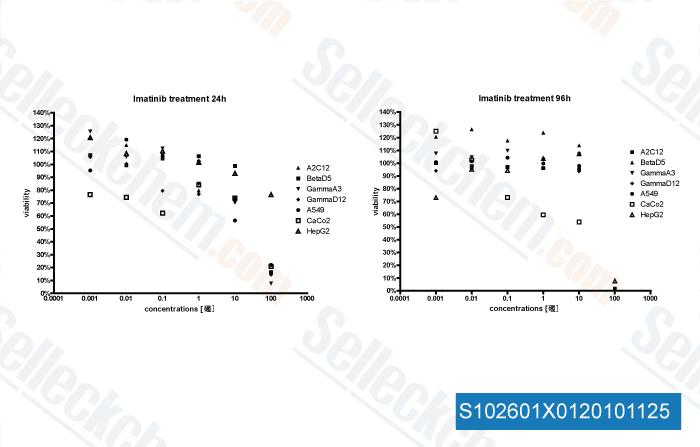
-
, , Dr. Thomas Kruwel of Fraunhofer
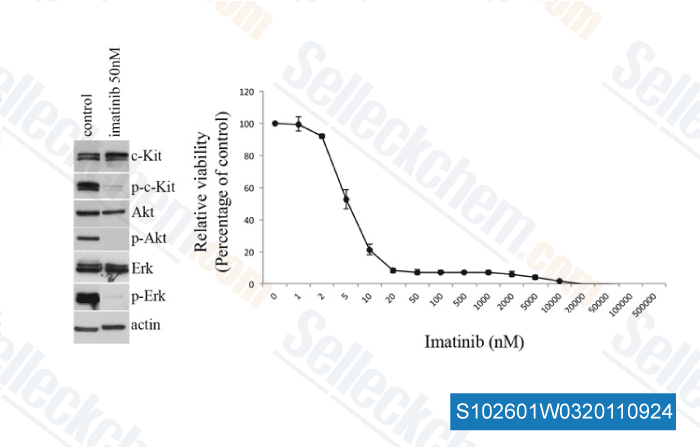
-
, , Dr. Helen Rizos from the university of Sydney
Sellecks Imatinib (STI571) Wurde zitiert von 326 Publikationen
| Proteogenomic characterization of non-functional pancreatic neuroendocrine tumors unravels clinically relevant subgroups [ Cancer Cell, 2025, 43(4):776-796.e14] | PubMed: 40185092 |
| CD19-targeted HSP90 inhibitor nanoparticle combined with TKIs reduces tumor burden and enhances T-cell immunity in murine B-cell malignancies [ Theranostics, 2025, 15(8):3589-3609] | PubMed: 40093890 |
| The landcape of Helicobacter pylori-mediated DNA breaks links bacterial genotoxicity to its oncogenic potential [ Genome Med, 2025, 17(1):14] | PubMed: 39994739 |
| Haploinsufficiency of miR-143 and miR-145 reveal targetable dependencies in resistant del(5q) myelodysplastic neoplasm [ Leukemia, 2025, 39(4):917-928] | PubMed: 40000845 |
| Systematic analysis of ZDHHC9 as a potential prognostic and immunotherapy biomarker in breast cancer [ Front Immunol, 2025, 16:1609621] | PubMed: 40740766 |
| Methylstat sensitizes ovarian cancer cells to PARP-inhibition by targeting the histone demethylases JMJD1B/C [ Cancer Gene Ther, 2025, 10.1038/s41417-025-00874-z] | PubMed: 39915607 |
| Activation of TMEM16E scramblase induces ligand independent growth factor receptor signaling and macropinocytosis for membrane repair [ Commun Biol, 2025, 8(1):35] | PubMed: 39794444 |
| Characterization of the Temporal Dynamics of the Endothelial-Mesenchymal-like Transition Induced by Soluble Factors from Dengue Virus Infection in Microvascular Endothelial Cells [ Int J Mol Sci, 2025, 26(5)2139] | PubMed: 40076764 |
| Senataxin and DNA-PKcs redundantly promote non-homologous end joining repair of DNA double strand breaks during V(D)J recombination [ Sci Adv, 2025, 11(25):eads5272] | PubMed: 40540553 |
| Utility of the Base Editing System for Introducing Drug-Resistant Gene Mutations Into Human Leukemia Cellular Models [ Cureus, 2025, 17(4):e81889] | PubMed: 40342439 |
RÜCKGABERICHTLINIE
Die bedingungslose Rückgaberichtlinie von Selleck Chemical gewährleistet unseren Kunden ein reibungsloses Online-Einkaufserlebnis. Wenn Sie in irgendeiner Weise mit Ihrem Kauf unzufrieden sind, können Sie jeden Artikel innerhalb von 7 Tagen nach Erhalt zurückgeben. Im Falle von Produktqualitätsproblemen, sei es protokollbezogene oder produktbezogene Probleme, können Sie jeden Artikel innerhalb von 365 Tagen ab dem ursprünglichen Kaufdatum zurückgeben. Bitte befolgen Sie die nachstehenden Anweisungen, wenn Sie Produkte zurücksenden.
VERSAND UND LAGERUNG
Selleck-Produkte werden bei Raumtemperatur transportiert. Wenn Sie das Produkt bei Raumtemperatur erhalten, seien Sie versichert, dass die Qualitätskontrollabteilung von Selleck Experimente durchgeführt hat, um zu überprüfen, dass die normale Temperaturplatzierung von einem Monat die biologische Aktivität von Pulverprodukten nicht beeinträchtigt. Nach dem Sammeln lagern Sie das Produkt bitte gemäß den in der Datenblatt beschriebenen Anforderungen. Die meisten Selleck-Produkte sind unter den empfohlenen Bedingungen stabil.
NICHT FÜR DIE ANWENDUNG AM MENSCHEN, FÜR VETERINÄRMEDIZINISCHE DIAGNOSTIK ODER THERAPEUTISCHE ZWECKE.