
Technische Daten
| Formel | C23H17FN6O |
||||||
| Molekulargewicht | 412.42 | CAS-Nr. | 1029712-80-8 | ||||
| Löslichkeit (25°C)* | In vitro | DMSO | 14 mg/mL (33.94 mM) | ||||
| Water | Insoluble | ||||||
| Ethanol | Insoluble | ||||||
| In vivo (Lösungsmittel einzeln und der Reihe nach zum Produkt hinzufügen.) |
|
||||||
|
* <1 mg/ml bedeutet schwer löslich oder unlöslich. * Bitte beachten Sie, dass Selleck die Löslichkeit aller Verbindungen intern testet und die tatsächliche Löslichkeit geringfügig von veröffentlichten Werten abweichen kann. Dies ist normal und ist auf geringfügige Batch-zu-Batch-Variationen zurückzuführen. * Versand bei Raumtemperatur (Stabilitätstests zeigen, dass dieses Produkt ohne Kühlmaßnahmen versendet werden kann.) |
|||||||
Vorbereitung von Stammlösungen
Biologische Aktivität
| Beschreibung | Capmatinib ist ein neuartiger, ATP-kompetitiver Inhibitor von c-MET mit einer IC50 von 0,13 nM in einem zellfreien Assay, inaktiv gegen RONβ sowie EGFR und HER-3. Capmatinib (INCB28060) hemmt die Wnt/β-catenin- und EMT-Signalwege und induziert die Apoptose bei diffusem Magenkarzinom, das positiv für c-MET-Amplifikation ist. Phase 1. | ||||
|---|---|---|---|---|---|
| Ziele |
|
||||
| In vitro | INCB28060 zeigt pikomolare enzymatische Potenz und ist hochspezifisch für c-MET mit mehr als 10.000-facher Selektivität gegenüber einem großen Panel menschlicher Kinasen. Diese Verbindung hemmt die Phosphorylierung von humanem c-MET und die c-MET-vermittelte Signalübertragung in Krebszellen. Es hemmt die c-MET-abhängige Zellproliferation und das Überleben und verhindert das Anker-unabhängige Wachstum von Krebszellen und die Zellmigration. |
||||
| In vivo | INCB28060 zeigt eine starke Antitumoraktivität in c-MET-abhängigen Maustumormodellen, selbst eine orale Behandlung mit 0,03 mg/kg dieser Verbindung führt zu einer etwa 50%igen Hemmung der c-MET-Phosphorylierung. Eine dosisabhängige Hemmung des Tumorwachstums wird bei tumortragenden Mäusen beobachtet. |
||||
| Merkmale | Inaktiv gegen RONβ, ein anderes Mitglied der c-MET RTK-Familie, sowie EGFR und HER-3 (Mitglieder der EGFR RTK-Familie). |
Protokoll (aus Referenz)
| Kinase-Assay: |
|
|---|---|
| Zell-Assay: |
|
| Tierstudie: |
|
Referenzen
|
Kundenproduktvalidierung
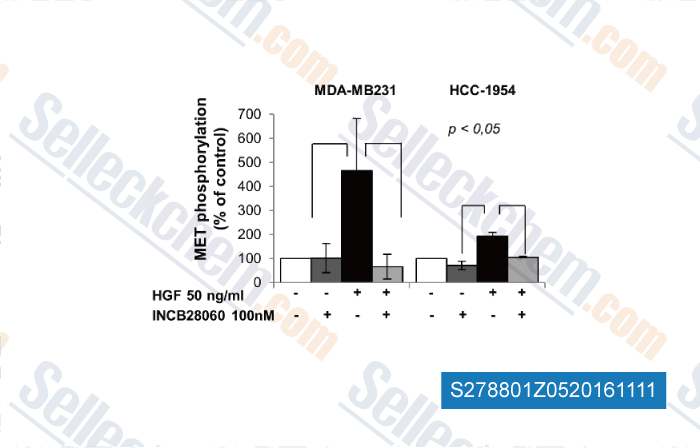
-
, , PLoS One, 2016, 11(3):e0150507.
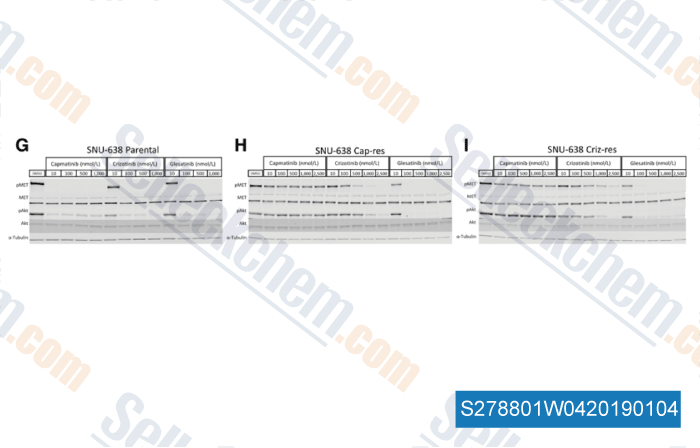
-
Daten von [ , , Clin Cancer Res, 2017, 23(21):6661-6672 ]
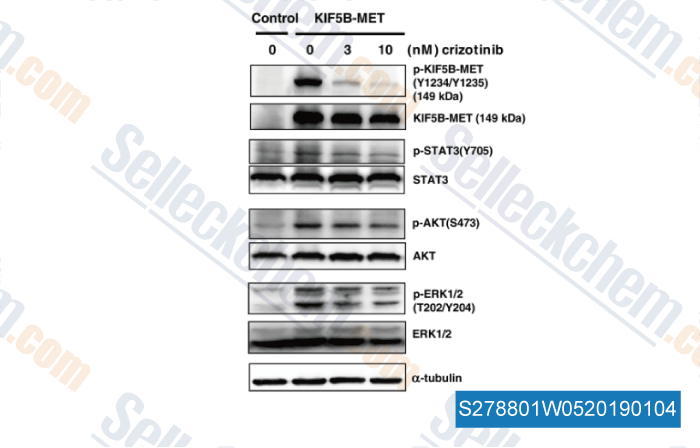
-
Daten von [ , , Neoplasia, 2018, 20(8):838-847 ]
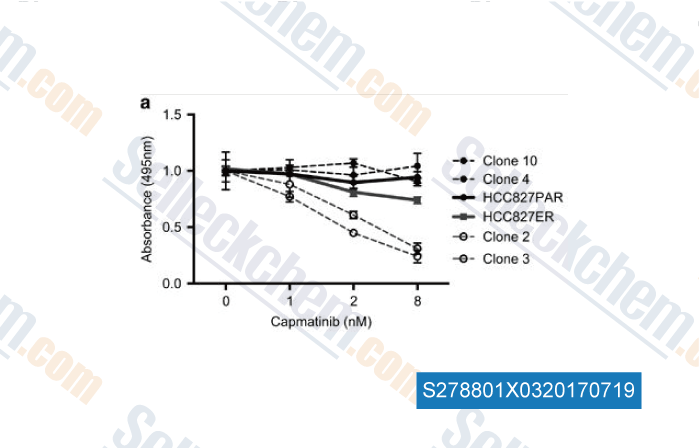
-
Daten von [ , , Oncogenesis, 2017, 6(4):e307 ]
Sellecks Capmatinib (INC280) Wurde zitiert von 84 Publikationen
| IFITM3-MET interaction drives osimertinib resistance through AKT pathway activation in EGFR-mutant non-small cell lung cancer [ Mol Cancer, 2025, 24(1):272] | PubMed: 41152910 |
| Development of a cyst-targeted therapy for polycystic kidney disease using an antagonistic dimeric IgA monoclonal antibody against cMET [ Cell Rep Med, 2025, 6(9):102335] | PubMed: 40914166 |
| PD-L1 regulates c-MET phosphorylation and contributes to MET-dependent resistance to osimertinib in EGFR-mutant NSCLC [ J Biomed Sci, 2025, 32(1):94] | PubMed: 41068729 |
| PI3K-dependent GAB1/Erk phosphorylation renders head and neck squamous cell carcinoma sensitive to PI3Kα inhibitors [ Cell Death Dis, 2025, 16(1):457] | PubMed: 40533463 |
| PTEN loss and ERBB2/ERBB3-mediated AKT reactivation drive resistance to MET inhibition in MET-amplified hepatocellular carcinoma [ Cell Oncol (Dordr), 2025, 10.1007/s13402-025-01097-y] | PubMed: 40991144 |
| MET variants with activating N-lobe mutations identified in hereditary papillary renal cell carcinomas still require ligand stimulation [ Mol Oncol, 2025, 19(8):2366-2387] | PubMed: 39980226 |
| Multifactorial stroma-mediated resistance is a major contributor to residual disease under targeted therapies in lung cancers [ Res Sq, 2025, rs.3.rs-6264377] | PubMed: 40313737 |
| Patient-derived rhabdomyosarcoma cells recapitulate the genetic and transcriptomic landscapes of primary tumors [ iScience, 2024, 27(10):110862] | PubMed: 39319271 |
| Synergistic Effects of Neratinib in Combination With Palbociclib or Miransertib in Brain Cancer Cells [ World J Oncol, 2024, 15(3):492-505] | PubMed: 38751701 |
| MUC1-C Is a Common Driver of Acquired Osimertinib Resistance in NSCLC [ J Thorac Oncol, 2023, 10.1016/j.jtho.2023.10.017] | PubMed: 37924972 |
RÜCKGABERICHTLINIE
Die bedingungslose Rückgaberichtlinie von Selleck Chemical gewährleistet unseren Kunden ein reibungsloses Online-Einkaufserlebnis. Wenn Sie in irgendeiner Weise mit Ihrem Kauf unzufrieden sind, können Sie jeden Artikel innerhalb von 7 Tagen nach Erhalt zurückgeben. Im Falle von Produktqualitätsproblemen, sei es protokollbezogene oder produktbezogene Probleme, können Sie jeden Artikel innerhalb von 365 Tagen ab dem ursprünglichen Kaufdatum zurückgeben. Bitte befolgen Sie die nachstehenden Anweisungen, wenn Sie Produkte zurücksenden.
VERSAND UND LAGERUNG
Selleck-Produkte werden bei Raumtemperatur transportiert. Wenn Sie das Produkt bei Raumtemperatur erhalten, seien Sie versichert, dass die Qualitätskontrollabteilung von Selleck Experimente durchgeführt hat, um zu überprüfen, dass die normale Temperaturplatzierung von einem Monat die biologische Aktivität von Pulverprodukten nicht beeinträchtigt. Nach dem Sammeln lagern Sie das Produkt bitte gemäß den in der Datenblatt beschriebenen Anforderungen. Die meisten Selleck-Produkte sind unter den empfohlenen Bedingungen stabil.
NICHT FÜR DIE ANWENDUNG AM MENSCHEN, FÜR VETERINÄRMEDIZINISCHE DIAGNOSTIK ODER THERAPEUTISCHE ZWECKE.