
Technische Daten
| Formel | C15H15N7O |
||||||
| Molekulargewicht | 309.33 | CAS-Nr. | 1224844-38-5 | ||||
| Löslichkeit (25°C)* | In vitro | DMSO | 62 mg/mL (200.43 mM) | ||||
| Ethanol | 2 mg/mL (6.46 mM) | ||||||
| Water | Insoluble | ||||||
| In vivo (Lösungsmittel einzeln und der Reihe nach zum Produkt hinzufügen.) |
|
||||||
|
* <1 mg/ml bedeutet schwer löslich oder unlöslich. * Bitte beachten Sie, dass Selleck die Löslichkeit aller Verbindungen intern testet und die tatsächliche Löslichkeit geringfügig von veröffentlichten Werten abweichen kann. Dies ist normal und ist auf geringfügige Batch-zu-Batch-Variationen zurückzuführen. * Versand bei Raumtemperatur (Stabilitätstests zeigen, dass dieses Produkt ohne Kühlmaßnahmen versendet werden kann.) |
|||||||
Vorbereitung von Stammlösungen
Biologische Aktivität
| Beschreibung | Sapanisertib (MLN0128, INK 128, TAK-228) ist ein potenter und selektiver mTOR-Inhibitor mit einer IC50 von 1 nM in zellfreien Assays; >200-fach weniger potent gegenüber Klasse-I-PI3K-Isoformen, überlegen bei der Blockierung von mTORC1/2 und empfindlich gegenüber Pro-Invasions-Genen (vs. Rapamycin). Phase 1. | |||||||||||
|---|---|---|---|---|---|---|---|---|---|---|---|---|
| Ziele |
|
|||||||||||
| In vitro | INK 128 weist eine enzymatische Hemmaktivität gegen mTOR und eine mehr als 100-fache Selektivität gegenüber PI3K-Kinasen auf. Als TORC1/2-Inhibitor hemmt INK 128 sowohl die Phosphorylierung von S6 und 4EBP1, den nachgeschalteten Substraten von TORC1, als auch selektiv die AKT-Phosphorylierung an Ser473, dem nachgeschalteten Substrat von TORC2. Darüber hinaus zeigt INK 128 auch potente Hemmwirkungen auf Zelllinien, die gegen Rapamycin und Pan-PI3K-Inhibitoren resistent sind. |
|||||||||||
| In vivo | In einem ZR-75-1-Brustkrebs-Xenograft-Modell zeigt INK 128 eine Hemmwirkung des Tumorwachstums bei einer Dosis von 0,3 mg/kg/Tag. Die tägliche orale Verabreichung von INK 128 hemmt die Angiogenese und das Tumorwachstum in Multiplex-Xenograft-Modellen. |
Protokoll (aus Referenz)
| Tierstudie: |
|
|---|
Referenzen
|
Kundenproduktvalidierung
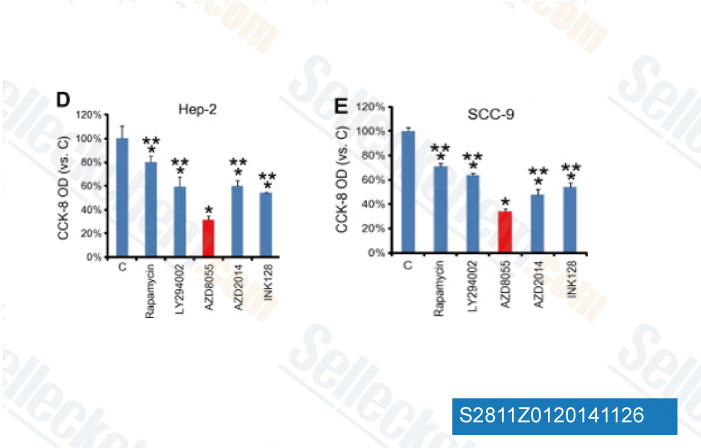
-
Daten von [ Biochem Biophys Res Commun , 2013 , 440(4), 701-6 ]
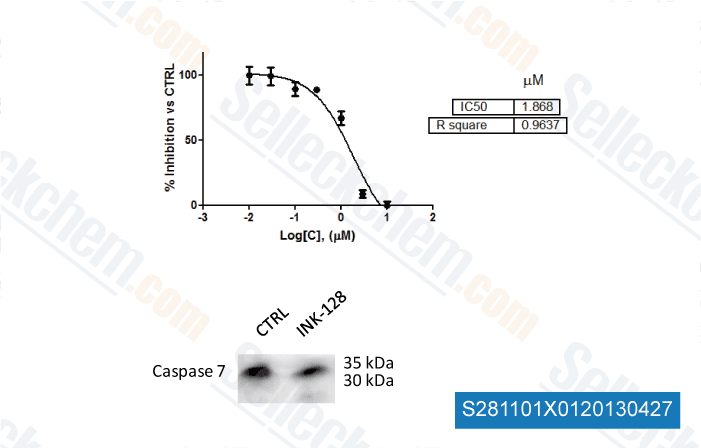
-
, , Antonino Maria Spart from University of Bologn
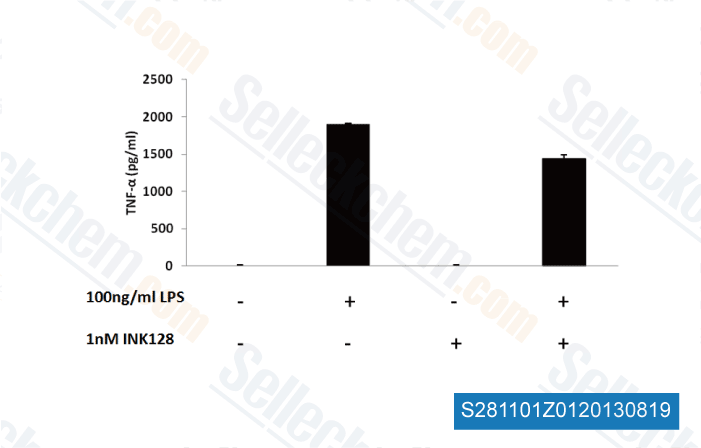
-
,
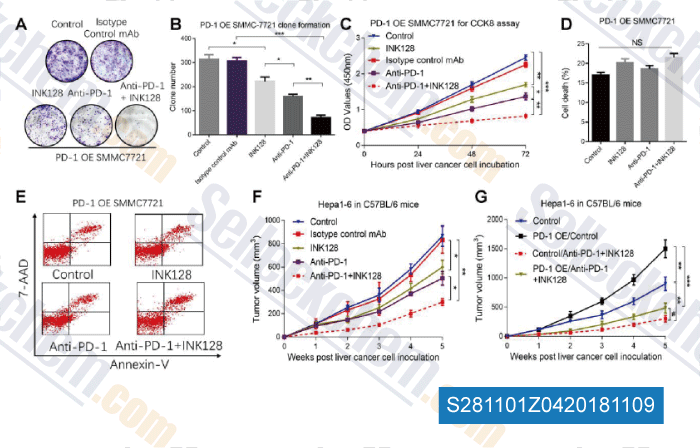
-
Daten von [ , , Hepatology, 2017, 66(6):1920-1933 ]
Sellecks Sapanisertib (MLN0128, INK-128) Wurde zitiert von 135 Publikationen
| Enhancing immunotherapy through PD-L1 upregulation: the promising combination of anti-PD-L1 plus mTOR inhibitors [ Mol Oncol, 2025, 19(1):151-172] | PubMed: 39258533 |
| Uncoupling of Akt and mTOR signaling drives resistance to Akt inhibition in PTEN loss prostate cancers [ Sci Adv, 2025, 11(6):eadq3802] | PubMed: 39919177 |
| A TFEB-TGFβ axis systemically regulates diapause, stem cell resilience and protects against a senescence-like state [ Nat Aging, 2025, 5(7):1340-1357] | PubMed: 40588651 |
| PI3K/mTOR inhibition induces tumour microenvironment remodelling and sensitises pS6high uterine leiomyosarcoma to PD-1 blockade [ Clin Transl Med, 2024, 14(5):e1655] | PubMed: 38711203 |
| Starvation-induced phosphorylation activates gasdermin A to initiate pyroptosis [ Cell Rep, 2024, 43(9):114728] | PubMed: 39264808 |
| NFκB and JNK pathways mediate metabolic adaptation upon ESCRT-I deficiency [ Cell Mol Life Sci, 2024, 81(1):458] | PubMed: 39560723 |
| Different Impacts of DNA-PK and mTOR Kinase Inhibitors in Combination with Ionizing Radiation on HNSCC and Normal Tissue Cells [ Cells, 2024, 13(4)304] | PubMed: 38391917 |
| PI3K-dependent reprogramming of hexokinase isoforms controls glucose metabolism and functional responses of B lymphocytes [ iScience, 2024, 27(10):110939] | PubMed: 39635128 |
| Epstein-Barr Virus Latent Membrane Protein 2A (LMP2A) Enhances ATP Production in B Cell Tumors through mTOR and HIF-1α [ Int J Mol Sci, 2024, 25(7)3944] | PubMed: 38612754 |
| The highly selective and oral phosphoinositide 3-kinase delta (PI3K-δ) inhibitor roginolisib induces apoptosis in mesothelioma cells and increases immune effector cell composition [ Transl Oncol, 2024, 43:101857] | PubMed: 38412661 |
RÜCKGABERICHTLINIE
Die bedingungslose Rückgaberichtlinie von Selleck Chemical gewährleistet unseren Kunden ein reibungsloses Online-Einkaufserlebnis. Wenn Sie in irgendeiner Weise mit Ihrem Kauf unzufrieden sind, können Sie jeden Artikel innerhalb von 7 Tagen nach Erhalt zurückgeben. Im Falle von Produktqualitätsproblemen, sei es protokollbezogene oder produktbezogene Probleme, können Sie jeden Artikel innerhalb von 365 Tagen ab dem ursprünglichen Kaufdatum zurückgeben. Bitte befolgen Sie die nachstehenden Anweisungen, wenn Sie Produkte zurücksenden.
VERSAND UND LAGERUNG
Selleck-Produkte werden bei Raumtemperatur transportiert. Wenn Sie das Produkt bei Raumtemperatur erhalten, seien Sie versichert, dass die Qualitätskontrollabteilung von Selleck Experimente durchgeführt hat, um zu überprüfen, dass die normale Temperaturplatzierung von einem Monat die biologische Aktivität von Pulverprodukten nicht beeinträchtigt. Nach dem Sammeln lagern Sie das Produkt bitte gemäß den in der Datenblatt beschriebenen Anforderungen. Die meisten Selleck-Produkte sind unter den empfohlenen Bedingungen stabil.
NICHT FÜR DIE ANWENDUNG AM MENSCHEN, FÜR VETERINÄRMEDIZINISCHE DIAGNOSTIK ODER THERAPEUTISCHE ZWECKE.