
Technische Daten
| Formel | C8H11N3O3S |
||||||
| Molekulargewicht | 229.26 | CAS-Nr. | 134678-17-4 | ||||
| Löslichkeit (25°C)* | In vitro | DMSO | 46 mg/mL (200.64 mM) | ||||
| Water | 46 mg/mL (200.64 mM) | ||||||
| Ethanol | Insoluble | ||||||
| In vivo (Lösungsmittel einzeln und der Reihe nach zum Produkt hinzufügen.) |
|
||||||
|
* <1 mg/ml bedeutet schwer löslich oder unlöslich. * Bitte beachten Sie, dass Selleck die Löslichkeit aller Verbindungen intern testet und die tatsächliche Löslichkeit geringfügig von veröffentlichten Werten abweichen kann. Dies ist normal und ist auf geringfügige Batch-zu-Batch-Variationen zurückzuführen. * Versand bei Raumtemperatur (Stabilitätstests zeigen, dass dieses Produkt ohne Kühlmaßnahmen versendet werden kann.) |
|||||||
Vorbereitung von Stammlösungen
Biologische Aktivität
| Beschreibung | Lamivudine ist ein potenter Nukleosidanalogon-Reverse-Transkriptase-Inhibitor, der zur Behandlung von chronischer HBV und HIV/AIDS eingesetzt wird. Er wirkt, indem er die HIV reverse transcriptase und die hepatitis B virus polymerase blockiert. | |
|---|---|---|
| Ziele |
|
|
| In vitro | Lamivudine’s anti- HBV activity, like its anti-HIV activity, has been shown to depend on the ability of LMV-TP to serve as both substrate and inhibitor of the DNA- and RNA-dependent polymerase activities of the HBV P gene product. This compound owes its activity to the remarkably broad substrate specificity of deoxycytidine kinase and the unusual substrate preference of the HBV polymerases for dNTPs with the unnatural L-conformation, whereas the anti-HBV activity of PCV appears to depend on several factors including optimal phosphorylation (sufficient for antiviral activity but not cytotoxicity) by key cellular enzymes, the long intracellular half-life of PCV-TP and the ability of PCV-TP to inhibit the HBV RT priming reaction as well as RT and DNA polymerase activity. This compound and Penciclovir inhibits duck hepatitis B virus (DHBV) replication to a comparable extent when used alone, and in combination, the two nucleoside analogs acts synergistically over a wide range of clinically relevant concentrations. It combined with Penciclovir is more effective in reducing the normally recalcitrant viral covalently closed circular (CCC) DNA form of DHBV than either drug alone. It inhibits p24 antigen production by HIV-I in PBMC, with ED50s ranging from 0.07 μM to 0.2 μM. |
Protokoll (aus Referenz)
| Zell-Assay: |
|
|---|
Referenzen
|
Kundenproduktvalidierung
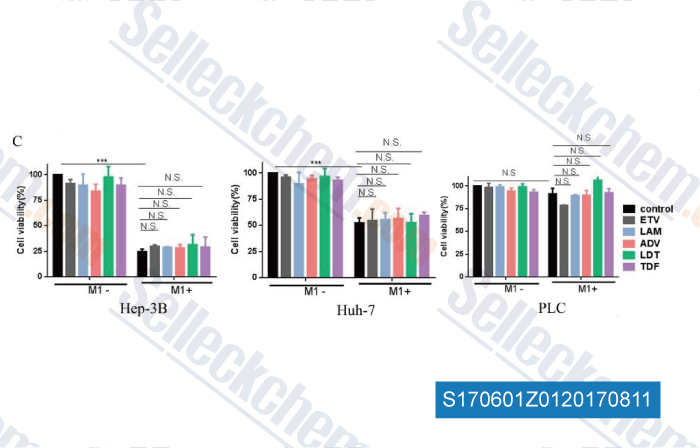
-
Daten von [ , , Oncotarget, 2017, 8(15):24694-24705 ]
Selleck's Lamivudine (3TC, BCH-189) Wurde zitiert von 31 Publikationen
| LINE-1 ORF1p Mimics Viral Innate Immune Evasion Mechanisms in Pancreatic Ductal Adenocarcinoma [ Cancer Discovery, May 02 2025, 1063-1082] | PubMed: 39919290 |
| Antiretroviral Drugs Regulate Epigenetic Modification of Cardiac Cells Through Modulation of H3K9 and H3K27 Acetylation [ Frontiers in Cardiovascular Medicine, April 09 2021, 634774] | PubMed: 33898535 |
| LINE-1 ORF1p Mimics Viral Innate Immune Evasion Mechanisms in Pancreatic Ductal Adenocarcinoma [ Cancer Discov, 2025, 10.1158/2159-8290.CD-24-1317] | PubMed: 39919290 |
| HELQ Maintains Genome Stability of Primordial Germ Cells by Inhibiting LINE-1 Expression [ FASEB J, 2025, 39(12):e70720] | PubMed: 40542648 |
| In vitro and patient studies with platelets to explore off-target cardiovascular effects of integrase inhibitors [ HIV Med, 2025, 26(2):285-294] | PubMed: 39544128 |
| Dietary nucleic acids promote oral tolerance through innate sensing pathways in mice [ Nat Commun, 2024, 15(1):9461] | PubMed: 39487135 |
| Inhibiting EZH2 targets atypical teratoid rhabdoid tumor by triggering viral mimicry via both RNA and DNA sensing pathways [ Nat Commun, 2024, 15(1):9321] | PubMed: 39472584 |
| Significance of hepatitis B virus capsid dephosphorylation via polymerase [ J Biomed Sci, 2024, 31(1):34] | PubMed: 38561844 |
| Preclinical and clinical antiviral characterization of AB-836, a potent capsid assembly modulator against hepatitis B virus [ Antiviral Res, 2024, 231:106010] | PubMed: 39326502 |
| Rupestonic Acid Derivative YZH-106 Promotes Lysosomal Degradation of HBV L- and M-HBsAg via Direct Interaction with PreS2 Domain [ Viruses, 2024, 16(7)1151] | PubMed: 39066313 |
RÜCKGABERICHTLINIE
Die bedingungslose Rückgaberichtlinie von Selleck Chemical gewährleistet unseren Kunden ein reibungsloses Online-Einkaufserlebnis. Wenn Sie in irgendeiner Weise mit Ihrem Kauf unzufrieden sind, können Sie jeden Artikel innerhalb von 7 Tagen nach Erhalt zurückgeben. Im Falle von Produktqualitätsproblemen, sei es protokollbezogene oder produktbezogene Probleme, können Sie jeden Artikel innerhalb von 365 Tagen ab dem ursprünglichen Kaufdatum zurückgeben. Bitte befolgen Sie die nachstehenden Anweisungen, wenn Sie Produkte zurücksenden.
VERSAND UND LAGERUNG
Selleck-Produkte werden bei Raumtemperatur transportiert. Wenn Sie das Produkt bei Raumtemperatur erhalten, seien Sie versichert, dass die Qualitätskontrollabteilung von Selleck Experimente durchgeführt hat, um zu überprüfen, dass die normale Temperaturplatzierung von einem Monat die biologische Aktivität von Pulverprodukten nicht beeinträchtigt. Nach dem Sammeln lagern Sie das Produkt bitte gemäß den in der Datenblatt beschriebenen Anforderungen. Die meisten Selleck-Produkte sind unter den empfohlenen Bedingungen stabil.
NICHT FÜR DIE ANWENDUNG AM MENSCHEN, FÜR VETERINÄRMEDIZINISCHE DIAGNOSTIK ODER THERAPEUTISCHE ZWECKE.