
Technische Daten
| Formel | C26H23N5O |
||||||||||
| Molekulargewicht | 421.49 | CAS-Nr. | 867160-71-2 | ||||||||
| Löslichkeit (25°C)* | In vitro | DMSO | 84 mg/mL (199.29 mM) | ||||||||
| Water | Insoluble | ||||||||||
| Ethanol | Insoluble | ||||||||||
| In vivo (Lösungsmittel einzeln und der Reihe nach zum Produkt hinzufügen.) |
|
||||||||||
|
* <1 mg/ml bedeutet schwer löslich oder unlöslich. * Bitte beachten Sie, dass Selleck die Löslichkeit aller Verbindungen intern testet und die tatsächliche Löslichkeit geringfügig von veröffentlichten Werten abweichen kann. Dies ist normal und ist auf geringfügige Batch-zu-Batch-Variationen zurückzuführen. * Versand bei Raumtemperatur (Stabilitätstests zeigen, dass dieses Produkt ohne Kühlmaßnahmen versendet werden kann.) |
|||||||||||
Vorbereitung von Stammlösungen
Biologische Aktivität
| Beschreibung | Linsitinib (OSI-906) ist ein selektiver Inhibitor von IGF-1R mit einer IC50 von 35 nM in zellfreien Assays. Es ist mäßig potent gegenüber InsR mit einer IC50 von 75 nM und zeigt keine Aktivität gegenüber Abl, ALK, BTK, EGFR, FGFR1/2, PKA usw. Phase 3. | ||||||
|---|---|---|---|---|---|---|---|
| Ziele |
|
||||||
| In vitro | Linsitinib (OSI-906) hemmt die Autophosphorylierung von IGF-1R und die Aktivierung der nachgeschalteten Signalproteine Akt, ERK1/2 und S6-Kinase mit einer IC50 von 0,028 bis 0,13 μM. Es ermöglicht eine intermediäre Konformation des Zielproteins durch Wechselwirkungen mit der C-Helix und zeigt eine günstige metabolische Stabilität in Lebermikrosomen. Diese Verbindung hemmt die Phosphorylierung von IR und IGF-1R vollständig bei einer Konzentration von 1 μM und hemmt die Proliferation mehrerer Tumorzelllinien, einschließlich nicht-kleinzelligem Lungenkrebs und kolorektalem Karzinom (CRC), mit einer EC50 von 0,021 bis 0,810 μM. | ||||||
| In vivo | Linsitinib (OSI-906) hemmt das Tumorwachstum in einem IGF-1R-getriebenen Xenograft-Mausmodell mit 100% TGI und 55% Regression bei einer Dosis von 75 mg/kg und 60% TGI und keiner Regression bei einer Dosis von 25 mg/kg. Seine Verabreichung induziert unterschiedliche Eliminationshalbwertszeiten bei Hund, Ratte und Maus, die 1,18 Stunden, 2,64 Stunden bzw. 2,14 Stunden betragen. Bei der Verabreichung in verschiedenen Einzeldosen einmal täglich an weibliche Sprague-Dawley-Ratten und weibliche CD-1-Mäuse zeigt sich, dass Vmax nicht dosisproportional zur Dosis ist. Diese Verbindung erhöht die Blutzuckerspiegel bei einer Dosis von 25 mg/kg nach 12 Tagen Verabreichung. Bei einer Einzeldosis von 75 mg/kg in einem IGF-1R-getriebenen humanen IGF-1R-Vollängen- (LISN) Xenograft-Mausmodell erreicht es eine maximale Hemmung der IGF-1R-Phosphorylierung (80%) zwischen 4 und 24 Stunden mit Plasmakonzentrationen des Medikaments von 26,6-4,77 μM. Bei der Verabreichung als Einzeldosis von 60 mg/kg in NCI-H292-Xenograft-Mäusen hemmt es die Glukoseaufnahme 2, 4 und 24 Stunden nach der Behandlung in vivo. Es hemmt auch das Wachstum von Tumoren in einem NCI-H292-Xenograft-Mausmodell. |
Protokoll (aus Referenz)
| Kinase-Assay:[1] |
|
|---|---|
| Zell-Assay:[1] |
|
| Tierstudie:[1] |
|
Referenzen
|
Kundenproduktvalidierung
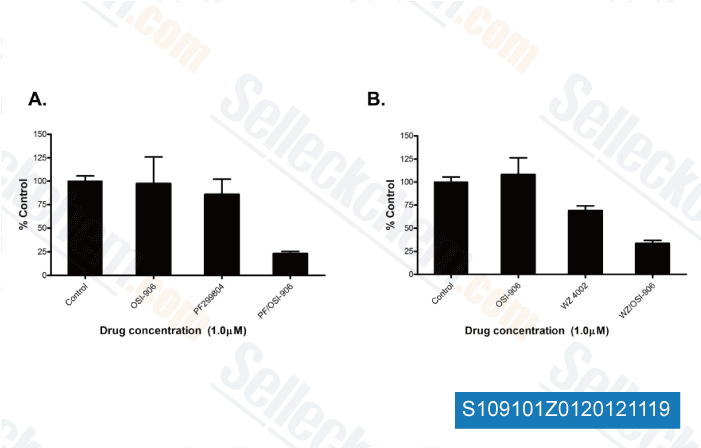
-
Daten von [ Cancer Res , 2013 , 73, 834-843 ]
![<p>OSI-906 prevents the emergence and inhibits growth of established hormone-indendent tumors . A and B, MCF-7 cells were injected s.c. into athymic mice supplemented with 14-day release E2 pellets. Mice with no tumors (A) or bearing tumors ≥ 150 mm<sup>3</sup> (B) were randomized to vehicle or OSI-906 (50 mg/kg/day, per os) for 6 weeks. Data are presented as number of tumors formed ; , P = 0.02, Fisher's exact test (A) , or mean tumor volume ± SEM; P < 0.05 versus vehicle, 2-way ANOVA (B). C, tumor-bearing mice from (A) were treated with vehicle or OSI-906 for 3 days. Xenografts were harvested 4 hours after the last dose. Tumor lysates were precipitated with a p-Tyr antibody; p-Tyr pull- downs and tumor lysates were analyzed by immunoblot with the indicated antibodies. D, tumor-bearing mice were imaged before and 4 hours after the initial dose of OSI- 906 by [18 F]FDG -PET. Images from a representative mouse show [18 F]FDG uptake pre- and post–OSI-906 (T-tumor ). Quantification is shown at the bottom. , P < 0.0001, 2-way ANOVA .</p>](https://file.selleckchem.com/downloads/review/700px/OSI-906-S109101W0120111101.gif)
-
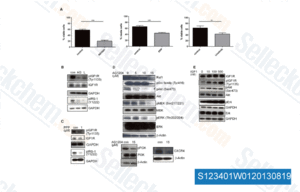
Daten von [ Cancer Res , 2011 , 71, 6773-84 ]
-
,
-
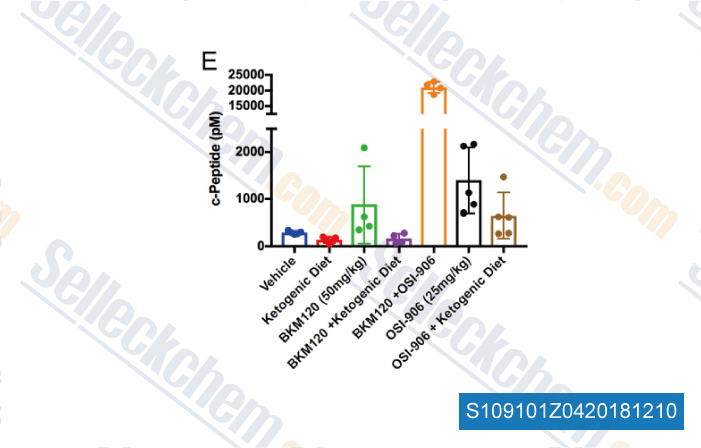
Daten von [ , , Nature, 2018, 560(7719):499-503 ]
Sellecks Linsitinib (OSI-906) Wurde zitiert von 210 Publikationen
| Placenta-derived factors contribute to human iPSC-liver organoid growth [ Nat Commun, 2025, 16(1):2493] | PubMed: 40082402 |
| Enhanced regenerative and developmental potential of embryonal and stem cell-derived platelets compared to adult platelets [ Cell Rep Med, 2025, 6(8):102297] | PubMed: 40795844 |
| Imeglimin suppresses glucagon secretion and induces a loss of α cell identity [ Cell Rep Med, 2025, 6(8):102254] | PubMed: 40713970 |
| PI3K-dependent GAB1/Erk phosphorylation renders head and neck squamous cell carcinoma sensitive to PI3Kα inhibitors [ Cell Death Dis, 2025, 16(1):457] | PubMed: 40533463 |
| Linsitinib Decreases Thyrotropin-Induced Thyroid Hormone Synthesis by Inhibiting Crosstalk Between Thyroid-Stimulating Hormone and Insulin-Like Growth Factor 1 Receptors in Human Thyrocytes In Vitro and In Vivo in Mice [ Thyroid, 2025, 35(2):216-224] | PubMed: 39718934 |
| Heparan sulfate fine-tuned interleukin-1 (IL-1) signaling inhibits insulin secretion of grafted pancreatic islets [ Sci Adv, 2025, 11(32):eady8566] | PubMed: 40779638 |
| Hypoxia-induced histone methylation and NF-κB activation in pancreas cancer fibroblasts promote EMT-supportive growth factor secretion [ bioRxiv, 2025, 2025.01.30.635486] | PubMed: 39974981 |
| Disease-relevant upregulation of P2Y1 receptor in astrocytes enhances neuronal excitability via IGFBP2 [ Nat Commun, 2024, 15(1):6525] | PubMed: 39117630 |
| Caloric restriction leads to druggable LSD1-dependent cancer stem cells expansion [ Nat Commun, 2024, 15(1):828] | PubMed: 38280853 |
| Acinar-ductal cell rearrangement drives branching morphogenesis of the murine pancreas in an IGF/PI3K-dependent manner [ Dev Cell, 2024, 59(3):326-338.e5] | PubMed: 38237591 |
RÜCKGABERICHTLINIE
Die bedingungslose Rückgaberichtlinie von Selleck Chemical gewährleistet unseren Kunden ein reibungsloses Online-Einkaufserlebnis. Wenn Sie in irgendeiner Weise mit Ihrem Kauf unzufrieden sind, können Sie jeden Artikel innerhalb von 7 Tagen nach Erhalt zurückgeben. Im Falle von Produktqualitätsproblemen, sei es protokollbezogene oder produktbezogene Probleme, können Sie jeden Artikel innerhalb von 365 Tagen ab dem ursprünglichen Kaufdatum zurückgeben. Bitte befolgen Sie die nachstehenden Anweisungen, wenn Sie Produkte zurücksenden.
VERSAND UND LAGERUNG
Selleck-Produkte werden bei Raumtemperatur transportiert. Wenn Sie das Produkt bei Raumtemperatur erhalten, seien Sie versichert, dass die Qualitätskontrollabteilung von Selleck Experimente durchgeführt hat, um zu überprüfen, dass die normale Temperaturplatzierung von einem Monat die biologische Aktivität von Pulverprodukten nicht beeinträchtigt. Nach dem Sammeln lagern Sie das Produkt bitte gemäß den in der Datenblatt beschriebenen Anforderungen. Die meisten Selleck-Produkte sind unter den empfohlenen Bedingungen stabil.
NICHT FÜR DIE ANWENDUNG AM MENSCHEN, FÜR VETERINÄRMEDIZINISCHE DIAGNOSTIK ODER THERAPEUTISCHE ZWECKE.